Congress needs a plan to remove incapable lawmakers who refuse to step down
Democracy requires that voters choose the people who represent them. But it also requires that the people charged with that responsibility must be able to discharge it.
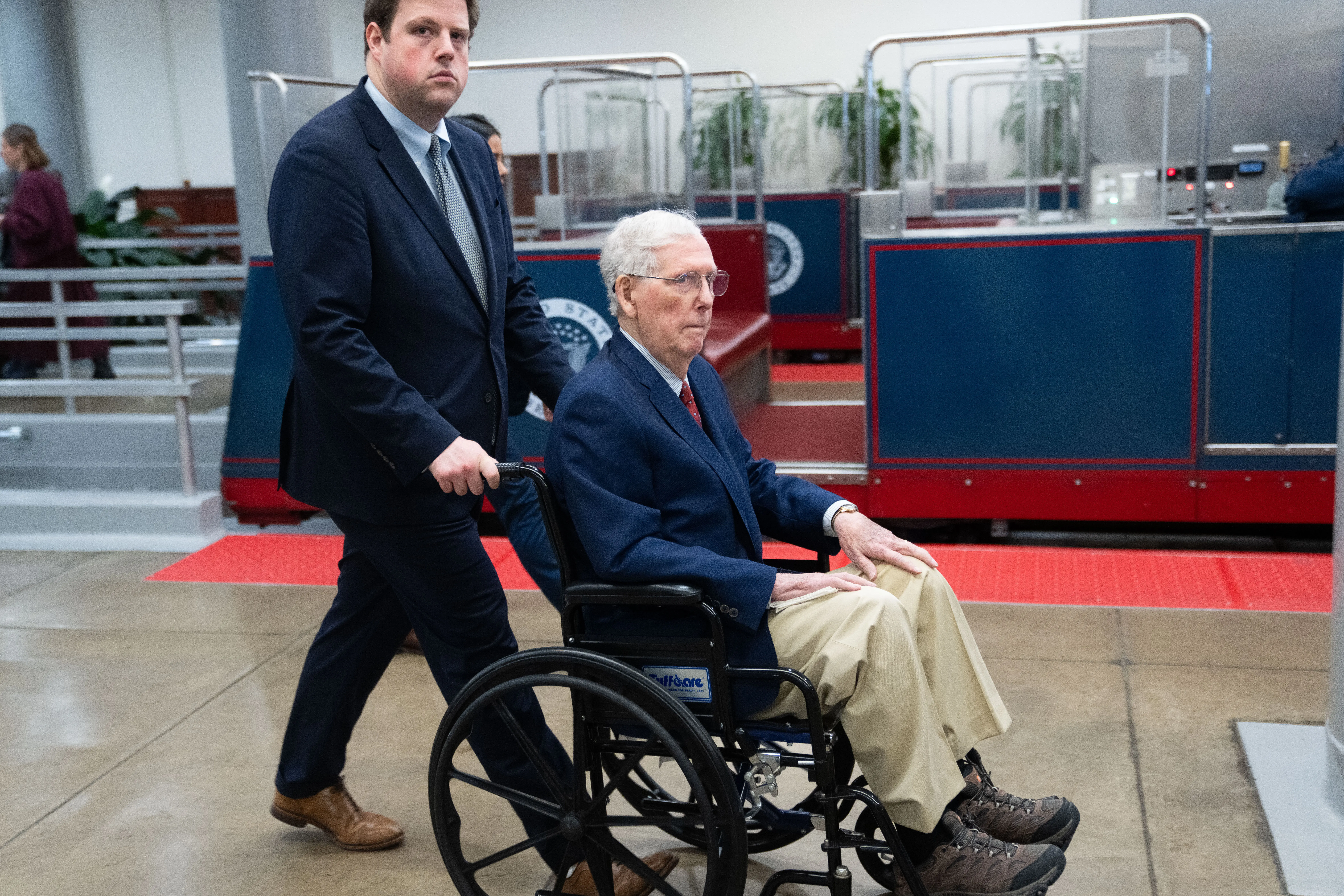
Aging is hard. It often brings illness and infirmity. Aging in the public eye is even harder. Just ask Mitch McConnell , Kay Granger or Dianne Feinstein.
And as the Bipartisan Policy Center notes , years ago, “Senator Karl Mundt of North Dakota suffered a stroke and was absent from the Senate for the final three years of his term. Illness forced Senator Carter Glass of Virginia to be absent from the Senate for nearly two years. In the case of Glass, citizens of Virginia petitioned courts to remove Glass from his seat, as it was effectively vacant. The court refused to take action.”
These are just a few of the names of members of Congress who have continued to serve long after they were equipped to do so. Each of them stayed on in spite of suffering debilitating illnesses, and there was nothing their colleagues could do other than expel them through a disciplinary procedure. That has never been done.
Congress needs to establish a separate procedure to address situations when members cannot discharge their duties. Because Congress determines the qualifications of its members and can remove them, there is no need for the equivalent of the 25th Amendment to the Constitution to deal with congressional inability to serve.
The average age of senators is now around 65 . Thirty senators are over 75, with Sen. Charles Grassley (R-Iowa) topping the list at 92. In the House of Representatives, which skews younger, there are 18 members over 80 .
But age in itself is not the issue. As Idaho’s 82-year-old Sen. Jim Risch told NBC, “You got to like the job, and you got to have enough time to spend with your family, and you got to have your health, and if you’ve got your health and you’re doing what you want to do, why not?”
Age is only relevant when it causes illness or infirmity that prevents someone from doing his or her job. The Constitution says nothing about either, although it does contain language about what should happen in the event of a vacancy caused by the death or resignation of a member of Congress.
Some have proposed using the constitutional amendment process to address congressional incapacity.
For example, in August 2023, Professor John Martin of the University of Virginia School of Law called for an amendment that would “permit members of Congress to temporarily transfer the duties of their office to an interim appointee in times of short-term incapacity … [and] create a process for involuntary transfers of such duties whenever a member of Congress has a long-term incapacitation but is unable or unwilling to use the voluntary transfer process or resign.”
He contends that such an amendment is necessary because the Constitution sets fixed terms for senators and representatives. But also, it also grants exclusive power to Congress when it comes to judging the qualifications of its own members, and courts are reluctant to interfere with its determinations.
Congress has broad discretion when it comes to deciding whether to expel a member; there is no reason why such discretion cannot be applied to removal for non-performance of duties. So, legislation or congressional rulemaking seems to me the right way to go.
On July 16, Reps. Seth Moulton (D-Mass.) and Ritchie Torres (D-N.Y.) offered one version of what a legislative approach would look like. Their proposal would require members of Congress to disclose if they plan to be absent for 21 days or more. The required disclosure would have to be filed within five days of when members believe they will be absent, and it includes a provision requiring an “honest” statement of the reasons for the absence.
“Transparency isn’t optional in public office,” Moulton argues . “People deserve to hear directly from the member representing them about whether they’re able to carry out the duties of the job they were elected to do. The Duty of Transparency Act simply asks members to be upfront with the people who put them there.”
That is a good step, but more is needed.
Congress should also establish a procedure to investigate instances in which members go for extended periods without attending congressional sessions or casting votes. If it is determined that a member is incapacitated and unable to do what they were elected to do, then the chamber in which they sit should be able to remove them by a two-thirds vote, as is now required for expulsion.
This would not be, and should not be, an easy thing to do. But right now, some members think it is acceptable to remain in Congress long past the time when they should step down. Alas, that seems too easy for them to do.
Democracy requires that voters choose the people who represent them. But it also requires that the people charged with that responsibility must be able to discharge it.
Just as we fight to preserve the first principle, we should also defend the second one.
Austin Sarat is the William Nelson Cromwell Professor of Jurisprudence and Political Science at Amherst College.
Topics in this story
Gathered from external sources. Rights to this text belong to whoever originally published it.