Trump’s ‘Big Advantage’ Nobody Is Talking About
Pull out a map. First, find Iran: the country we’ve found ourselves talking about every day. Then, look for Russia. Not hard to find given its size and the tensions that have existed between The Bear and the Eagle for decades on end. And then, look for the spot of land right in-between. That region…
First, find Iran: the country we’ve found ourselves talking about every day.
Then, look for Russia. Not hard to find given its size and the tensions that have existed between The Bear and the Eagle for decades on end.
And then, look for the spot of land right in-between. That region is called the South Caucasus: Georgia, Azerbaijan, and Armenia.
It’s Russia’s backyard. It’s Iran’s doorstep. And it’s one of the most strategic regions the United States is digging into.
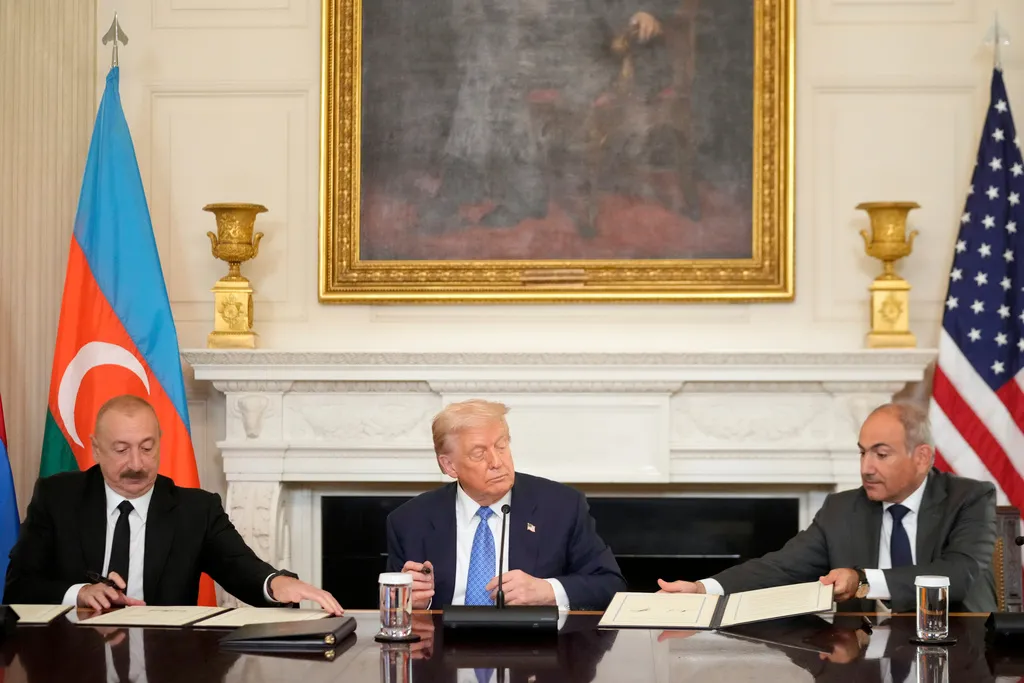
We’re now one year removed from the president of Azerbaijan and the prime minister of Armenia being at the White House to initial a peace agreement and put an end to multiple armed conflicts over the last few decades.
I spoke exclusively with Armenia’s ambassador to the United States, Narek Mkrtchyan, to discuss the one-year anniversary of the Washington Declaration between the two. What he told me, combined with comments President Trump gave me directly by phone this week, makes clear the region isn’t just stabilizing. It’s being reshaped, with Washington now holding real equity in the outcome — literally.
Frankly, it’s one of the most significant geopolitical maneuvers almost everyone has missed. I say almost everyone because we, NewsNation and The Hill, were there in February when Vice President JD Vance became the highest ranking US official in history to visit Armenia and Azerbaijan : a trip nobody thought much about.
A US-owned corridor through Russia and Iran’s backyard
To make this peace deal happen, a cornerstone of the agreement is the building of a road that runs through Armenia connecting Azerbaijan to its exclave. The road will be called the Trump Route for International Peace and Prosperity (TRIPP).
What’s more? The United States will have a 74 percent stake in the development company for at least 49 years. That means the Americans get a big piece of the roads, railways, energy pipelines, and digital networks for half a century.
In an exclusive phone call with President Trump late last week after Iran targeted U.S. service members in Jordan, I asked him about this project and the United States’ growing involvement in the region.
He told me in the short term it’s “not gonna change” how he handles the war with Iran, though he did acknowledge it gives him “a big advantage” when it comes to dealing with Tehran down the road. Put simply, the leverage is real — but tucked away in the back pocket for now.
Ambassador Mkrtchyan told me Armenia is “totally fine” with the U.S. being in the region and having such a large stake long-term, insisting that jurisdiction — customs, taxation, security, policing — stays with Armenian institutions regardless of who owns the equity.
The part of this not sitting well in Moscow: Armenia, Azerbaijan and Georgia are all former Soviet Republics. The West hasn’t dared, or at the very least bothered, to trek into this region before since it’s in such proximity to Russia.
I asked the ambassador directly whether Armenia is moving away from Russia. He pushed back on that framing — repeatedly. What’s happening, he told me, is “diversification” of procurement, of supply chains, of economic partnerships, of security partnerships. Not abandonment of Moscow, in his telling, but a hedging away from dependence on any single power.
But the list of instances in which the two nations are deepening their ties is growing, from the drone technology the vice president brought to Yerevan in February to the comprehensive strategic partnership Secretary of State Marco Rubio signed with Armenia in May.
Iran: everything’s on the table — but not yet in motion
The most sensitive question I put to the ambassador was about Iran. Washington has been making a public push in recent weeks to pressure allies and partners to isolate Tehran economically as part of “Operation Economic Outcast.”
Armenia shares an actual border with Iran, and hundreds of millions of dollars in annual trade with it. So has the U.S. asked Armenia to cut that off?
“Everything is discussable and everything can be taken into consideration,” the ambassador said. Nothing ruled in, nothing ruled out.
The ambassador went on to say that Armenia has been directly reassuring Tehran about TRIPP: “We communicated with our neighbors, saying that this is not against you — this is only about communication, this is only about infrastructure, trade, commerce. There is nothing, literally nothing, related to possible military.”
Armenia and Azerbaijan still have no diplomatic relations and no signed final peace treaty — three decades of war don’t resolve on the signing of one framework.
Reconciliation between the two societies, he told me, is “the most difficult part” of the whole process. “It’s not easy,” he said. “It’s not easy because the pain is still fresh. But we need to break a lot of stereotypes.”
It is clear however that the cogs are starting to churn forward between the two nations. We saw as much as we heard from citizens in both Armenia and Azerbaijan while there in February who were cautiously optimistic the U.S. efforts could produce long-term stability.
“Armenian nation will always remember President Trump,” Mkrtchyan told me, calling the peace deal a legacy achievement built on respect for Armenian sovereignty.
The ambassador described the broader U.S.-Armenia relationship in similarly weighty terms — pointing to the export licenses and technology transfers now flowing into the country as evidence of what he called “diplomacy based on trust.”
Armenia, he said, is glad to be seen in Washington “as the trusted partner for modern technologies, for sophisticated technologies.”
The fruit is already visible on the vine: a $4 billion NVIDIA data center , with a second, larger agreement behind it; a vice presidential visit that never would have happened two years ago; a 74 percent American stake in a corridor the sitting president himself calls “a big advantage” against Iran.
Whatever comes next — the treaty, the reconciliation, the ground itself — there’s real work still ahead. But the past twelve months have already produced more concrete change in the South Caucasus than the previous three decades combined.
Robert Sherman is an international correspondent for NewsNation. For a look at Sherman’s full interview with Armenia’s ambassador to the U.S., please click here.
Topics in this story
Gathered from external sources. Rights to this text belong to whoever originally published it.