McConnell’s return shines spotlight on older lawmakers
Sen. Mitch McConnell’s (R-Ky.) expected return to the Senate next week is drawing attention again to the health of aging lawmakers. McConnell, 84, was hospitalized over the summer for nearly two months after falling at home and receiving treatment for pneumonia. He has since been recovering at home and engaging in what he described as…
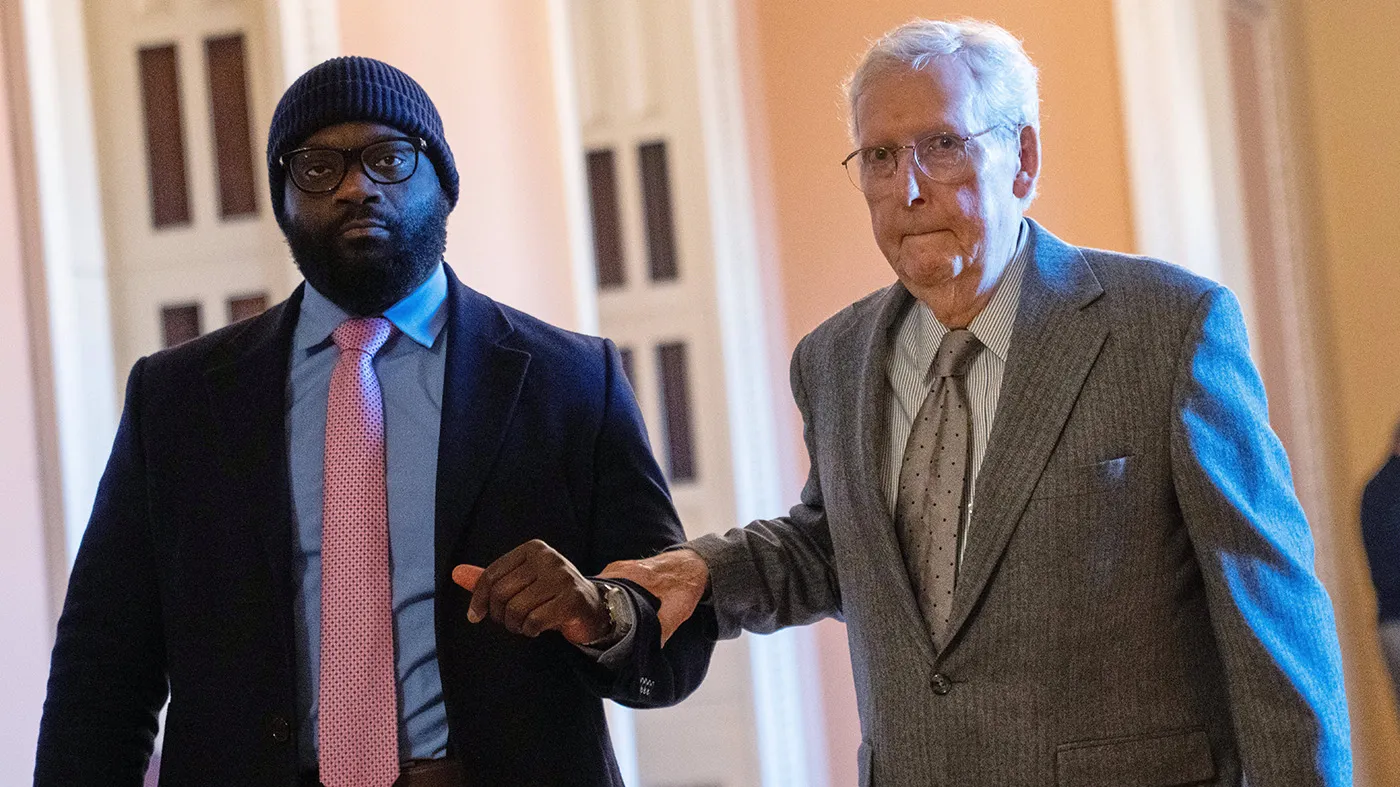
Sen. Mitch McConnell’s (R-Ky.) expected return to the Senate next week is drawing attention again to the health of aging lawmakers.
McConnell, 84, was hospitalized over the summer for nearly two months after falling at home and receiving treatment for pneumonia. He has since been recovering at home and engaging in what he described as an “intensive regimen of physical therapy.”
His extended absence and advanced age have reignited conversations about lawmakers staying in office too long, with polls showing many voters support term limits, even as they also keep reelecting elder statesmen.
McConnell was first elected to the Senate in 1985 and is the 10th longest-serving senator in U.S. history. He is not seeking reelection to his current term, which ends in January.
Kentucky Gov. Andy Beshear (D) has repeatedly raised questions over whether McConnell is fit to serve because of his health challenges this summer.
“I hope that he is one of the reasons that we get term limits. I’ll tell you what, I’d even name the bill after him,” he told CNN.
Iowa’s 44-year-old Democratic gubernatorial candidate, Rob Sand, has voiced his support for both age and term limits.
“The idea is, I want term limits. I want age limits. Let’s go get them,” he told reporters in April.
Compounding these arguments is the recent spate of lawmakers who have died in office, six in this term alone. Reps. Raúl Grijalva (D-Ariz.) Gerry Connolly (D-Va.) and David Scott (D-Ga.) were a decade or more past the typical retirement age of 65. Sen. Lindsay Graham (R-S.C.) was 71 when he died in office in July from aortic dissection a sudden condition that is not typically screened for.
In 2023, 90-year-old Sen. Dianne Feinstein (D-Calif.) died while in office.
Rep. Kay Granger (R-Texas) had left office just over a year before her death last month at age 83. The end of her tenure was marred by the revelation that she had been residing in a senior living facility and experiencing what her son Brandon Granger described at the time as “dementia issues.” Her family confirmed her death was caused by complications from Alzheimer’s disease.
Support for term limits on Congress remains overwhelmingly popular among Americans across the political spectrum.
An NPR/PBS News/Marist Poll released in May found that 83 percent of U.S. adults support term limits, with self-identified Republicans showing the highest rate of support at 89 percent. The same survey found that 80 percent of Americans also support an age cap on congressional candidates.
According to Aaron Dukette, senior strategist for the nonpartisan advocacy group U.S. Term Limits, support for imposing term limits has “skyrocketed” among Congress members in the past few years.
“We have 130-plus people who have signed a pledge and gotten on as co-sponsors for our amendment. So, it’s not obviously at the two-thirds threshold that you need to have both chambers, but it’s certainly growing,” Dukette told The Hill. “And I think people on both sides of the aisle started to recognize that this is something that’s going to benefit our whole electoral process and not just one party over the other.”
The joint resolution supported by his organization proposes limiting U.S. senators to two terms and House members to three terms. The version introduced in the House last year has 115 co-sponsors, 107 of whom are Republicans.
Although conversations and support for term limits and age limits persist among the general public, the discussions are rarer among lawmakers themselves, according to those who’ve worked with them.
Rodney Whitlock, managing director of Cozen O’Connor Public Strategies, was health policy adviser to Sen. Chuck Grassley (R-Iowa) until 2015. Grassley, 92, is now the oldest member of Congress and was among the oldest when Whitlock last worked for him more than a decade ago. Grassley ranks as the longest-serving U.S. senator currently in the chamber, exceeding McConnell’s tenure by four years.
“It is not as common as one would think, unless the member starts to have issues,” Whitlock said when asked whether lawmakers and their staff talk about age.
He argued that the issue of an aging workforce is a broad one.
“Nobody should be looking at this going, ‘This is a unique problem to members of Congress.’ No, it’s not. It is societal. It is our issues with aging. All of these things are part of this conversation,” said Whitlock. He noted that during his time as a congressional staffer, views on aging lawmakers were more respectful, but the discussions have since become “overtly political.”
While describing that Grassley sees public service as a “calling,” Whitlock said there are “certainly” lawmakers who stay in office simply because they have “grown so accustomed to the lifestyle.”
Discussions about American gerontocracy encompass all branches of government. President Trump, 80, is the oldest person to be sworn in as U.S. president; former President Biden became the oldest sitting president, leaving office at 82.
At the Supreme Court, five out of eight sitting justices are past age 65; Justice Clarence Thomas is the oldest at 78.
Dukette from U.S. Term Limits said his organization is focused on limiting congressional service based on terms over age, reasoning that limiting terms would naturally resolve the age issue.
“We understand the concern and the desire for age limits, given the fact that we have many prominent elderly members of Congress that are running into health troubles while still being in office and they go … missing for a time,” said Dukette. “If it wasn’t for the 20, 30, 40-year careers that put them in that place in the first place — most members that run for Congress don’t start doing so in their 60s or 70s. They do so in their 40s or even in their 50s, and then they’re there for decades of service.”
When reached for comment on his condition and expected return, McConnell’s office referred to the senator’s last public statement released at the start of August, in which he said he would “continue my recovery at home” and “continue to engage with my staff and colleagues on important Senate business.”
The Hill has reached out to Grassley’s office for comment.
Topics in this story
Gathered from external sources. Rights to this text belong to whoever originally published it.