Ketanji Brown Jackson issues public dissent in New Hampshire voting case
Justice Ketanji Brown Jackson publicly broke with her Supreme Court colleagues in a Thursday ruling allowing New Hampshire to fully block voters from using student IDs in the upcoming midterms. Jackson, the high court’s most junior liberal justice, wrote in a short dissent that she would have left in place a lower court decision that…
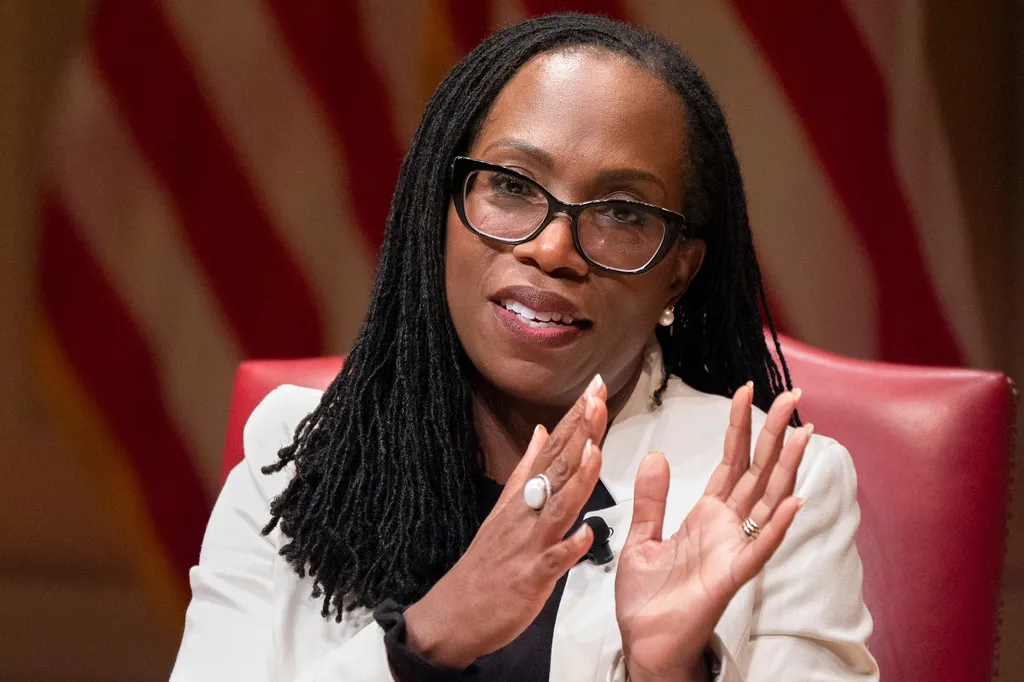
Justice Ketanji Brown Jackson publicly broke with her Supreme Court colleagues in a Thursday ruling allowing New Hampshire to fully block voters from using student IDs in the upcoming midterms.
Jackson, the high court’s most junior liberal justice, wrote in a short dissent that she would have left in place a lower court decision that found New Hampshire’s Republican secretary of state went too far with the voter identification restriction.
“I respectfully dissent because—even, and perhaps especially, when an election is looming—I would not disturb a clearly justifiable federal-court order issued to ensure that the public receives accurate information about a State’s electoral processes,” Jackson wrote.
None of the other justices publicly indicated their votes, which is common for cases decided on the court’s emergency docket. It is also not unusual for Jackson to dissent on her own.
The case stemmed from a law passed by the Republican-controlled state Legislature earlier this year that prohibited student identification cards from being used to register to vote or receive a ballot for the Nov. 3 election.
Voting advocacy groups sued, arguing the restrictions were unconstitutional and discriminated against young voters.
U.S. District Judge Joseph Laplante declined to block the law entirely but ruled the plaintiffs were likely to succeed in their claim that the secretary of state’s directive went further than the statute itself. He said the state still needed to consider student IDs as evidence of voter identity.
The Supreme Court sided with New Hampshire, citing a long-standing legal principle known as Purcell, which says courts should not intervene to alter the rules so close to an election to avoid voter confusion.
“Here, the District Court did not point to anything that would justify deviating from that principle,” the majority wrote in its brief, unsigned opinion.
Jackson asserted Purcell did not apply in this case because the judge’s injunction was “reasonably designed to address alleged misinformation, not to change the law.”
“Under such circumstances, the relief the District Court provided actually promoted the interests Purcell sought to protect,” the justice wrote. “When a federal court determines that material misrepresentations are being made about a State’s election rules, an injunction to prohibit that conduct does not contribute to public confusion, it prevents that very problem.”
The Senate race in New Hampshire is shaping up to be one that could help decide control of the upper chamber, with Democratic Rep. Chris Pappas running against former Republican Sen. John Sununu. The Hill’s election forecasting partner, Decision Desk HQ, ranks the race as a “likely” victory for the Democrat.
Topics in this story
Gathered from external sources. Rights to this text belong to whoever originally published it.