Ro Khanna and the fight for the post-Bernie left
Rep. Ro Khanna is positioning himself as a leading figure for progressives ahead of the 2028 Democratic primary by promoting his brand of progressive capitalism and seeking to build broad coalitions across the political spectrum.
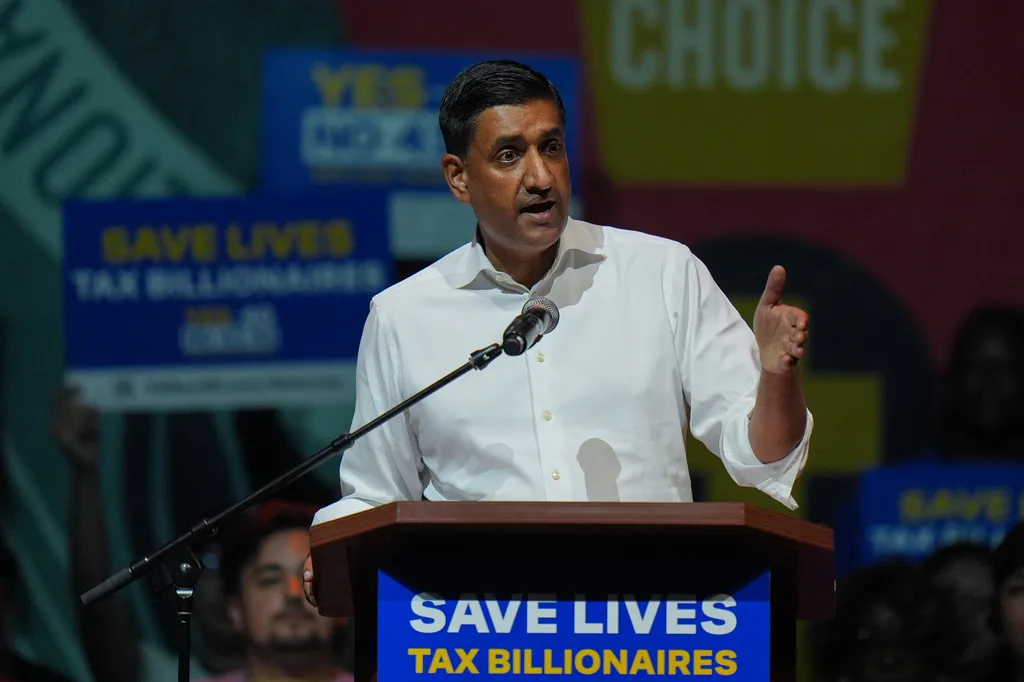
“Stop shilling for billionaires,” Rep. Ro Khanna (D-Calif.) said of California Gov. Gavin Newsom, as we strolled across the University of California, Berkeley’s campus. Silicon Valley’s congressman has made the rebuke something of a refrain. The two have taken opposing sides on Proposition 40 , the billionaire tax now buckling under an onslaught of money from tech billionaires.
You wouldn’t have guessed its troubles from the mood at the rally on campus last week. There, a budding California resistance gathered around candidates , including Rep. Aisha Wahab (D); Jane Kim, who is running for insurance commissioner; and Angela Gonzales-Torres who is running against Democratic Rep. Jimmy Gomez, all backed by the Working Families Party.
Khanna was asked the obvious question: “Will you run for president?” The crowd roared. A couple of “Ro for President” signs supplied their own answer. It was hard to imagine another California politician being greeted quite like this at Berkeley, as king hereafter. Progressive capitalism was the cause, and the crowd had settled on its leader.
Khanna finds it easy to define himself against Newsom. Newsom is a neoliberal. Khanna is a “New Deal Democrat” who’ll tax the oligarchs. Newsom triangulates on Gaza. Khanna opposes military aid to Israel, period.
Yet in the 2028 Democratic primary, his most direct interfactional rival may lie elsewhere. Newsom would compete with Pennsylvania Gov. Josh Shapiro (D) and Kentucky Gov. Andy Beshear (D). For Khanna, the contest for the left would more likely run through socialist Rep. Alexandria Ocasio-Cortez (D-N.Y.) — if they both run, at least.
I asked Khanna what, in practice, distinguishes progressive capitalism from socialism. “Free enterprise means that the government doesn’t have control over all of the means of production,” he said. “You wouldn’t want Donald Trump controlling everything.”
Fair enough. What he wants, he said, is a system that works for “hardworking individuals,” rather than people “accumulating wealth in their sleep because of the growth of the stock market.” His answer became a critique of capitalism as currently practiced. The distinction remained elusive.
I tried again. What would he actually do differently from Ocasio-Cortez or Sen. Bernie Sanders (I-Vt.)? Khanna pointed to a capital fund supporting entrepreneurship, innovation and small businesses, and to the jobs and entrepreneurship programs he had been setting up across America.
So is the difference a matter of priorities?
Khanna is, so far, doing reasonably well at the delicate business of remaining credible on the left while admitting to being a capitalist. As socialism gains ground in the party, that takes a certain suppleness. He represents Silicon Valley, so it’s not really his fault — wink, wink.
His offer to the left has its attractions: He won’t throw the socialists under the bus when, say, Bill Maher invites him on his show. He certainly didn’t in his conversation with me. I asked about the legacy of Woke 1.0 — the 2020-era peak of defund-the-police slogans and critical race theory. In August, Ocasio-Cortez had laughed the period off with a line borrowed from a Brooklyn councilman: “ Woke one was crazy .” Had Democrats seriously reckoned with the era’s excesses, I asked, or merely learned to shrug them away? What did they owe voters?
“I’ve always had a deep love of this country,” he said. “I think we need to celebrate America’s history and culture.”
He went on to invoke slavery and Jim Crow. “Woke means being aware of injustices — I think there’s nothing wrong with that.” The answer offered little reckoning, but plenty of reassurance. His endorsement of socialist Francesca Hong (D) in her unsuccessful Wisconsin gubernatorial primary bid might have earned him some trust among the Democratic Socialists of America faithful, too. Her pandemic-era statements against the police and Thanksgiving became a political liability, but Khanna stood by her side anyway.
Meanwhile, his willingness to celebrate America’s history, defend strong borders and accept the need for an immigration enforcement agency gives moderate Democrats something to like. Khanna seems determined to keep everyone in the conversation.
Khanna oozes Silicon Valley. He knows the guts of the world he proposes to reform and has a silver tongue for soothing those whose feathers he ruffles. His resume offers some explanation: a stint as President Obama’s deputy assistant secretary of Commerce, followed by work as an intellectual-property lawyer at techy law firm Wilson Sonsini.
When Silicon Valley Bank collapsed in 2023, Khanna went all-in supporting a federal guarantee of its depositors’ money. There was a progressive case for intervention: businesses needed to meet payroll, and allowing regional banks to fail would concentrate still more power in the largest banks. He made it fluently. There was also an obvious constituency interest. When Silicon Valley needed Washington, its congressman answered the call.
That combination of appeals could make Khanna more than another Sen. Elizabeth Warren (D-Mass.). Khanna is betting 2028 will be no 2020 — that a left tired of losing will tolerate a candidate who can win over the Democratic Socialists of America organization and Curt Mills of the American Conservative, who has suggested that he’d take Khanna over Secretary of State Marco Rubio (R).
Khanna has already earned some goodwill across those constituencies. Yet Ocasio-Cortez, heir to Sanders’s movement, has never had to explain what separates her from socialism. Khanna does.
For now, he has room to keep making his case to all of them.
William Liang is a writer living in San Francisco. He volunteers for Connie Chan’s congressional campaign in California’s 11th District.
Topics in this story
Gathered from external sources. Rights to this text belong to whoever originally published it.