Colours, symbols and the battle for political meaning in UP
UP parties ramp up colour politics ahead of 2027 polls as SP’s PDA Rath Yatra sparks debate on blue, saffron and Ambedkar symbols to woo voters.
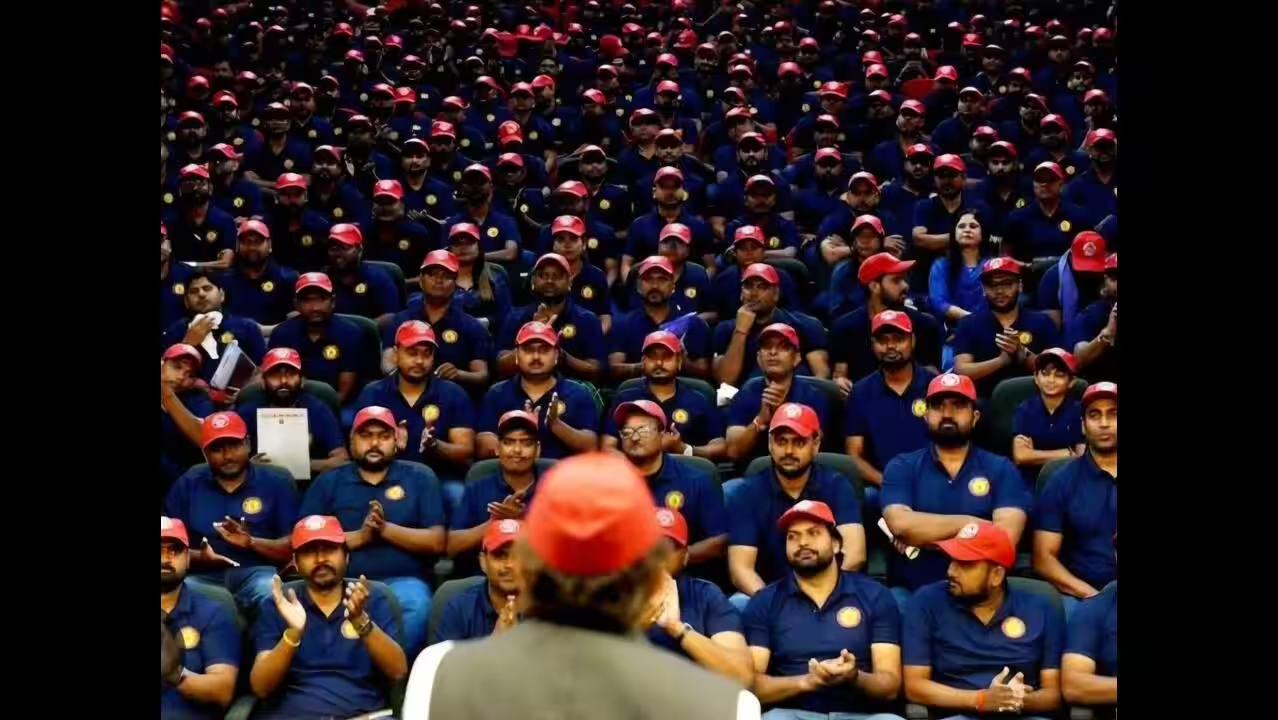
Lucknow: As political parties in Uttar Pradesh gear up for the 2027 assembly elections, colours are increasingly becoming political messages in themselves. From blue and saffron to green, parties are deploying visual symbolism alongside slogans and icons to signal social alliances, cultural positioning and electoral intent.The latest debate was triggered by Samajwadi Party chief Akhilesh Yadav’s PDA Rath Yatra, launched from Rae Bareli. Akhilesh flagged off his Rath Yatra from Congress leader Sonia Gandhi’s bastion in a luxury bus carrying the slogan, “Jo peedit hai wahi PDA hai.” The vehicle also prominently displayed a portrait of Dr BR Ambedkar and featured a noticeable saffron shade, elements that political observers believe are far from incidental.The PDA slogan, Ambedkar imagery and blue colour palette are being interpreted as signals aimed at Dalit voters. At the same time, the visible saffron tint on the Rath has generated discussion about whether opposition parties are increasingly seeking to engage with religious and cultural narratives that resonate with a broader Hindu electorate.The yatra came days after SP unveiled blue uniforms for its student wing, a move that drew attention because blue has long been associated with Dalit assertion, the legacy of Dr BR Ambedkar and Bahujan Samaj Party.The symbolism was not lost on BSP chief Mayawati, who argued that adopting blue or invoking Ambedkar’s legacy was not enough to represent the interests of Dalits, tribals, backward classes and other marginalised communities. She maintained that genuine commitment to Ambedkarite politics required substantive policy and ideological change rather than symbolic gestures.However, SP’s former MLC Udaiveer Singh said that the party had always followed in the footsteps of those great personalities who have raised their voices against suppressed, deprived and exploited people, and it has nothing to do with the use of colours and symbols.The debate has highlighted how colours have acquired distinct political meanings in Uttar Pradesh over the years. Blue has traditionally been associated with Dalit empowerment and BSP. Saffron has emerged as the dominant political colour of BJP, drawing from broader Hindu cultural and religious symbolism. Green, meanwhile, has long been associated with Rashtriya Lok Dal and now is also used prominently by AIMIM, where it often carries minority outreach symbolism.Political observers note that in Uttar Pradesh’s highly competitive electoral landscape, colours function as immediate visual cues capable of communicating political intent faster than speeches or manifestos. Flags, scarves, campaign vehicles, stage backdrops and even clothing frequently become instruments of political messaging.The timing is significant. In the 2024 Lok Sabha elections, BSP’s performance saw a dramatic decline. Its vote share fell from 19.42% in 2019 to 9.39%, and the party failed to win a single seat. SP, which fought the election in alliance with Congress as part of the broader INDIA bloc, emerged as the biggest gainer in the state. It secured a record 37 Lok Sabha seats and garnered 33.59% of the vote share, compared to just five seats and 18.11% vote share in 2019.Congress, meanwhile, also registered significant gains. Contesting as an ally of SP, it increased its vote share from 6.3% in 2019 to 9.53% in 2024 and improved its tally from one seat to six seats. BJP remained the single largest force in the state but also witnessed a decline. Its vote share dropped from 49.98% in 2019 to 41.67% in 2024, while its seat tally came down from 62 to 33 seats.SP functionaries attribute much of their dramatic rise not only to anti-incumbency against BJP but also to a substantial dent in BSP’s traditional support among Jatav Dalits. While some Congress leaders maintain that the shift in Dalit votes was facilitated by SP-Congress alliance, SP camp believes that a section of Jatav voters consciously chose SP in 2024 irrespective of the alliance arrangement.So, since the 2024 LS elections, questions have intensified about the future alignment of Dalit votes in the state. Political parties are now competing not only through policy promises but also through symbols that evoke identity, representation and belonging.Such symbolism is hardly new in Uttar Pradesh politics. BSP’s use of blue, SP’s traditional red-and-green flag, BJP’s saffron imagery and AIMIM’s green branding have all helped create distinct political identities over time. What appears to be changing is parties’ willingness to experiment with colours traditionally associated with rival social or political constituencies.SP functionaries reject suggestions that their use of colours is driven by electoral calculations. They argue that the party’s politics has always focused on the concerns of deprived and marginalised sections of society and that colours should not be overinterpreted. They also reject the claim that the party is borrowing from BJP’s ideological playbook. SP national secretary Avlesh Singh has asserted that the party represents the “true Sanatani” tradition, while accusing BJP leaders of being “pseudo Sanatanis.”UP BJP’s chief spokesperson Dinesh Pratap Singh said people of UP are scared of red colour, used by SP. “Hence the SP Chief first changed the colour of its student’s wing uniform to blue and now putting saffron shade in the rath. Saffron has been and will remain BJP’s colour and 2027 assembly polls will again see saffron wave across the state. Akhilesh these days is so frequently ‘changing colours’ that even the chameleons are embarrassed,” Singh further said.Yet for political observers, the current contest suggests that the battle for Uttar Pradesh in 2027 is likely to be fought not only through caste equations, welfare schemes and political narratives, but also through powerful visual symbols. Whether it is blue, saffron or green, colours are increasingly becoming shorthand for competing visions of representation and alliance-building in the state’s evolving electoral politics.You Can Also Check: Gold Rate in Lucknow | Silver Rate in Lucknow | Bank Holidays in Lucknow | Public Holidays in Lucknow | Lucknow AQI | Weather in Lucknow | Petrol Price in Lucknow | Diesel Price in Lucknow | CNG Price in Lucknow | LPG Price in LucknowStay updated with the latest Lucknow news. Download the TOI App.
Topics in this story
Gathered from external sources. Rights to this text belong to whoever originally published it.