Election forecasters don’t see polling ‘sugar-high’ Democrats fear — for now
Pollsters and independent handicappers are increasingly convinced that Democrats aren’t experiencing an artificial “sugar-high” in polling but that multiple metrics are right now pointing to a good midterm environment for the party. The nonpartisan election handicapper Cook Political Report became the latest independent forecaster this week in predicting that Republicans looked poised to lose the…
Pollsters and independent handicappers are increasingly convinced that Democrats aren’t experiencing an artificial “sugar-high” in polling but that multiple metrics are right now pointing to a good midterm environment for the party.
The nonpartisan election handicapper Cook Political Report became the latest independent forecaster this week in predicting that Republicans looked poised to lose the House in November, and recent polling has shown Senate candidates like James Talarico in Texas and Abdul El-Sayed in Michigan leading their GOP counterparts.
Decision Desk HQ, too, forecasts a 72 percent probability of Democrats winning the House and a 54 percent probability of the party flipping the Senate.
Experts caution that the dynamics could still change between now and November, noting how Republicans deploy their financial advantage in battleground states remains a key variable.
But they say polling isn’t the only indicator suggesting Democrats could see a good cycle: They say look no further than President Trump’s tanking approval ratings, Democratic enthusiasm in primaries and Republican candidates publicly breaking with the president.
“[Trump] keeps saying, ‘I’m on the ballot. I’m on the ballot.’ And it’s like, I hope, God willing, you’re on the ballot. I hope you’re on the ballot. We’re going to drive that home,” said veteran Democratic pollster Celinda Lake.
Pollsters and analysts alike expect Democrats to take the House this fall, with many agreeing that control of the Senate is now a toss-up – the latter of which seemed almost unthinkable a year ago.
While Democrats only need to pick up three seats to claim the Speaker’s gavel, three independent nonpartisan handicappers have offered a range on how well the party might do in the lower chamber.
Independent nonpartisan handicapper Inside Elections projects Democrats will pick up between two and 10 seats in the House while Miles Coleman, an associate editor at the nonpartisan handicapper Sabato’s Crystal Ball at the University of Virginia Center of Politics, told The Hill he could see a scenario of Democrats reaching into the 220s or “they just kind of blow past all of their targets.”
Cook Political Report keeps its range for Democrats between five and 15 pickups in the House.
Polling analyst Nate Silver’s the Silver Bulletin generic congressional ballot polling average has shown Democrats inching up more than a point this month. Emerson College Polling, with whom The Hill partners, released a poll this week showing the party with an 11-point lead on the generic ballot compared to a similar survey last month showing the party with an 8-point lead.
And yet, some Democrats are skeptical of a double-digit lead on a congressional ballot poll, and experts point out that generic congressional ballot polls don’t offer as clear a picture of the individual battleground House races.
“The generic ballot can give us a window into the political environment, but there’s no such thing as a generic congressional race,” explained Nathan Gonzales, editor and publisher of Inside Elections.
“These are candidates with strengths, weaknesses, different levels of fundraising, different levels of name ID, different levels of baggage,” he added.
Still, even Republican pollsters say Democrats have a slight edge in those competitive battleground areas.
“If you look at the swing districts, it’s a much closer generic ballot with the Democrats leading by two or three points rather than eight or nine,” GOP pollster Whit Ayres said, comparing the swing district polling to generic congressional ballot polls.
The Senate, meanwhile, is more volatile given the races are more individualized, with more attention given to candidate quality and local- and state-specific issues. But even some handicappers like Inside Elections project Democrats are likely to gain control of the upper chamber, gaining between two and four seats.
How good of a political environment November will be for Democrats is anyone’s guess, with several Democratic and independent pollsters forecasting what they expect could be a blue wave while other handicappers and pollsters are more circumspect. Republicans still have a significant financial resources advantage to deploy, with the help of President Trump’s super PAC, MAGA Inc, which could make some races tighter.
But experts point out Democrats are fielding a favorable environment for now based on several clear metrics: For one, Trump’s approval ratings have fallen into the 30s and even upper 20s.
For another, high prices on things from gas and diesel to fertilizer – fueled by the U.S. war in Iran and the Trump administration’s tariff policies – have rankled voters, leading even some Republicans in more reliably red areas like Kansas and Iowa to break with the president publicly.
“You see [Sen.] Roger Marshall saying, ‘Oh, well, actually, [U.S. Immigration and Customs Enforcement] has kind of overstepped its boundaries,’” Coleman of Sabato’s Crystal Ball said.
“In a solidly red state like that, that’s not necessarily something you know you might not expect a Republican to take such a nuanced position there,” he added.
Gonzales also noted that where Republicans are spending money is another indicator of the political environment, noting that Trump’s affiliated groups like No Going Back PAC have spent money in Texas’s newly redistricted 9th Congressional District. Cook Political Report has the seat with a partisan edge of nine points toward Republicans – yet the spending suggests the district may not be as solidly red this year as previously believed.
Perhaps one of the strongest indicators that Democrats could be in for a good night is the sheer advantage Democrats had in primary turnout versus Republican turnout.
“The Democrats outvoted the Republicans in a lot of red states or purple states, so that’s an indication of voter excitement,” explained Spencer Kimball, executive director of Emerson College Polling. “We saw the opposite in ‘22, where the Republicans were coming out at higher numbers in those primaries. So those are indications that the polling data is accurate in that there is excitement on the left.”
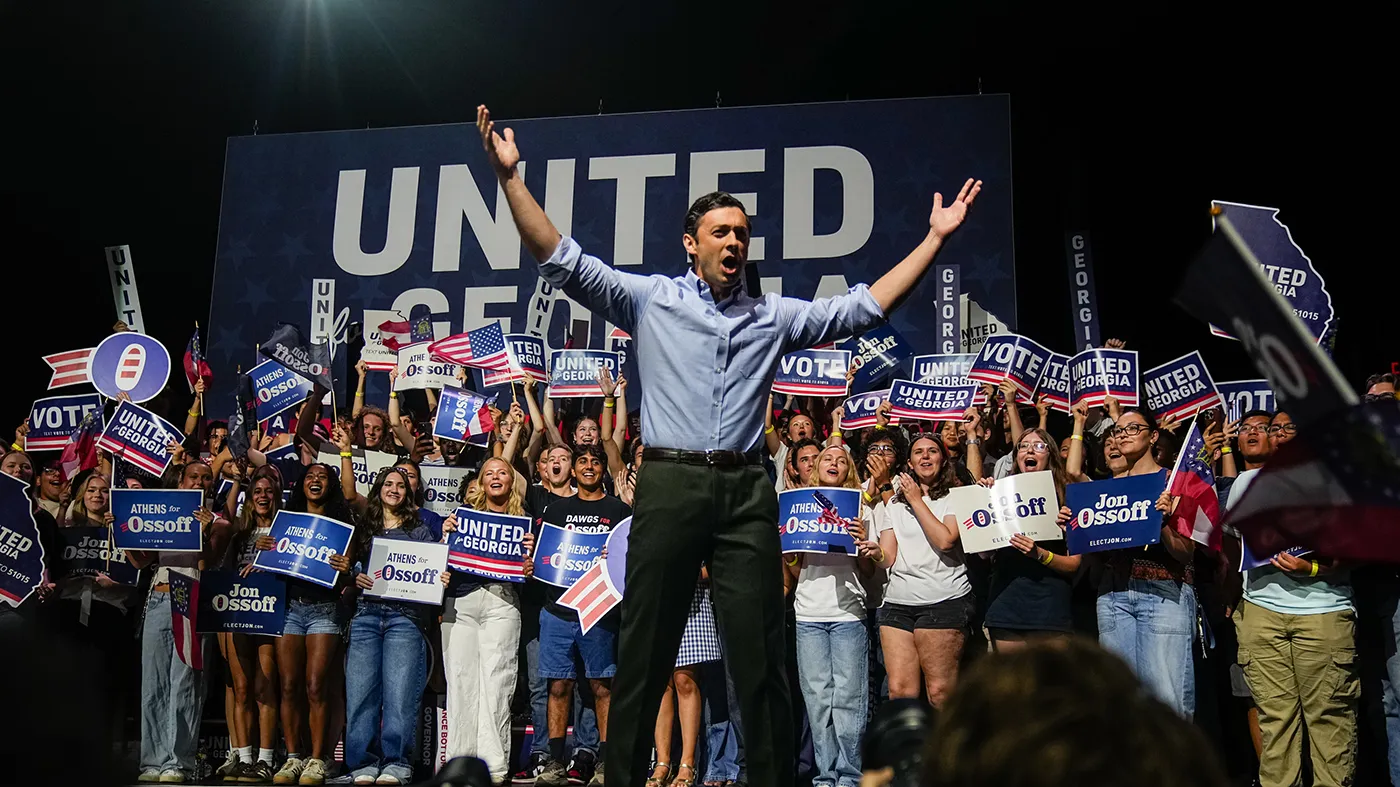
For example, in Texas, 2.3 million voted in the Democratic primary for the Senate race on March 3 compared to 2.1 million on the GOP side . In Georgia, just over 912,000 voted in the contested Senate GOP primary on May 19 compared to more than 1 million that voted in the Democratic primary where Sen. Jon Ossoff (D-Ga.) ran uncontested.
Still, experts think Democrats shouldn’t readily get too giddy before the fall.
“I think Democrats have a really strong overall environment on the economy and on the president’s job approval, those things all point to a good Democratic year,” explained Charles Franklin, director of the Marquette Law School Poll. “The reason to not get carried away are the relatively small number of competitive seats compared to previous decades” and still relatively high party loyalty among the GOP.
Republican pollster Bob Ward suggested some of the polling he’s seen shows Democrats’ advantage over Republicans in key Senate races being propped up by younger and independent voters who are less reliable come Election Day.
“If a blue wave doesn’t turn out to be quite as blue [a] wave, I think the age gap and the motivation gap there will have a serious role to play,” he told reporters at a recent briefing hosted by the AARP.
Gathered from external sources. Rights to this text belong to whoever originally published it.