The Memo: Trump’s convention may struggle to turn tide for GOP
President Trump basked in the approval of the MAGA base during this week’s Republican midterm convention in Dallas. But the bigger question is whether the event made any difference to a political landscape that is seriously challenging for Republicans as Election Day looms less than eight weeks away. The Hill’s data partner Decision Desk HQ…
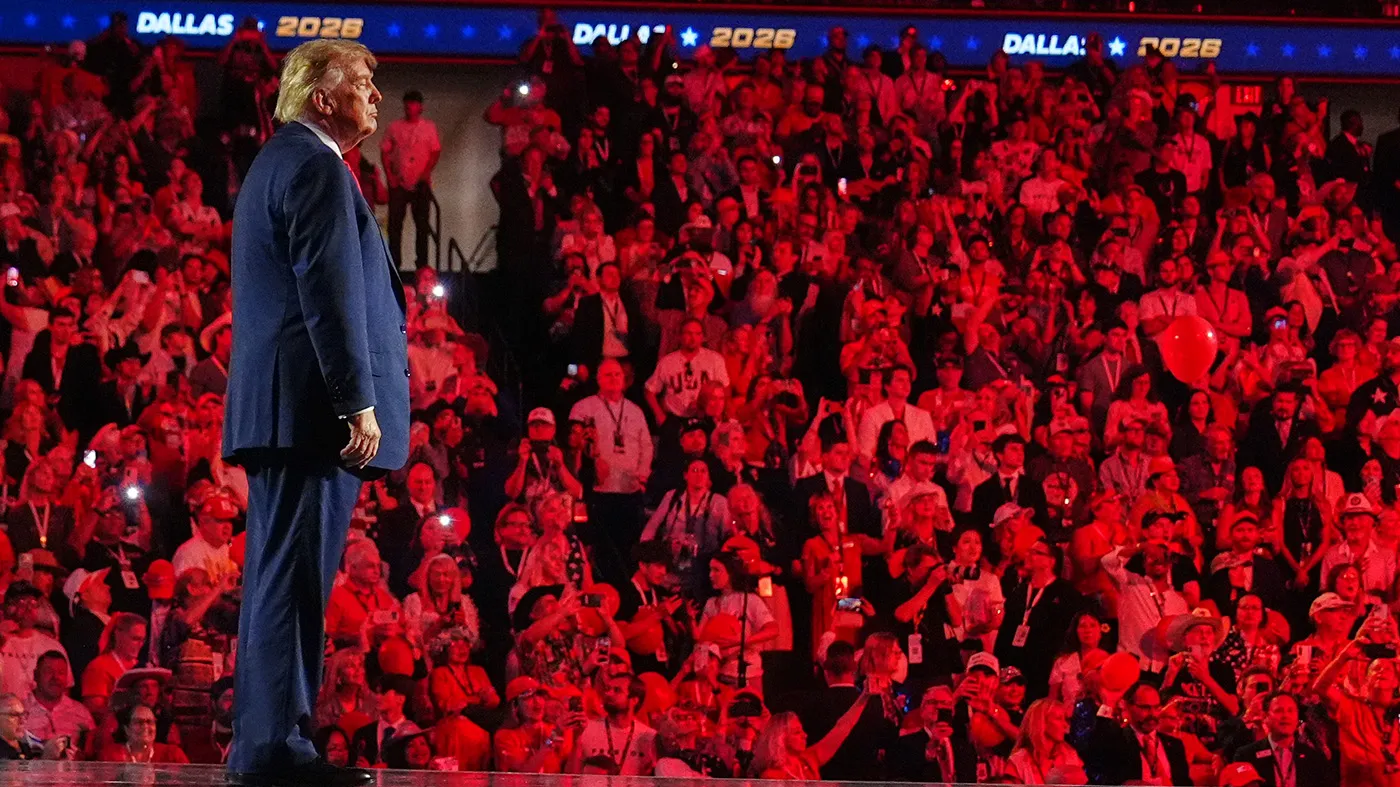
President Trump basked in the approval of the MAGA base during this week’s Republican midterm convention in Dallas.
But the bigger question is whether the event made any difference to a political landscape that is seriously challenging for Republicans as Election Day looms less than eight weeks away.
The Hill’s data partner Decision Desk HQ (DDHQ) on Friday gave Democrats a 68 percent probability of taking control of the House, with control of the Senate — once considered relatively safe for the GOP — a 50-50 split. Virtually no significant polling has been conducted since the Republican gathering, however.
By Friday, it was notable how swiftly the national news agenda was moving on from the GOP convention. Instead, commemorations marking the 25th anniversary of the terrorist attacks of Sept. 11, 2001, were the focus of attention.
The most significant news from the Dallas event was Trump’s pledge to send a $5,000 “dividend” to every adult American citizen if Republicans win the elections in November.
But there are massive questions around this — even beyond the charge that it is, in essence, adjacent to bribery.
First of all, Trump has a record of making comparable pledges of windfalls from tariffs and from savings ostensibly made by the Elon Musk-led Department of Government Efficiency (DOGE).
None of those promises has materialized.
On Thursday evening, Trump lashed out angrily at a reporter — Rachel Scott of ABC News — when she began asking a question about his track record in this respect. The website The Bulwark, often a locus of Trump criticism, compiled several clips of his past pledges.
Even among some Republicans, reaction has been lukewarm at best. A back-of-the-envelope calculation suggests Trump’s plan would cost roughly $1.3 trillion — and at a time when the national debt is already over $40 trillion and the global bond markets are getting antsy about the state of the federal government’s finances.
A back-of-the-envelope calculation suggests Trump’s plan would cost roughly $1.3 trillion — and at a time when the national debt is already over $40 trillion and the global bond markets are getting antsy about the state of the federal government’s finances.
Vice President Vance notably did not mention the proposal during his keynote address on Thursday night, though he had defended it when asked during a Fox News interview the previous evening.
On the same network, Sen. Ted Cruz (R-Texas) said his opinion of the idea would depend “on how it’s structured,” and that he favored a tax refund for people who are employed. “I don’t think we should be paying people that are not working,” he said.
Other Republicans were even more equivocal. Rep. Pat Fallon (R-Texas), also speaking on Fox News, said “President Trump isn’t saying that if we win we’ll do this. He’s saying we’ll be in a position to do this.”
But Trump took to social media on Friday to insist it would happen . “When I say something, I mean it!” he claimed.
Republican pollster David Winston cautioned against reading too much into the way other GOP members reacted, given that it appears few had advance notice of the proposal Trump unveiled.
“Part of the reaction you are hearing is that people are unsure,” Winston asserted. “They’re not saying it’s good or bad. When something like that gets dropped on you, you want some time to think through it.”
But others took a harsher view — including some Trump-skeptical Republicans.
Rick Tyler, a veteran GOP strategist who is often critical of Trump, called the dividend proposal “a gimmick,” adding “they don’t mean it.”
“I struggle with the level of sophistication of people thinking, ‘I’m going to get $5,000 if I vote for the Republicans,” Tyler said.
The broader political question over the Republican convention concerns the wisdom of making Trump so central to the party’s strategy heading into November.
The fundamental problem is Trump is significantly unpopular in the nation at large.
The DDHQ polling average on Friday afternoon found the president’s job performance eliciting disapproval from 57 percent of Americans and approval from 40 percent. Data analyst Nate Silver has Trump performing a few points worse, with just 38 percent approval.
Trump, as usual, proclaims enormous confidence. “Pretend I’m on the ballot,” he has said several times.
Democrats, however, are more than happy for Trump to be front and center.
“If Republicans in swing districts want to appear with Donald Trump, let the chips fall where they may,” Democratic strategist Julie Roginsky told this column.
“I understand they are trying to get as many MAGA voters as possible, but I think even those voters who will turn up for Trump will not, at this point, turn up for Republicans in a midterm election. So I just think aligning yourself with Trump is political suicide,” Roginsky added.
Tyler reached a similar conclusion, but from a different route.
The GOP strategist contended that there are indeed some times when it makes sense for a party to nationalize a midterm election.
He cited the success enjoyed by Republicans back in 1994, when their-whip Newt Gingrich (R-Ga.), unveiled a “Contract with America.”
But, Tyler added, “when you are the party in power and affordability is the number one issue and not getting better, it is not the time to nationalize the election. It’s the time to localize the election, and make the election about the opponent and what would happen if the opponent got elected.”
He contended that the event in Dallas “did precisely the opposite. It highlighted ‘we are the people in charge, we’re the ones you’re not happy with.’”
Some Republicans argue that, for all the coverage the convention created, it is substantive factors like the economy and the war in Iran that will ultimately determine the outcome of the midterms.
Winston, the pollster, argued that Republicans still have time to turn things around.
“The key moment would be when someone can walk into a grocery store and think, ‘’I am better able now to handle these prices,’” he said. “That could happen anytime up until Election Day. Somebody could walk into a grocery store on the last day of October and have that thought.”
As a hypothetical, that may be true. But Trump’s approval ratings on inflation are especially poor, and new data released on Friday showed the annualized inflation rate unchanged at 3.4 percent.
If things are going to change for Trump and the GOP, they need to do so soon — regardless of the claims made from the stage in Dallas.
The Memo is a reported column by Niall Stanage.
Topics in this story
Gathered from external sources. Rights to this text belong to whoever originally published it.