Democrats see battleground map expand to South Carolina, Florida, Mississippi
Democrats are giddy about the possibility of a bigger blue wave than expected in the battle for the Senate as polls show that South Carolina, Florida and Mississippi — three seats that were long seen as safe Republican holds — are now competitive races. Democrats view the Republican candidates running in those states as mediocre political…
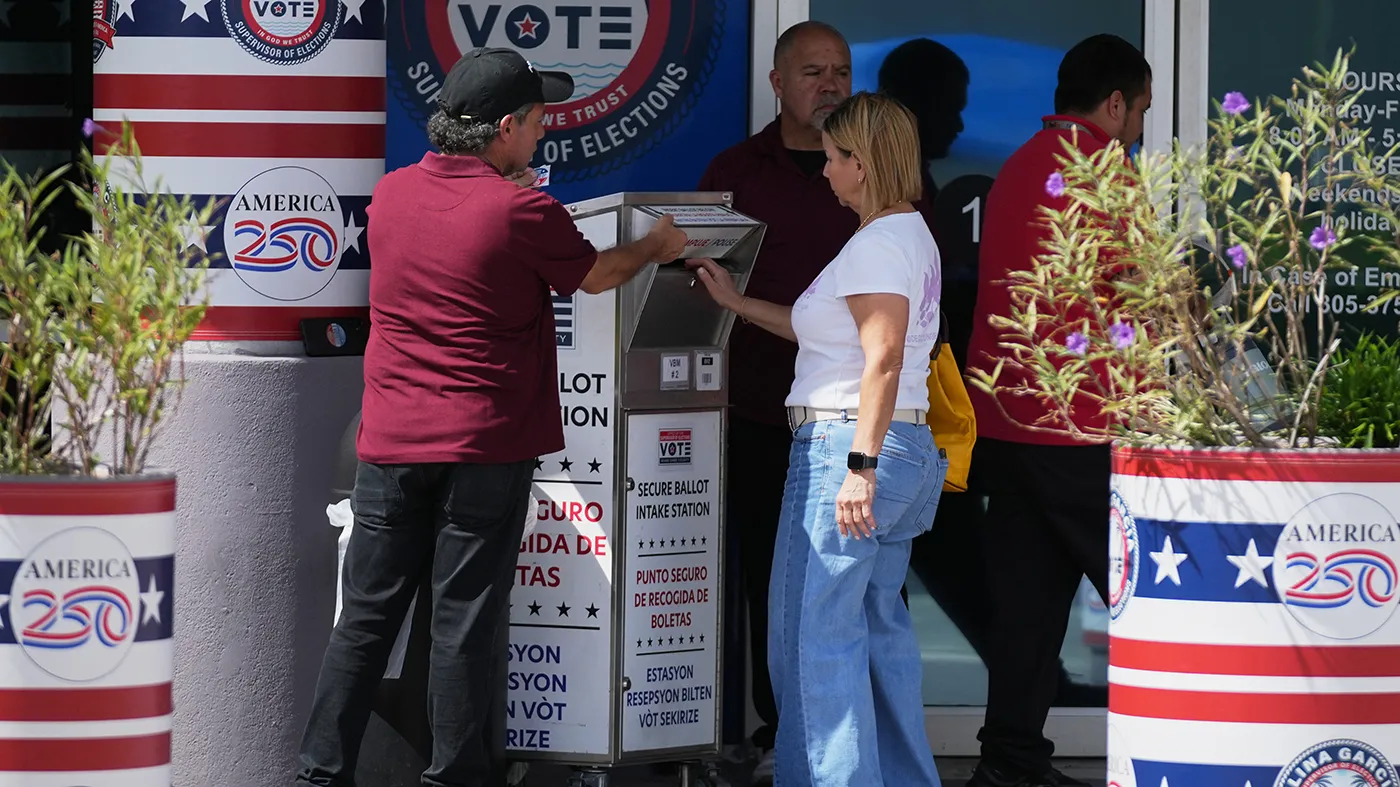
Democrats are giddy about the possibility of a bigger blue wave than expected in the battle for the Senate as polls show that South Carolina , Florida and Mississippi — three seats that were long seen as safe Republican holds — are now competitive races.
Democrats view the Republican candidates running in those states as mediocre political talents who must fight historic headwinds caused by President Trump’s unpopularity, voter anger over inflation and the war in Iran, and burgeoning Democratic voter enthusiasm.
The Senate battleground map has steadily expanded throughout the 2026 midterm election cycle as political handicappers have shifted seats that were thought to be in solidly Republican territory — such as Alaska, Iowa, Kansas and Texas — to the “toss-up” category.
But now Republicans have to worry about losing Senate seats in states that were unthinkable as realistic Democratic pickup opportunities at the start of the election cycle, most notably South Carolina, which last elected a Democrat, Fritz Hollings, to the Senate in 1998.
A New York Times/Siena poll of 707 voters in South Carolina published Wednesday showed Sen. Darline Graham (R-S.C.) tied with Democrat Annie Andrews, 48 percent to 48 percent.
The poll showed Andrews with support from 57 percent of independent voters and 7 percent of Republican voters.
“Everybody’s got to understand that this could be a monumental election, that the normal arithmetic of voting adds up differently,” said Tad Devine, a Democratic strategist who worked on several presidential campaigns.
“The way Democrats can win — and South Carolina can be a great example — all through the South is to have a multiracial coalition that relies on overwhelming support of African American voters and solid support from white voters,” he said, citing former President Biden’s and Democratic Sens. Jon Ossoff’s and Raphael Warnock’s victories in Georgia in 2020.
Democrats knocked off two GOP incumbents in Georgia that year, and Biden narrowly defeated Trump in the state.
Devine noted Biden won Georgia with a sizeable minority of white voters at 27 percent, according to an estimate by The New York Times, and an overwhelming majority of Black voters at 92 percent.
Devine said Biden had won more than 30 percent of white voters in Georgia, a number that is difficult to gauge because it relies on exit polling and other imprecise measurements. And he said that Ossoff and Warnock won with similar percentages of white voters.
Democrats think a similar formula of a larger-than-usual number of white Southern voters casting ballots for their candidates and big turnout from minority voters in favor of their party could produce victories next week in unexpected places, such as South Carolina, Texas and even Florida and Mississippi.
The nonpartisan Cook Political Report rates South Carolina as having a partisan lean of R+8, which measures the leaning of a state in a neutral environment. It rates Texas as R+6, Florida as R+, and Mississippi as R+11.
“These coalitions — if you put them together state by state and you have a target — mean that Democrats can win statewide races in places like South Carolina, Georgia, really across the board. We’ll see whether or not it works in Mississippi, too,” Devine said.
“I think it’s all possible this year because Trump has changed the calculus, and he’s really gone in and taken groups of voters who were reliably Republican and turned them into swing voters,” he continued. “I would not be surprised to see any of these long-shot races come home for Democrats next Tuesday.”
The New York Times/Siena poll found only 42 percent of likely voters in South Carolina strongly or somewhat approve of Trump’s job performance while 55 percent disapprove.
White voters made up 71 percent of registered voters in South Carolina in 2024 and Black voters made up 24 percent, according to a report from the South Carolina Election Commission.
Senate Republicans argue that pollsters, especially those working for legacy media outlets and universities, have a long track record of overestimating the strength of Democratic candidates in GOP-leaning states such as South Carolina and Texas.
“The polling industry is blowing the whistle on its own negligence and track record of misses in Senate races,” said Bernadette Breslin, the national press secretary for the National Republican Senatorial Committee (NRSC).
“Senate Republicans remain focused on exposing Democrats’ dangerous, unaffordable agenda while racking up historic victories that have helped level the playing field on spending and put [Senate Minority Leader] Chuck Schumer [(D-N.Y.)] on defense,” she continued.
Breslin noted Owen Winter, a reporter for The Economist, observed that if polling errors follow the average historical trend, the leads that Democratic Senate candidates have in Alaska and Texas could be “wiped out,” and toss-up races in Iowa and Kansas would move “firmly into the Republican column.”
The Cook Political Report rates South Carolina as “lean” Republican, Mississippi as “likely” Republican and Florida as “solid” Republican.
A New York Times/Siena survey of 813 voters in Florida, also released Wednesday, showed Democrat Angie Nixon trailing Republican incumbent Sen. Ashley Moody by 6 percentage points — 44 percent to 50 percent.
Democrats in Washington have largely ignored the Florida Senate race but some in the party think that a surprise in the Sunshine State is not out of the question.
“Notwithstanding what’s happened in Florida in recent years, I’ve always believed Florida is a place where Democrats with the right candidate and the right message can put together a winning coalition,” Devine said. “And I’ve seen that going way back, I worked for [former Sen.] Bill Nelson [(D-Fla.)] when he was insurance commissioner and also in the first couple of Senate races that he did there that he won.”
He said that Black voter turnout “skyrocketed” in the 2000 presidential election, which put then-Vice President Al Gore within several hundred votes of winning the state.
Black voters made up 12 percent of the general election electorate in Florida in 2024.
Trump won Florida over former Vice President Kamala Harris by more than 13 percentage points two years ago even though Harris won an estimated 35 percent of white voters.
But Trump was able to run up a large margin of victory in large part because he won 13 percent of Black voters and a whopping 56 percent of Hispanic voters.
Democratic strategists believe Hispanic voters will shift decisively toward Democratic candidates, driven by Trump’s lower approval ratings on handling the economy, inflation and immigration enforcement.
Steve Jarding, a Democratic strategist who previously worked as a senior adviser to the Senate Democrats’ campaign arm, agreed that South Carolina and other Republican-leaning states are on the table.
He said that Democrats in South Carolina “are performing like a +11 or +12,” putting Graham’s Senate race in play. He said Florida could also be in striking distance for Democrats.
“It’s going be contingent on turnout. Democrats seem to be fired up, Republicans less so,” he said.
Jarding noted that Democrats have won by healthy margins in special election races since Trump took office in 2025, saying, “All of a sudden a R+8 state is in play.”
“There could be a hell of a lot of states in play,” he said. “Florida would be interesting to me.”
“I’d be more surprised with Florida, I would not be surprised with South Carolina,” Jarding added.
The New York Times/Siena survey found only 43 percent of Florida voters approve of Trump’s job performance while 53 percent disapprove.
Democratic strategists think that young voters — who turned out in huge numbers in the 2008 presidential election, helping former President Obama win in Republican-leanings states such as Indiana and North Carolina — could be a wild-card factor in next week’s election.
Democrats also gained seven Senate seats in 2008 — not counting the Minnesota race which was subject to an extended recount.
Democrats are quietly hoping that the Mississippi Senate race, where low-profile Republican Sen. Cindy Hyde-Smith is running for reelection, could be another election night surprise.
The Democratic Senatorial Campaign Committee made a splash this week by announcing a $500,000 coordinated ad buy with Mississippi Democratic Senate candidate Scott Colom. Semafor first reported the coordinated ad buy Thursday.
Democrats have pounced on Hyde-Smith’s awkward response earlier this year when asked about skyrocketing beef prices. Hyde-Smith, who usually refuses to talk to reporters in the Senate hallways, inartfully pointed out “you have so many proteins to choose from” if you can’t afford steaks or hamburgers.
A Change Research poll of 842 likely Mississippi voters conducted from Oct. 21-22 and sponsored by the Democratic-aligned Government That Works PAC found Hyde-Smith leading Colom by only 3 percentage points, 43 percent to 40 percent.
Breslin, the NRSC’s national press secretary, slammed Colom for being supported by progressive megadonor George Soros.
“Instead of saving himself the embarrassment of being denied a job twice by Hyde-Smith, Colom is running a campaign backed by Chuck Schumer, funded by George Soros, and built on pro-transgender and other far-left policies,” she said.
Hyde-Smith blocked Colom’s nomination to serve as a federal judge during the Biden administration.
Topics in this story
Gathered from external sources. Rights to this text belong to whoever originally published it.