Congress drafted a historic climate bill. Environmental groups want to kill it.
Environmental organizations are opposing the Bipartisan American Affordability and Jobs Act, which aims to accelerate the U.S. clean energy transition by streamlining permitting processes and limiting litigation.
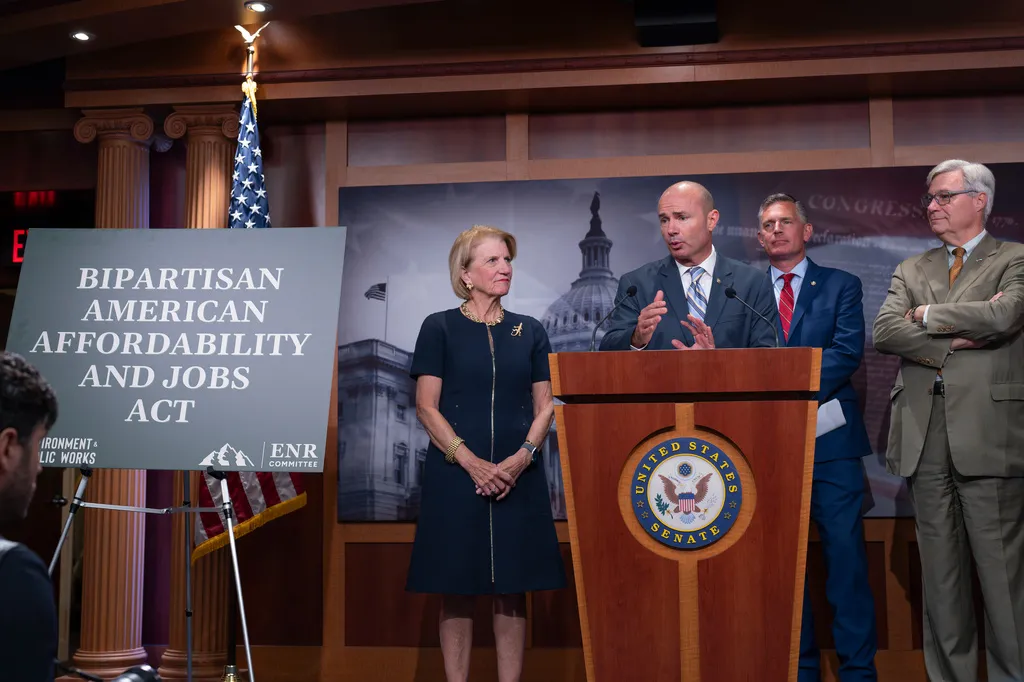
On Nov. 9, the Senate will take up the Bipartisan American Affordability and Jobs Act , a sweeping bill that could become one of America’s most powerful climate policies. Stunningly, environmental groups are lining up in opposition.
America’s clean energy transition is underway, but slow permitting, aging power lines, yearslong lawsuits, and White House interference have prevented solar and wind projects from being built and connected as quickly as the climate crisis demands. This bill could change that. It would streamline project approvals and grid connections, limit lawsuits that stall construction, and restrict presidential intrusion. It could help America accelerate the clean energy buildout necessary to lower electric bills and fight climate change.
Yet 222 environmental organizations, including Greenpeace USA, the Climate Justice Alliance, and the Center for Biological Diversity, signed a letter urging Congress to reject the bill, arguing its environmental cost would “outweigh the potential emissions reductions” it could deliver. That calculation dangerously undervalues the status quo’s climate cost. By rejecting limits on the ability to delay or derail development, environmentalists risk sacrificing the biggest opportunity in decades to advance a sustainable future.
Energy economics has fundamentally changed. Globally, 91 percent of renewables commissioned in 2024 were cheaper than fossil fuel alternatives. Over the past decade, solar panel prices fell by 90 percent , onshore wind by 70 percent , and batteries by more than 90 percent . Unfortunately, developers spend years purchasing land, securing approvals, navigating environmental reviews and public comments, upgrading the grid, and fighting lawsuits before installing a single panel or turbine. Today’s challenge is no longer affording solar and wind, but whether our convoluted procedures allow them to be built.
The backlog is staggering: 773 gigawatts of solar capacity sat in America’s grid interconnection queues as of December, over two and a half times the solar capacity installed nationwide. Of proposals between 2016 and 2020, 11.3 percent of solar capacity in red states became operational, compared with 5.4 percent in blue states. Policy doesn’t tell the whole story — too many projects fail everywhere — but states with fewer bureaucratic hurdles get more proposed solar permitted and built than their climate-ambitious but high-regulation counterparts.
After developers secure permits and transmission upgrades, appeals challenging renewable projects can take over two years to resolve . Many stem from President Trump’s crusade against offshore wind , but environmental groups counterintuitively bring a substantial share of lawsuits themselves. Uncertainty forces developers to maintain land without revenue, making promising renewable projects uneconomical while Americans burn far worse fossil fuels instead.
The bill could dramatically improve this. Federally, it would impose permitting deadlines, coordinate grid upgrades, and give regulators greater authority to approve interstate power lines. Lawsuits challenging federal environmental reviews would generally face a 150-day filing deadline , with stricter guidelines for courts overturning approvals. Crucially, the bill would prevent presidents from revoking permits or targeting energy sources for political reasons, as Trump has repeatedly attempted with wind.
Knowing this, one might expect environmental organizations to be the legislation’s fiercest champions. Instead, many are its fiercest opponents.
Many environmentalists object that the bill would ease fossil fuel permitting, a concession they consider untenable. But today’s infrastructure barriers don’t displace fossil fuels; they entrench them as the only option. Reform won’t fix that alone, but with solar, onshore wind, and battery storage comprising 93 percent of planned 2026 U.S. electricity additions, clean energy is better positioned to capitalize on deregulatory policy. American Clean Power projects the bill could avert 290 million metric tons of carbon emissions annually, a 6 percent reduction. The faster we build clean energy, the more it can meet America’s growing electricity demand, letting us retire fossil fuels without harming people’s energy bills and lifestyles.
The letter also argues reforming environmental laws would cause damage outweighing these emissions cuts. That may be defensible for specific provisions, and legislators should seek amendments, particularly on tribal sovereignty and judicial remedies . But measured against the status quo, fossil fuel extraction and worsening climate change threaten our air, water, and ecosystems far more than an accelerated-but-still-lawful clean energy buildout. Speed matters in climate mitigation. Competing environmental concerns cannot keep taking years to raise and evaluate.
The groups also claim “now is not the right moment” for compromise and a future Democratic Congress could deliver a preferable package. That’s a terrifying gamble. This polarized Congress has passed no discretionary bipartisan reforms of comparable scope. Its closest bipartisan success, the 21st Century ROAD to Housing Act, went unsigned by the president . Nevertheless, the unpredictable White House seems open to permitting reform . If Democrats bail, they risk politicizing future reform under a president willing to reject popular bipartisan legislation to punish Democrats. The Inflation Reduction Act fallout revealed waiting for one-party trifectas and legislating alone won’t produce stable climate policy . This legislation may not satisfy every environmentalist’s wish list, but squashing a rare bipartisan chance to reform 50-year-old laws for the century’s most urgent environmental challenge because it’s “not the right moment” is incredibly misguided.
For decades, environmentalists have notched victories blocking destructive development and protecting natural spaces. But those efforts were never ends in themselves. They envisioned a better future: cleaner air and water, thriving communities, and prosperity without sacrificing the planet. Today, realizing that future requires green infrastructure to replace fossil fuels, mitigate climate change, and lower electric bills. This bill offers a historic opportunity to build that. By fighting it, environmental organizations risk jeopardizing the vision they’ve spent decades imagining. I hope they reconsider.
Ethan Brown is Program Manager at the University of Rhode Island’s Metcalf Institute. He is an award-winning climate writer and commentator with a B.A. in Environmental Analysis & Policy from Boston University. His opinions are his own. Click here to follow his work.
Topics in this story
Gathered from external sources. Rights to this text belong to whoever originally published it.