Drone warfare will be won at the operator level
Rather than building systems around individual platforms and asking operators to navigate between them, we should build around the operator.
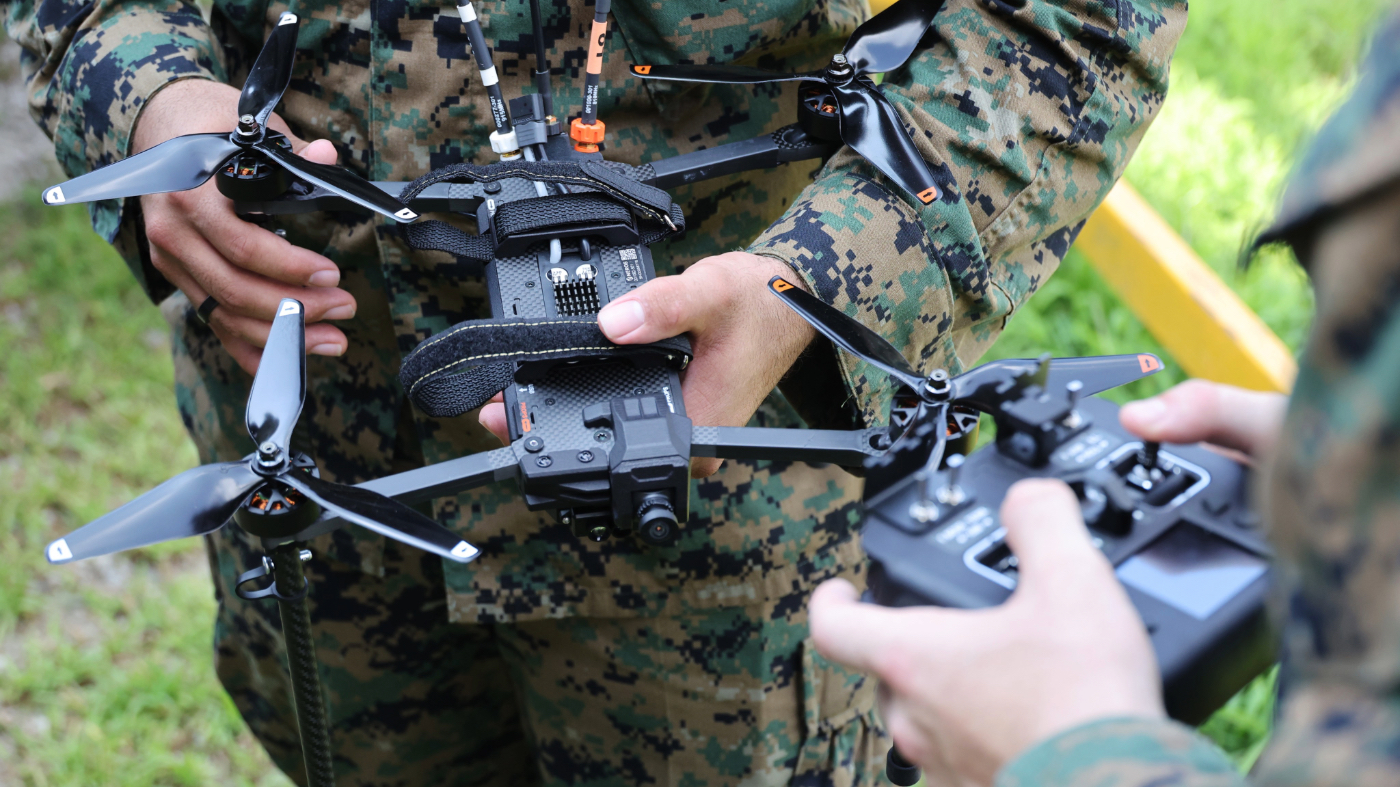
We are witnessing modern warfare create a paradox. The battlefield has never had more intelligence, yet the soldier may have less time than ever to use it. A drone can be detected by one system, classified by another, tracked by a third and defeated by yet another. Each system may work as designed. But if those capabilities can’t converge around the person who has seconds to act, technological superiority becomes irrelevant.
It poses a fundamental and lethal gap for our warfighters.
Drone warfare will be won at the operator level. The advantage won’t belong to the military with the best drones or the most sophisticated interceptor, but to the military that brings intelligence and capability together around the individual solider, creating a decision advantage at machine speed.
For decades, military modernization has delivered extraordinary advances in sensing, communications and precision. But drone warfare exposes a dangerous weakness. A small aerial threat can emerge with little warning, leaving a soldier seconds to understand what’s happening and respond. The challenge isn’t simply whether information exists. It’s whether the person who needs it can understand it and act before it’s too late.
Information superiority doesn’t automatically translate into decision superiority. A warfighter surrounded by sensors and intelligence may still lack a clear picture of what to do next. More information can become a burden when every new capability introduces another stream of data demanding attention.
We have spent years putting more information in front of soldiers. Now we must remove the complexity. Militaries are developing increasingly capable electronic warfare systems. The challenge is making them work together.
Rather than building systems around individual platforms and asking operators to navigate between them, we should build around the operator — something like an Iron Dome for the individual. Sensors, autonomous assets and defensive capabilities should converge through a common coordination layer that absorbs technical complexity and presents the operator with a clear understanding of the threat and available options.
Agentic artificial intelligence could transform this process. Unlike AI that simply analyzes information, agentic systems can coordinate tasks and available tools. Such a system could process sensor data, classify a threat, identify available defensive capabilities and present options. The operator would no longer need to navigate multiple systems to understand what can be done.
The goal isn’t to show warfighters everything a machine knows. It’s to provide what they need to know when they need it. Machine speed should compress complexity while humans remain in charge.
Our perspectives come from different experiences. One of us spent two decades in Army Special Operations, including 18 combat deployments. Another has worked across government and emerging technology, focusing on artificial intelligence and systems design. And one of us investigated and uncovered dangerous flaws on the production line of one of the nation’s most complicated and important military aircraft.
Yet all these experiences point to the same principle: Battlefield technology should make the operator more capable, not irrelevant.
Such a system could give an individual soldier a tactical edge by coordinating capabilities that once required multiple interfaces or specialists. This wouldn’t eliminate command structures. It would create greater situational awareness and improve decision-making on the battlefield.
But it must work under battlefield conditions even when communications fail, GPS degrades and networks go down. Adversaries can manipulate information and attack the systems carrying it. Battlefield AI must be designed for degraded environments, enabling useful intelligence even when distant command centers or cloud connections are unavailable.
The Pentagon should also expand how it measures counter-drone performance. Detection range, interception probability, accuracy and cost remain important. But so does the time between detecting a threat and enabling a human response. A system that detects a drone earlier but complicates the decision-making process isn’t an operational advantage.
There are real risks. AI can misclassify threats, fail in unexpected conditions or encourage excessive trust in machine recommendations. These dangers are serious when lethal force is involved. The answer is not simply greater autonomy.
Human oversight must be built in. Operators need more than the ability to approve a final action; they need situational understanding and authority over decisions. AI should perform tasks that machines can execute faster while helping humans make better decisions under pressure.
The U.S. must stop asking only how much more technology it can put in warfighters’ hands. It must ask how much complexity it can remove. As drones proliferate and autonomy increases, the time available to make decisions shrinks. More sensors and interceptors won’t matter if operators can’t act quickly.
Drone warfare will be won by the military that connects its systems, compresses decision time and puts intelligence where it matters most: with the person whose life depends on it.
The goal of battlefield AI is not to remove the human from the fight. It is to give the human an advantage within it.
Thomas Payne is a recipient of the U.S. Army’s Medal of Honor for actions during his service in Iraq in 2015. Cesar R. Hernandez is a fellow at Harvard’s Kennedy School of Government, a developer at the MIT Media Lab, and an MBA graduate of Oxford University. Alan M. Cohn is a Peabody and Emmy Award-winning journalist.
Topics in this story
Gathered from external sources. Rights to this text belong to whoever originally published it.