Senate braces for nasty fight over seating Peltola after Alaska Senate race
Senators are bracing for a potential floor fight over accepting the results of the Alaska Senate race between incumbent Sen. Dan Sullivan (R) and former Rep. Mary Peltola (D) — and perhaps other battleground contests — if President Trump urges allies to dispute what he might view as unfair or “rigged” results. Democratic senators generally…
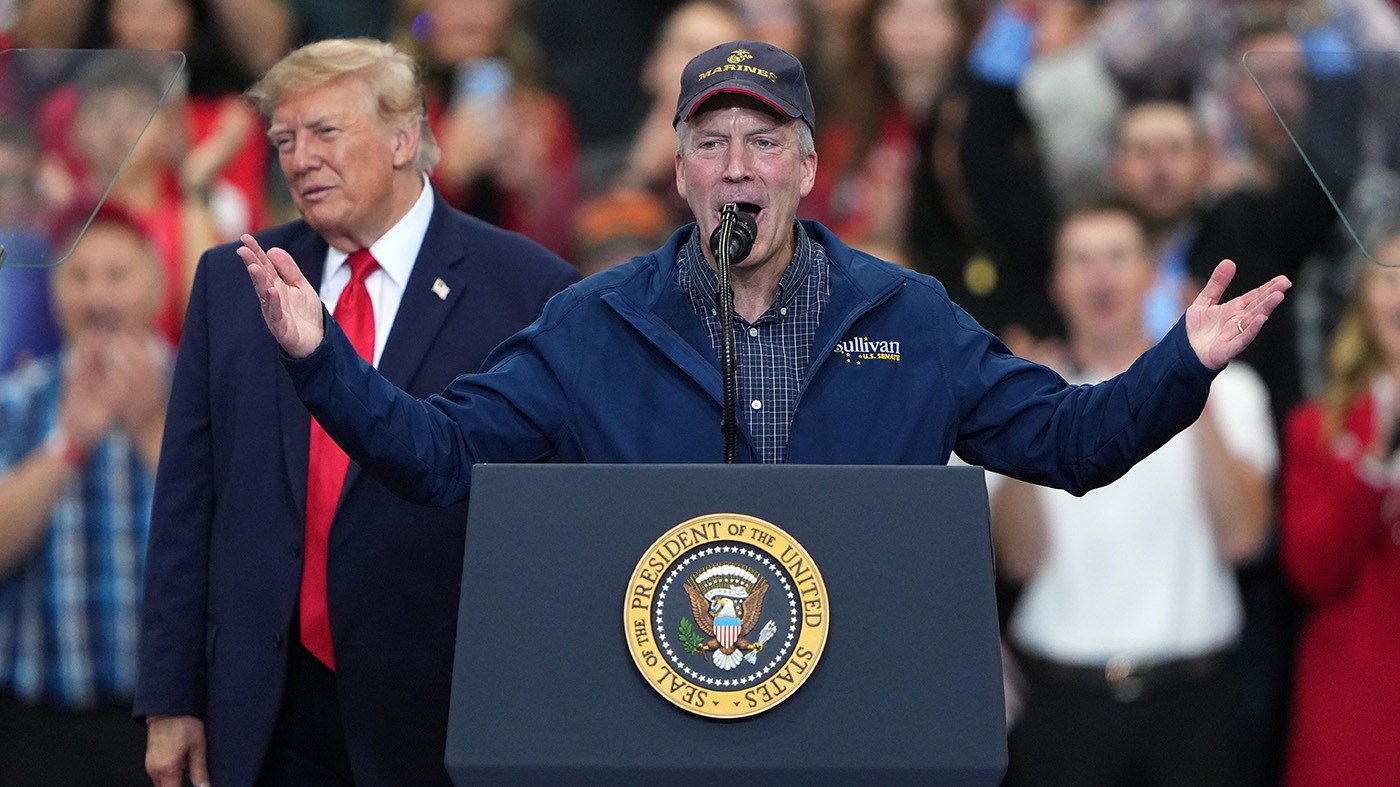
Senators are bracing for a potential floor fight over accepting the results of the Alaska Senate race between incumbent Sen. Dan Sullivan (R) and former Rep. Mary Peltola (D) — and perhaps other battleground contests — if President Trump urges allies to dispute what he might view as unfair or “rigged” results.
Democratic senators generally view Senate Majority Leader John Thune (R-S.D.) as a straight shooter who would be averse to rejecting an election result in an Alaska Senate race certified by the governor and lieutenant governor.
But they aren’t ruling out the possibility that the president will prod his MAGA allies in the Senate to contest the election results if Sen. Dan Sullivan loses by a narrow margin and blames his loss on voter confusion leading to a significant number of votes for his opponent with a similar name, Daniel J. Sullivan Jr.
If Alaska’s top officials certify Peltola as the winner, and Trump calls on Senate allies to reject that finding, it puts Thune in a tough spot and potentially sets up a messy floor fight.
“Everybody is gaming everything out, and everybody is preparing for everything,” a Senate Democratic aide said of the preparations for potential Republican objections if Peltola narrowly beats the incumbent Republican senator.
Sarah Binder, a professor of political science at George Washington University and a Senate rules expert, said Trump’s aggressive threat to challenge a Democratic win in Alaska could lead to a nasty Senate floor fight.
“We can’t rule anything out at this stage just given the president’s single-minded persistence that there’s a lot of electoral fraud conducted by Democrats,” she said.
“Would he push Republicans to object to the seating, if Alaska certified the seating of Peltola? The second question is, if he did that, would Republicans actually follow through?” Binder continued.
“That gets us into the hornet’s nest of what the Senate would do to challenge a literal swearing in,” she added. “There’s no single charted pathway here.”
She noted that, historically, if Alaska certifies Peltola as the winner over Sen. Dan Sullivan, Republicans could object to swearing her in.
“I could imagine a scenario where they would want to swear her in, and somebody objects,” she said.
Senate sources familiar with how the floor process would play out said that a Trump-allied senator or a group of GOP senators could signal an intention to object to Peltola — or to the Democratic winner of another close Senate race where Trump might claim election fraud — taking the oath of office to become senator in 2027.
That would then lead to a negotiation between Thune and Senate Democratic Leader Chuck Schumer (N.Y.) over how to resolve the situation.
Senate Republican sources say they’re confident that incumbent Sen. Dan Sullivan will defeat Peltola next week.
Recent polls show Peltola leading the GOP senator by 2 percentage points, but the race is within the margin of error.
Recent surveys by Data for Progress, InsiderAdvantage and Alaska Survey Research showed the Democrat leading by 2 points while a New York Times/Siena poll conducted from Sept. 24 to Oct. 1 showed her ahead of Sullivan by 7 points.
Alaska has ranked-choice voting, which could shift how some votes are counted.
One relevant Senate precedent comes from January 1997, when Republican candidate Woody Jenkins petitioned the Senate to throw out Democrat Mary Landrieu’s victory in the 1996 Senate race in Louisiana.
Landrieu won by more than 5,000 votes, but Jenkins alleged “widespread vote tampering.”
Senate leaders resolved the matter by agreeing to seat Landrieu “without prejudice” and referring the allegations of election fraud to the Senate Rules Committee to investigate. The deal left open the door to the Senate voting to unseat Landrieu by a majority vote if the charges of cheating were substantiated.
In the end, the Rules Committee voted unanimously in October 1997 to end its investigation and clear Landrieu of wrongdoing even though it acknowledged some voting irregularities.
Trump is laying the groundwork for a similar fight this fall if Peltola wins, giving Democrats a crucial pickup in a GOP-leaning state.
The Trump Justice Department last week asked a federal court to block the certification of the winner of the Alaska Senate race if Sen. Dan Sullivan loses by a narrow margin and could argue that he would have won if his near-namesake, Daniel J. Sullivan Jr., hadn’t been on the ballot.
Legal experts have broadly dismissed the Justice Department lawsuit as meritless, raising the prospect that Trump’s next move may be to demand that GOP senators refuse to seat Peltola if she wins by a small margin.
“They’ve set up the argument already that there’s a deliberate deception on the part of the other Dan Sullivan, and even though this seems to have been adjudicated in Alaska law, they will certainly argue the issue of fairness remains,” said Steven S. Smith, a professor of political science at Arizona State University, who follows Senate politics.
Alaska’s Division of Elections, which is led by the state’s Republican lieutenant governor, initially removed “Dan J. Sullivan” from the ballot, but a state judge later ruled that he be placed back on the ballot.
The Alaska Supreme Court upheld that decision .
To avoid confusion, the Alaska ballot lists “Dan S. Sullivan” as the Republican incumbent and lists his opponent as “Daniel J. Sullivan Jr.” without party affiliation.
Given that the Alaska Supreme Court has already ruled that the little-known Daniel J. Sullivan Jr. deserves a spot on the ballot, it would be hard to see how state officials could withhold the certification of a narrow Peltola victory without being overturned by the courts, legal experts say.
That then sets the stage for a fight in the Senate, where any number of Trump allies or ambitious Republican senators who are looking for a springboard for national publicity could object to seating Peltola.
“This is really a question of Trump-backed Republicans, and I think with Trump probably urging them to exploit every opening, the certification of the Democrat will lead to a Republican challenge if they’re in a position in the Senate to do so,” Smith said.
If Peltola wins her race by a narrow margin, however, she will need Alaska’s Republican Gov. Mike Dunleavy and Lt. Gov. Nancy Dahlstrom, who handles the duties of the secretary of State, to certify her victory.
If Republican state officials refuse to certify a Peltola victory, then Senate Republicans argue the Senate rules would not allow the upper chamber to seat her when the Senate convenes for the new Congress on Jan. 3.
The matter would need to be resolved by Alaska’s courts.
A similar stalemate played out in 2009 after the close contest between Democrat Al Franken and GOP Sen. Norm Coleman in Minnesota.
The state’s Republican Gov. Tim Pawlenty signed the election certificate validating Franken’s victory only after the Minnesota Supreme Court unanimously ruled in June 2009 that Franken had won the race by just more than 200 votes.
Democrats, who had 59 seats at the time, agreed not to seat Franken until the legal process played out.
Topics in this story
Gathered from external sources. Rights to this text belong to whoever originally published it.