What College GameDay Taught Us About Welcoming Opposing Views
"Sports debate has always been at its best when it challenges its audience to think, question and engage. Saturday provided an opportunity to do exactly that...
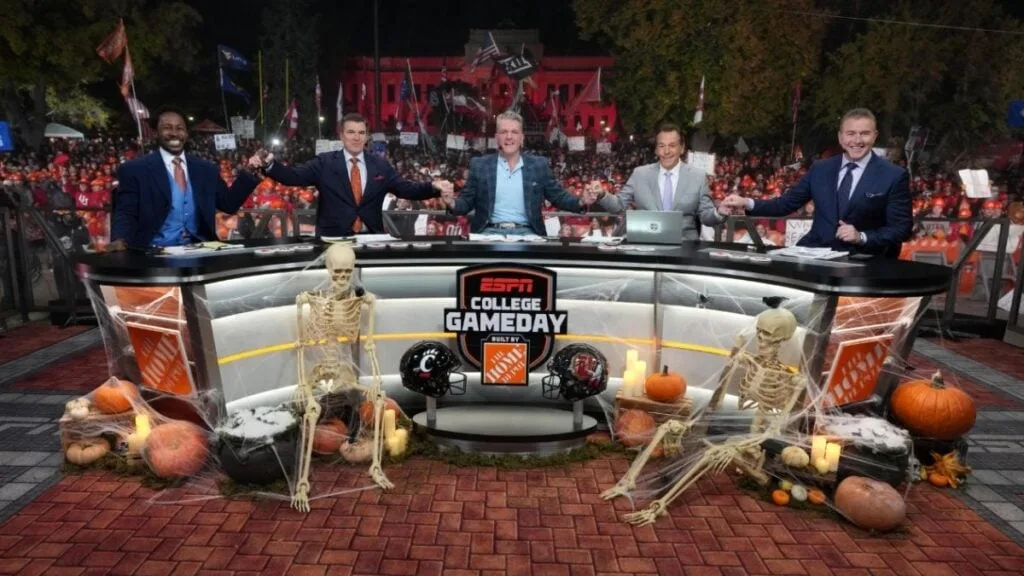
It's not the first time, nor will it be the last. This past Saturday, College GameDay devoted a segment to the upcoming vote on the Protect College Sports Act this week in Congress. Regardless of your political leanings, a college football pregame show devoted time at the official kickoff of the season to publicly support national legislation with no representation of the opposing view.
Is this the new normal? Is this the expectation moving forward? Without question, college football needs some sort of reform. But is this act the fix? And should it be debated on a college football pregame show to kick off a new season of Saturdays in the fall? If Saturday was an example, where was the debate? There was none.
I'm not naive enough to believe sports and politics have never mixed on sports television programming. I've always argued that if there is a direct connection between sports and a political debate, then engage. But engage properly. Except, Saturday provided a moment where the intersection was direct. However, the forum was not open to the other side.
Instead, this was lobbying. Not discussion. This was advocacy, not debate.
Yes, Nick Saban is a staunch supporter of the act proposed in Congress. In fact, he testified before a Senate committee in support of the bill and appears in a commercial supporting it. Yes, Pat McAfee is also a supporter of the act. He's said as much on his daily sports talk program.
But the heart of the legislation is still up for debate. The vote comes this week. Saban himself said he considers the bill 80% good.
Why only 80%? Where is the other 20% lacking? That could have used another point of view from someone opposed to the act.
Make no mistake about it. ESPN has been a lightning rod for years over talent embracing social commentary and political conversation on air. The network has faced criticism from both sides of the political spectrum when its talent has ventured into broader discussions involving sports and politics.
We've seen it with Colin Kaepernick and the national anthem debate. We've seen it in discussions surrounding the NBA and WNBA with issues of political and social policy. Depending on the audience and the topic, ESPN has always been accused of being too "this" or too "that."
But at the heart of those criticisms is often the same complaint: the absence of an opposing viewpoint. Taking a stance instead of embracing debate and conversation. That doesn't mean every argument needs to receive equal weight. What it does mean is that when a program chooses to enter a discussion involving a matter of public policy, the audience deserves an opportunity to hear more than one perspective.
If shows or talent wish to dive into these discussions, they should ensure that both sides have representation. That's what fair coverage deserves, and what every sports talent should understand.
At the end of the day, every program should give viewers and listeners an informed and entertaining point of view. Political discussions demand that broadcasters present more than one perspective. Any sort of reform has its supporters and detractors. News networks attempt to provide both sides. Talk radio also makes an effort to present both angles of a discussion.
Without debate, nothing is accomplished. Compromise is never reached. Agreement is never final.
There is a dissenting side to the legislation in Congress. But you wouldn't know that by watching College GameDay on Saturday. Withholding that point of view when you choose to enter the discussion is misguided. It doesn't accomplish the service your program is designed to provide: entertain and inform.
Saturday's edition of College GameDay should be an example every sports talk program attempts to avoid. If a program chooses to enter the political arena, it has a responsibility to do more than present one side of the argument. When legislation is being debated, especially legislation that could directly impact the sports being discussed, the audience deserves to hear the strongest arguments from both supporters and opponents. It didn't happen.
By doing so, that's giving viewers and listeners enough perspective to form their own opinions. Isn't that the goal? Have the audience decide?
Talent can have a position. Programs can have a point of view. But when the discussion involves politics and public policy, presenting only one side risks turning commentary into advocacy. And that distinction matters.
Sports debate has always been at its best when it challenges its audience to think, question and engage. Saturday provided an opportunity to do exactly that and missed it. The Protect College Sports Act deserved a conversation, not a campaign pitch.
Every sports talk program entering similar territory should remember the difference.
Barrett Media produces daily content on the music, news, and sports media industries. Sign up for our newsletters to stay updated and get the latest information right in your inbox.
Topics in this story
Gathered from external sources. Rights to this text belong to whoever originally published it.