Trump wants a referendum on Trump ahead of the midterms — let’s give him one.
In Dallas, Donald Trump told voters to “pretend that I’m on the ballot.” OK. Let’s do exactly that.
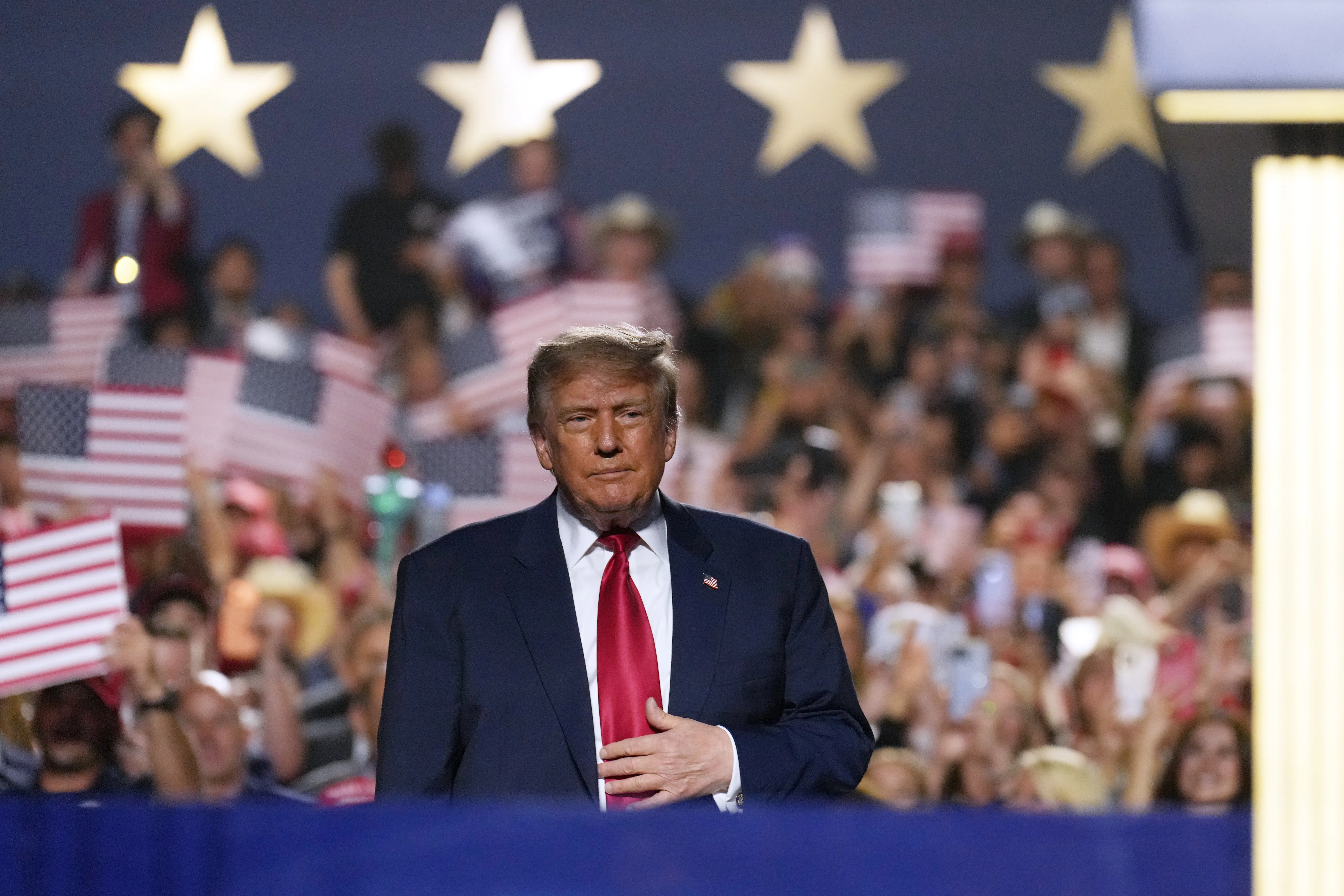
The strangest thing about last week’s Republican convention in Dallas wasn’t that Donald Trump managed to turn a midterm election into something resembling another presidential campaign. It was that so many people immediately began arguing about the spectacle.
Was this normal? Was it appropriate? Was it another example of a political party organizing itself around one man? What did it say about the Republican Party? What did it say about Trump?
At one point, Trump asked the audience to raise their right hands and pledge themselves to the “greatest president in the history of the United States” and to voting in November. Then, with his own hand raised, he declared: “I don’t care if I’m registered or not, I’m going to try to cheat like hell like they do.”
It was weird. It was cringy. It was wildly inappropriate. And a sitting president joking about cheating in an election after years of making unsupported claims that his opponents do exactly that deserves criticism.
But it also illustrates something exhausting about American politics in the Trump era. Every provocation becomes the story. Every norm-breaking moment generates several days of outrage, defense and counter-outrage. Then another one arrives.
In Dallas, Trump actually offered Americans a much more useful way to judge him. He told voters to “ pretend that I’m on the ballot .”
Trump has spent most of his adult life asking to be judged as an executive. So let’s borrow an executive term and look, as impartially and dispassionately as possible, at his key performance indicators.
Trump’s approval rating now stands at 33 percent in the Reuters/Ipsos poll, the lowest level of his political career. He began his second term at 47 percent . Among independents, the numbers are particularly ugly. Heading into an election Trump has explicitly asked voters to make about him, independents currently prefer Democratic congressional candidates 36 percent to 22 percent.
Approval ratings are snapshots, of course; they are not history’s final verdict on a presidency. But they are certainly a KPI. So is the economy.
Trump returned to office in no small part because Americans were angry about affordability. Today, 71 percent disapprove of his handling of the cost of living , including four in 10 Republicans.
Has the economy has collapsed? No. And there are areas of genuine strength for Trump; the border is unquestionably quieter than it was when he returned to office, and that is a KPI on which he deserves substantial credit.
That is what a dispassionate review requires. Count the wins. Count the losses. Do not move the goalposts for either. Then look overseas.
Trump ran as the president who would keep America out of prolonged wars . The United States is now in the seventh month of a war with Iran, w ith no immediate end in sight. The Strait of Hormuz has been severely disrupted. Energy prices have risen . The conflict has threatened to widen again through Yemen and another crucial shipping passage, at Bab el-Mandeb.
There may be legitimate arguments for confronting Iran. History may ultimately judge some of Trump’s decisions more favorably than voters do today. But that is not the KPI Trump originally offered. He promised something considerably simpler: strength would produce peace .
Trump spent years saying Russia’s invasion would never have happened had he been president. More importantly, he repeatedly claimed that his negotiating ability could end the war extraordinarily quickly. At times he talked about doing it within 24 hours , even before taking office.
He has now been president for nearly 20 months. The war continues.
American negotiators are still attempting to broker a settlement. Russia and Ukraine remain divided on fundamental issues . Ukrainians are preparing for another winter of Russian attacks.
There may be no American president capable of quickly resolving a conflict in which Vladimir Putin and Ukraine want fundamentally incompatible things. But that is precisely why the original promise matters. Trump did not campaign on the proposition that Ukraine was an extraordinarily difficult geopolitical problem requiring patience, compromise and years of diplomacy. He campaigned on the proposition that he could solve it, fast.
And that is the useful thing about applying KPIs to Trump. We do not even have to devise the metrics ourselves because, for years, Trump himself has supplied them.
Wars would end. Prices would fall. America would become more prosperous. Adversaries would respond to strength. His negotiating ability would succeed where traditional diplomacy had failed.
Some of those promises have produced results. Others plainly have not.
Trump wants Americans to pretend he is on the ballot in November. They should. Not because they adore him. Not because they despise him. And certainly not because of another week of arguments over whether his latest convention performance was normal.
Open the dashboard instead. Look at the promises. Look at the numbers. Look at the world Trump inherited and the world nearly two years of his presidency has produced. Then think about who should win in November’s elections.
Aron Solomon is chief strategy officer for AMPLIFY and has taught entrepreneurship at McGill University and the University of Pennsylvania.
Topics in this story
Gathered from external sources. Rights to this text belong to whoever originally published it.