Jewish Democrats contend with another glass ceiling: Their religion
Sen. Jon Ossoff (D-Ga.) has emerged as one of the most closely watched contenders in the initial polling for the 2028 Democratic primary. But one factor strategists say could be a challenge for the Georgia senator is his religion. Amid party tensions over Israel and the war in Gaza, Ossoff’s rise is pushing an uncomfortable question to the…
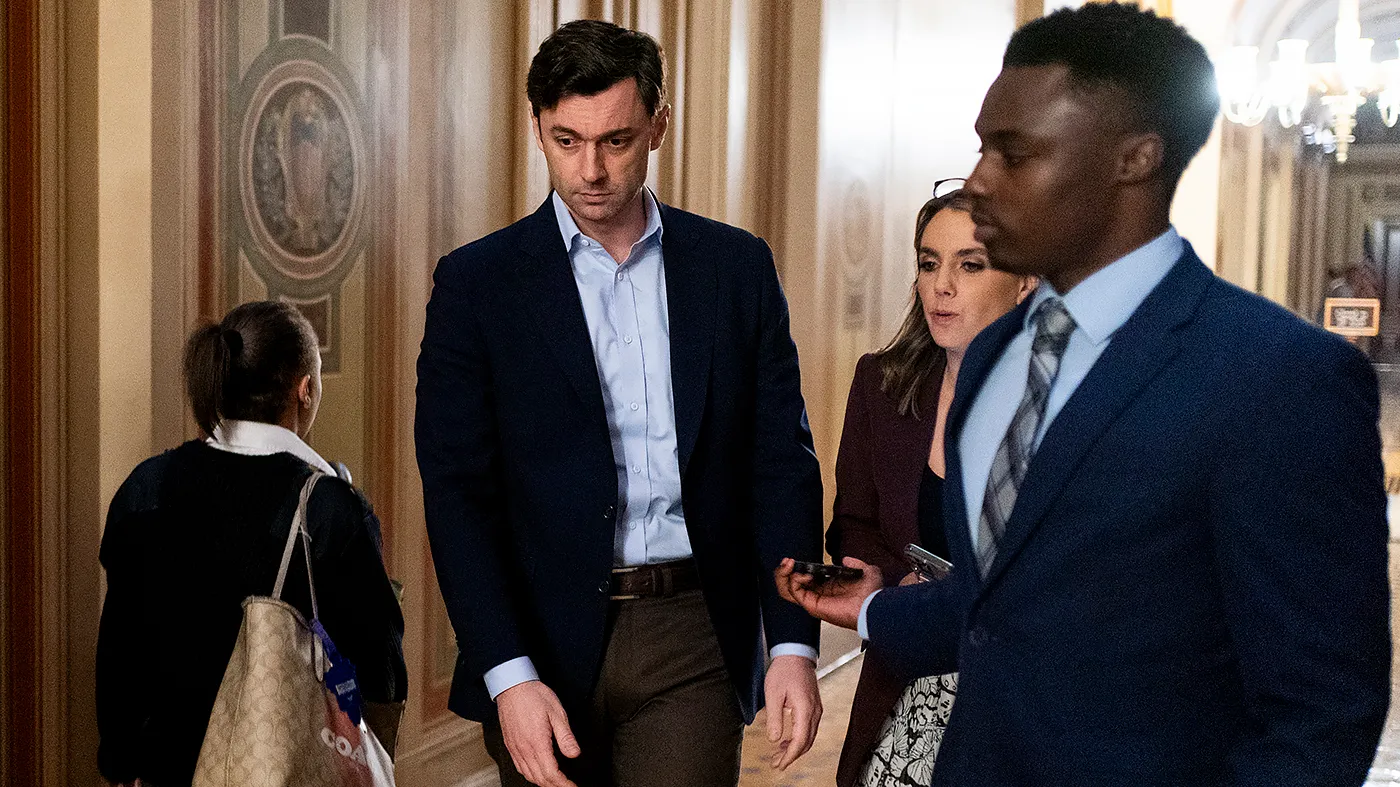
Sen. Jon Ossoff (D-Ga.) has emerged as one of the most closely watched contenders in the initial polling for the 2028 Democratic primary. But one factor strategists say could be a challenge for the Georgia senator is his religion.
Amid party tensions over Israel and the war in Gaza, Ossoff’s rise is pushing an uncomfortable question to the forefront for party operatives: whether being Jewish could be another glass ceiling in presidential politics.
If Ossoff enters the race, “It’s going to be part of the conversation,” one Democratic strategist who plans to be part of the 2028 election said candidly. “Is it unfair? Yeah but it’s how our politics operate.”
It’s of particular interest among those watching the early stages of the Democratic Party’s contest given the fierce, years-long debate over U.S. support for Israel in the context of Gaza. The debate has been fierce in political primaries and led to drives for people to vote “uncommitted” when then-President Biden was running for reelection in early 2024.
While plenty of Jewish Americans and politicians are opposed to Israel’s government and its handling of Gaza, the battles have also stretched to such issues as Israel’s right to exist. Accusations of antisemitism against various politicians have also been leveled.
It also comes at a time when some Jewish voters themselves are questioning their place in the party and whether they would support candidates including Abdul El-Sayed in the Michigan Senate race.
Ossoff is not the only potential 2028 contender who is Jewish. Pennsylvania Gov. Josh Shapiro, a finalist in former Vice President Kamala Harris’s search for a running mate in 2024, is another top potential candidate. So is Illinois Gov. JB Pritzker, who has said that his faith “influences” him.
Asked if Democratic voters would turn their backs on a Jewish candidate like Ossoff, Shapiro or Pritzker, Democratic strategist Steve Schale said, “I sure as hell hope it’s not an issue.”
“I believe, in the end, it’s going to be everything else that matters more,” added Schale, who ran former President Obama’s successful Florida operation during the 2008 presidential campaign.
Recent polling underscores why Democrats are talking about the issue.
A Politico/Public poll out earlier this year found that being of Jewish faith hurt hypothetical candidates among both Democratic and Republican voters, compared with candidates who were Christian.
A separate survey out last week found that Democrats were less likely to support candidates who regularly attended synagogue over those who only went to temple once a year or did not practice a religion. Among Republicans, however, candidates who regularly attended synagogue fared better than those who attended occasionally.
Strategists say the numbers are telling — for any of the prospective Jewish candidates.
“I think it’s going to be the big debate of ‘Do they just sort of let it lie and talk about it as it comes up or try the big head-on speech about it?’ Democratic strategist Eddie Vale said.
Vale pointed to Obama’s speech on race during his 2008 campaign and John F. Kennedy’s address on religion before he became the nation’s first Catholic president to show how candidates can turn perceptions, or even take on prejudices, head-on.
“Overcoming people’s perceptions and biases” on Judaism will be something candidates will have to overcome, Vale said. “And it’s an open question where it ends up.”
The late Sen. Joe Lieberman (Conn.) became the first Jewish candidate on a major party ticket as Al Gore’s running mate in 2000.
And when Lieberman, who was an observant Orthodox Jew, was running for president in 2004, he also found ways of discussing his religion proactively.
“He found a way to deploy faith on the campaign trail,” said Basil Smikle, the Democratic strategist who worked for Lieberman during the campaign. “I went to a Black church with [him] and he discussed his faith openly and was well-received.
“The issue isn’t religious affiliation. It’s connectivity,” Smikle added.
A candidate’s positions on Israel will come under deep scrutiny during the Democratic presidential primary no matter their religion, but it’s possible Jewish candidates will come under even more scrutiny from some voters.
Ossoff has described himself a “pro-Israel Jewish American.” He has supported aid for Israel to defend itself but has been critical of Prime Minister Benjamin Netanyahu and the Israeli government’s actions in Gaza.
As part of that criticism, he has voted to restrict some weapons transfers to Israel, which has angered and alienated some of his Jewish constituents in Georgia.
Last month, Michael Morris, the publisher of the Atlanta Jewish Times, wrote an open letter blasting Ossoff for his Senate votes opposing Israel.
“I apologize for being blunt but please, stop lying to me and your constituents,” Morris wrote in the letter. “I hear you claim, over and over again, that you support Israel — that your support is ‘ironclad.’ It is not. You vote against Israel on the Senate floor in Washington, then come home to Georgia and make this untruthful claim.”
Rep. Mike Collins (R-Ga.), who is running against Ossoff in this year’s Senate race, has pounced on that criticism, calling the senator a “sellout” and accusing his rival of pandering to progressive Democrats while highlighting his own record of support for Israel.
While antisemitism and protests toward the Israeli government’s treatment of Gaza have increased, Smikle said, he predicted that voters will be able to look past those tensions.
Politicians, he said, “should be expected to celebrate their own faith.”
But Schale said that “religiosity in general isn’t great” among Democrats.
“I think our base has simply become very urban and secular, many of whom didn’t grow up in a family where faith was part of their lives,” he said.
He warned that as population growth shifts congressional seats and Electoral College votes toward the South after the 2030 census, it will require Democrats to “create space” in the coalition for people of faith, no matter their religion.
“If we really want to be a party that is open to all, that tent has to include people of faith, regardless of how they practice their faith,” he said.
Topics in this story
Gathered from external sources. Rights to this text belong to whoever originally published it.