With Lonnie Bunch’s ouster, Trump chills free speech at the Smithsonian
What obviously led to Bunch’s abrupt resignation was Trump on his case.
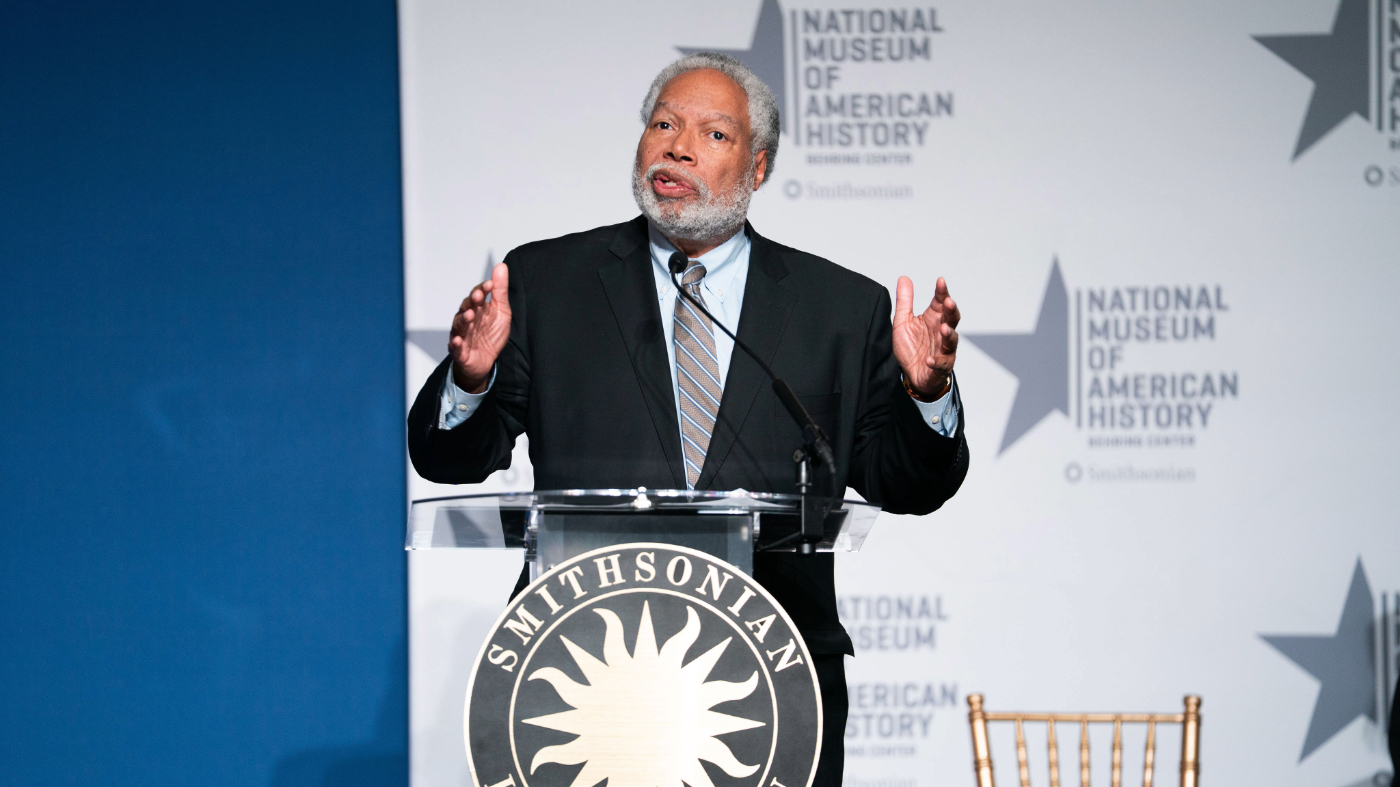
The Smithsonian Institution is a group of museums, education and research centers, created by Congress as a trust in 1846 “for the increase and diffusion of knowledge.” About 62 percent of its funding comes from the federal government. The Smithsonian is supposed to be independent of the executive branch. A bipartisan board of regents runs the show.
The Smithsonian’s first Black chieftain, Lonnie G. Bunch III 73, announced his retirement last week after more than seven years in the institution’s top job. Chief Justice John G. Roberts Jr., who serves as the Smithsonian’s chancellor, lauded Bunch for “excellence in the telling of our nation’s story,” stating that the Smithsonian had “benefited greatly from his wisdom, vision and leadership.”
The truth is Trump forced Bunch out of his job, heralding a tectonic shift in institutional purpose.
Over nearly 40 years in various roles at the Smithsonian, Bunch proved himself as an effective advocate and diplomat, and an incredible fundraiser. As the institution’s guiding spirit, he was also a forceful voice on race, particularly after the 2017 Charlottesville incident and George Floyd’s 2020 Minneapolis murder.
Bunch is a man of considerable soft-spoken warmth. I met him in New York last June when he was honored by the conservative Gilder Lehrman Institute of American History for his contributions to history, education and scholarship. He left an indelible impression. The son of two teachers, his love of history was palpable as he said eloquently, “there is nothing more powerful than a people, than a nation, steeped in its history. And there’s nothing more noble than honoring all our ancestors by remembering.”
What obviously led to Bunch’s abrupt resignation was Trump on his case. Out of some perverse desire for political cleansing of artistic expression, Trump waged a chilling campaign on the Smithsonian to purge what he called “improper ideology,” going so far as to threaten the institution’s federal funding and challenge its autonomy.
Bunch told the New York Times it was not the Trump freeze-out that spurred his departure, but admitted that at times, his role had been “stressful”.
“When you’re Black in America, you’ve got to figure out how to get through, right?” he said. “You’ve got to figure out how to build allies, when to stand firm, when to bang the table.”
Trump’s drive to gut the Smithsonian began in March 2025 with an executive order that accused the institution of spouting a “divisive” and “race centered” message. The White House subsequently identified exhibits it found objectionable, principally targeting discussions of race, slavery, immigration and transgender identity.
The sparks flew further in May 2025 when Trump said he had fired Kim Sajet, longtime director of the National Portrait Gallery, calling her highly partisan and a supporter of diversity, equity and inclusion. The Smithsonian’s regents pushed back. After a tense meeting, they publicly affirmed that personnel decisions belonged to Bunch, with oversight by the board. Sajet resigned four days later , saying her departure was the best way to serve the institution.
Pressure soon expanded beyond personnel. Trump went ballistic posting on social media in August 2025 that the institution “is OUT OF CONTROL,” and only discusses “how horrible our Country is, how bad Slavery was, and how unaccomplished the downtrodden have been.”
“We have the “HOTTEST” Country in the World, and we want people to talk about it, including in our Museums,” he added.
This spring, Bunch said he was proud of what the Smithsonian had achieved under his leadership despite the barrage of Trump attacks. “Nothing can take that away,” he said . “So, I’m trying to make sure I don’t let this moment steal my joy. ”
The White House next produced a July 4 report about the National Museum of American History that accused its director of “ radical activist ideology ” and charges the museum with undermining “faith in American institutions.” The board called for its 21 museums to review their content for partisanship or bias. But the administration began its own review of exhibitions, wall text and social media to assess “tone, historical framing and alignment with American ideals.”
After the report, the salvos continued. Museum director Anthea M. Hartig came under fire at two congressional hearings . Trump ordered posting of warning signs to convey his view that the museum did not accurately reflect American history. The signs never appeared.
Later, the White House escalated again, with a 162-page report accusing the National Museum of American History of portraying the American story as one of “regret, tragedy, and shame.”
Bunch, who generally avoided publicly confronting Trump, forcefully pushed back. He told Smithsonian employees the report was “not a fair characterization” of the museum and said its work remained driven by “scholarship, accuracy, and an uncompromising commitment to tell the fullness of America’s story.”
“America is not afraid of its own history,” Bunch said. “My job is always to help the Smithsonian tell complicated stories that really allow us to understand the fullness of the American experience.” The institution’s 180-year-old history is “a reservoir…for understanding of science, of history, of art.”
“For me, it is really building on the Smithsonian’s long history of saying, ‘No matter what, we will be independent.’”
Bunch plans to depart by the end of the year.
James D. Zirin is a former federal prosecutor in the Southern District of New York and a published legal analyst.
Topics in this story
Gathered from external sources. Rights to this text belong to whoever originally published it.