Democrats eye ways to rein in the power of future presidents
Confident in their odds of flipping the House, Democrats are eyeing ways to curb the powers of the presidency. The effort is not likely to result in any significant reforms while President Trump remains in office and controls the veto pen. But Democrats, who have long accused Trump of abusing his executive authority, want to…
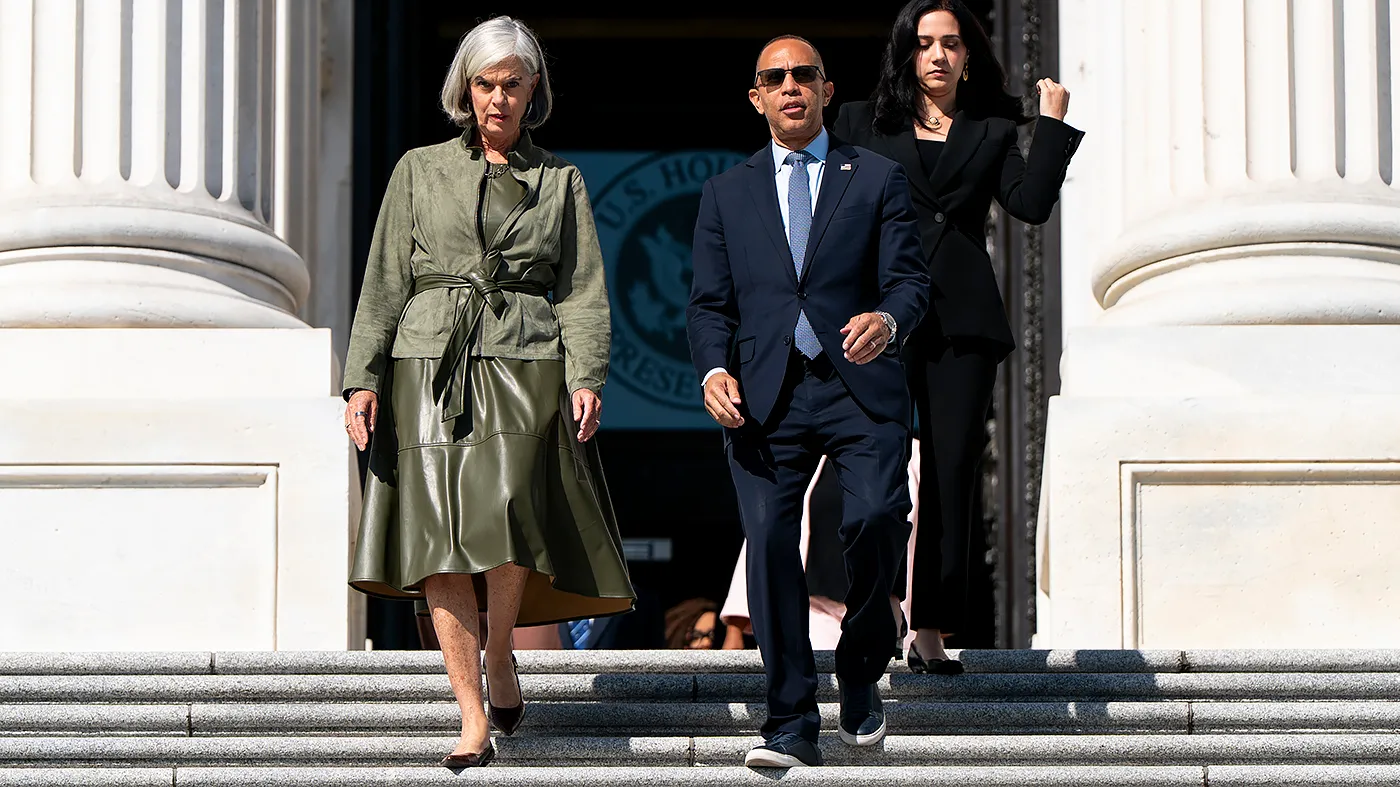
Confident in their odds of flipping the House, Democrats are eyeing ways to curb the powers of the presidency.
The effort is not likely to result in any significant reforms while President Trump remains in office and controls the veto pen. But Democrats, who have long accused Trump of abusing his executive authority, want to send the message that the country needs robust new guardrails to ensure future presidents don’t follow Trump’s playbook.
“This administration has revealed the holes in our checks and balances, and it’s very clear that power has swung way too far in the direction of the executive branch, and the abuses of norms point out that perhaps we need to codify some of these norms,” Rep. Suhas Subramanyam (D-Va.) said.
“It baffles me that the president continues to openly defy Congress as well, and our recourse involves hoping that the executive branch agencies like the DOH [Department of Justice] will enforce some of our powers when it’s very clear that those agencies are now simply loyalists to the president, so there’s generally a lot we need to do to patch some of the holes in our system,” he added.
The push is reminiscent of the effort at the end of Trump’s first term, when Democrats controlled the House gavels and were widely critical of his expansive view of presidential power — not least Trump’s efforts to use the office to overturn the results of his 2020 election defeat.
The violence of Jan. 6, 2021, led to Trump’s second impeachment and stirred a sense that his political career was over. Since voters reelected Trump to the White House in 2024, however, he has only been more aggressive in exerting executive powers , using the office to pardon people convicted of violent crimes , gut the federal workforce and prosecute perceived political enemies .
Those moves have infuriated Democrats and renewed the appetite within the party to move legislation designed to rein in the actions they deem to be abusive. Some see it as a Watergate moment, when Congress passed a number of laws designed to curb presidential power in the wake of former President Nixon’s ignominious fall.
“I think what we’ve learned with this Trump administration is they’ve pushed the envelope, gone beyond the envelope in so many ways … we should know that we need to significantly tighten that up and codify things in the law that we just had assumed, our previous Congresses had assumed, administrations wouldn’t try to do,” Rep. James Walkinshaw (D-Va.) said.
One reform Democrats are targeting is increasing transparency around presidential pardon power. The issue had drawn renewed scrutiny after Trump had issued sweeping pardons to hundreds of people charged with crimes tied to the Jan. 6 Capitol attack.
Former President Biden also pardoned his son Hunter Biden in 2024, which quickly infuriated Republicans. Hunter Biden had pleaded guilty to nine federal tax charges and was found guilty on three felony charges over his purchase and possession of a gun in 2018.
“We need to make sure that any criminal history of a pardon recipient is made very public, and we can prevent individuals who receive a presidential pardon from making a large contribution to the president or his party, as well as to the president’s family or friends,” Subramanyam said.
“Part of the issue is pardons are essentially for sale now. We have lobbyists going around trying to sell their pardon power by saying, ‘If you pay me X amount, I’ll go get you a pardon, and then just throw this much money into a campaign committee,’ or maybe, ‘Do this deal with the president’s family, and we can pardon you,’” Subramanyam said.
Subramanyam introduced legislation , dubbed the No Pardon Paydays Act, in September with Democratic Reps. Ted Lieu (Calif.) and Joe Neguse (Colo.) that would require the pardon attorney to “submit a review to Congress” of any pardon recipient’s criminal history. It would also bar such recipients from making high-end donations to political action committees tied to the president who issued the pardon.
Democrats are also keen to curb the president’s powers to fire federal workers. That purge was a major component of Trump’s first year back in office, when he formed the Department of Government Efficiency, led by Elon Musk, to slash the federal workforce in the name of cutting federal spending and weeding out “deep state” bureaucrats.
The firings have been challenged in the courts — in some cases successfully — but not before thousands of federal employees had already retired or moved into jobs outside of government. The issue resonates with particular intensity for Democrats in the Washington area, who represent a disproportionate number of federal workers and want to protect those constituents going forward.
Walkinshaw said he plans to reintroduce legislation, dubbed the Limit on Sweeping Executive Reorganization Act, in January. His bill requires “any proposed reorganization that cuts large numbers of federal employees, slashes budgets, or outsources core government functions to secure explicit approval from Congress,” according to a press release .
“Obviously, that’s in response to what we’ve seen with USAID [U.S. Agency for International Development] being dismantled, Department of Education being dismantled, CFPB [Consumer Financial Protection Bureau] being effectively shut down. So I think it would reestablish the balance between the president’s constitutional authority to manage the federal government as the executive with Congress’s power of the purse and right to establish and fund federal agencies,” Walkinshaw said.
Democrats are also hoping to reinforce Congress’s power of the purse and ensure that funds appropriated by lawmakers are spent as directed. This comes as the Trump administration has faced scrutiny over its efforts to withhold congressionally approved funding .
The Government Accountability Office, for instance, found that the Department of Health and Human Services withheld more than $78 million in research grant funding in fiscal 2025, violating the Impoundment Control Act.
Trump also redirected millions of dollars meant to go to the U.S. National Park Service to D.C.-based projects.
“The ads that he aired during the World Series and playoff games, paid for by the U.S. government. Where’s that money coming from?” Rep. Dave Min (D-Calif.) said. “Because it wasn’t from Congress.”
“He’s taking money from elsewhere and reappropriating, same as he did with … the White House ballroom, the reflecting pool, all these pet projects,” he added. “He’s taking money that we appropriated for certain purposes and using it for his own purposes. That’s totally illegal. The problem again is no one’s enforcing the law.”
Min, along with Democratic Reps. Eugene Vindman (Va.) and Sam Liccardo (Calif.), introduced a bill last year that would allow individuals, states and local jurisdictions to challenge the administration’s impoundment of funds.
Trump’s return to office has been accompanied by a massive increase in his personal wealth, from $2.4 billion in 2024 to roughly $6.6 billion today, according to Forbes .
The president says he’s benefited from a robust economy, particularly the surging stock market. But some of those gains have come from his meme coin and other cryptocurrency ventures controlled by his family, which has profited from the industry even as Trump has relaxed regulations governing it.
Democrats are vowing to tighten the screws. They’ve already introduced numerous bills to restrict presidents from using the office for personal gain, including legislation prohibiting the commander in chief from suing his administration to secure a financial settlement , as Trump did with the Internal Revenue Service earlier this year.
Democrats are also likely to move legislation barring federal policymakers from owning and trading individual stocks. House Republicans had passed one version of that bill this year, but it was opposed by most Democrats because Trump was exempt from the restrictions. The Democrats’ alternative bill would include presidents and vice presidents.
“We need to put the best legislation forward that protects the American people and reins in corruption and abuse, and put it on the president’s desk,” Subramanyam said. “If he decides he wants to veto a bill that will rein in corruption, then he’s on the record as doing that.”
“What I found is when we put good legislation on the president’s desk that has overwhelming support from the public, he often gets cornered into either signing it or just letting it go into law without signing it directly, instead of vetoing it,” he continued. “So we need to make sure that we put the best legislation on his desk and force him into a hard decision whether to veto popular legislation.”
Still, Rep. Mark Pocan (D-Wis.) said Democrats will focus on ensuring existing laws are properly enforced, noting that new legislation “doesn’t necessarily” have to be passed to rein in some of the administration’s actions.
“Most of [Trump’s] actions have been illegal, so the easiest way to address them isn’t trying to pass a new law to get through the House and the Senate and have signed by the guy that you’re going against,” Pocan said.
“It’s going to be going through the courts and enforcing current law,” he added. “And then secondly, we can try to introduce legislation to make people aware of things. But you know, do we think Donald Trump’s going to sign them into law? Less likely, so we’re going to be doing things the most effective way.”
Topics in this story
Gathered from external sources. Rights to this text belong to whoever originally published it.