'Defeated Goliath': Did faith help Democrats flip key midterm races?
Religion proved pivotal in the 2026 midterms as voters shifted toward Democrats in key races nationwide.
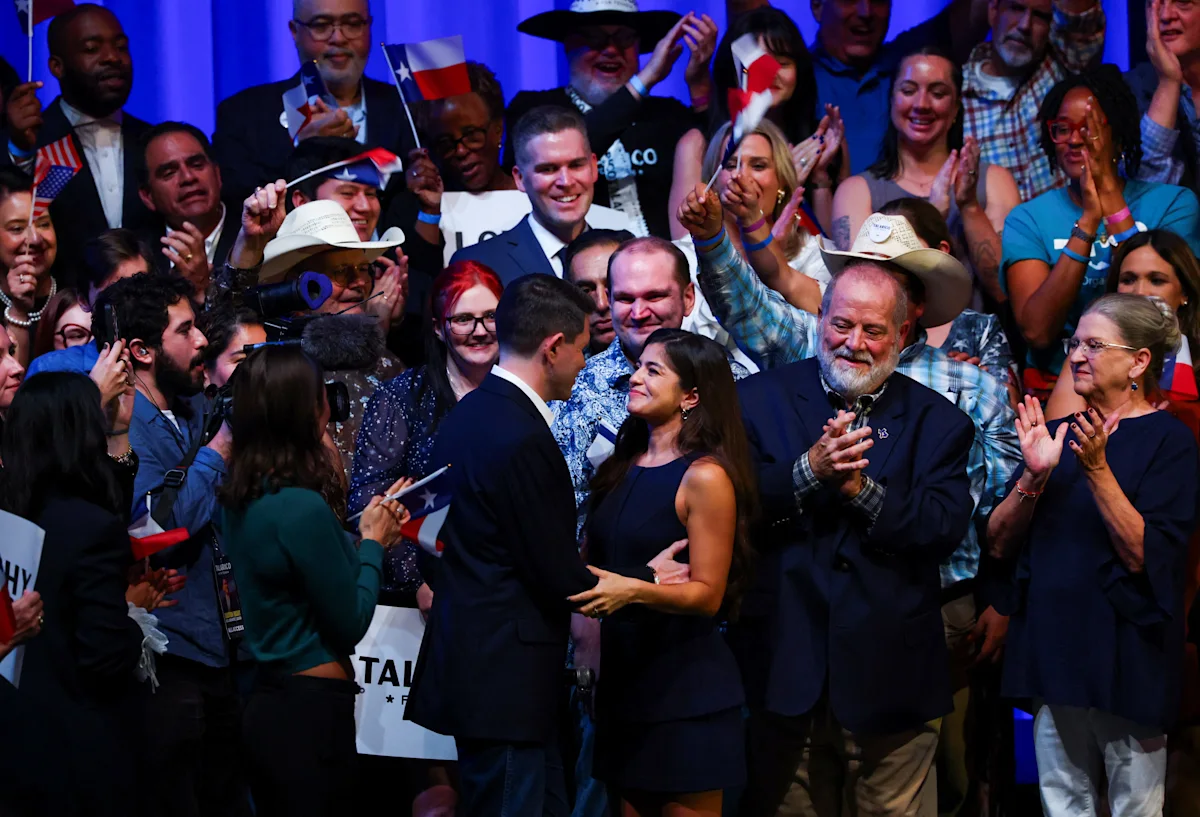
As Democrat James Talarico of Texas delivered his acceptance speech Tuesday in Austin after his decisive U.S. Senate race win over Republican Ken Paxton , a large placard in front of him featured the words, "Love Thy Neighbor."
That message seemed to resonate with voters nationwide, who vastly backed Democrats in a sweeping series of victories that some saw as a humanitarian rejection of federal policies such as overly aggressive immigration enforcement, unauthorized war, efforts to stamp out diversity and economic measures that have left many families struggling.
Religion proved pivotal at the ballot box nationwide, experts say, shaping voter views on key issues that turned previously red states blue. Faith was also brandished by candidates like Talarico to appeal to the electorate, even as conservatives blasted his progressive Christianity; in some cases, religion was weaponized by opponents, as in Islamophobic attacks and ad campaigns in Michigan and Texas.
Who is James Talarico? Meet the new Texas Senator
"You did see some rejection of Republicans, especially with Hispanic Catholics in Texas," said Michael Moreland, director of the Eleanor H. McCullen Center for Law, Religion and Public Policy at Villanova University in Pennsylvania. "Especially along the South Texas border, aspects of the administration's immigration enforcement alienated a lot of voters. President Trump in 2024 peeled off a lot of those voters, but he lost them Tuesday night."
Democrat megachurch pastor Adam Hamilton flipped a U.S. Senate seat in Kansas, while in Ohio, Democrat Amy Acton was elected both the state's first Jewish and female governor, her Judaism informing her progressive platform.
Meanwhile, a record seven Muslims were elected to Congress nationwide, including Democrat physician Abdul El-Sayed of Michigan, who became the nation's first Muslim U.S. senator. The number could rise to eight, depending on how California Democrat Aisha Wahab fares in her race for the state's 14 th Congressional district seat.
Talarico, a Presbyterian seminarian and grandson of a Baptist preacher, was among several candidates who charted rare territory for white Democrats by making religion a central part of his campaign, citing scripture and stressing his Biblical grounding.
Dubbed " Talafreako " by President Donald Trump , Talarico kicked off his acceptance speech by using the Bible story of David and Goliath as a metaphor for his race against Paxton and "billionaire megadonors" like Elon Musk , who spent nearly $230 million to support Paxton's campaign against Talarico.
"We went up against our own Goliath – the richest man in the world, the most powerful man in the world and the entire D.C. establishment," Talarico said. Comparing himself to the shepherd boy who wielded a slingshot to slay his mightier foe, he told the crowd: "You were my slingshot. The people of Texas were my slingshot. And tonight, we defeated Goliath."
Swing to Dems more pronounced among some faiths
Nationwide, exit polls conducted by NBC News revealed sizable shifts among several groups in the midterms compared to the 2024 election . Just under half of Catholics backed Republican candidates in the midterms , NBC found, compared to 59% who voted for Trump in 2024.
Jewish voters, meanwhile, swung the other way, NBC found: While 78% supported Democratic presidential candidate Kamala Harris in 2024, 68% voted for Democrats in this year's midterms.
"Donald Trump said voters should pretend he was on the ballot in the midterms, and Jewish Americans did just that," Halie Soifer, CEO of the Jewish Democratic Council of America, said in a statement. "Jewish voters are not a monolith, but they widely disapprove of Donald Trump. This, coupled with the strength of the Democratic candidates who flipped red seats blue, led to overwhelming support for Democrats among Jewish voters in this election."
Among religiously unaffiliated voters, NBC found, 27% supported Trump in 2024, compared to 20% who favored Republican candidates this fall.
Meanwhile, 86% of Muslims supported Democratic candidates in 2026 – the share wasn't tallied in 2024 – while slightly fewer Protestants or other Christians supported Republican candidates this year compared with 2024.
Exit polls conducted by the Council on American-Islamic Relations indicated the Iran war, the economy, rising Islamophobia and Israel's war in Gaza were foremost in their midterm voting choices. "Rising Islamophobia strengthened their motivation to vote," the council said in a statement . "They overwhelmingly backed Democrats, but many remain unconvinced that either party listens to their concerns."
During his race for Michigan's Senate seat, El-Sayed was dismissed as a " jihadist " by Trump and accused of links to terrorist groups, both without evidence. Others criticized him for what they saw as a failure to sufficiently denounce antisemitism.
Frank Lacopo, an assistant professor of history at Southeast Missouri State University in Cape Girardeau, said such comments backfired with voters concerned with other issues.
"It really seems like El-Sayed's more secular messaging on affordability was more effective," Lacopo said. "What he showed people in Michigan was a vision of an American who happens to be Muslim."
Did Catholics feel betrayed by Trump, GOP?
More than 50 million Catholics live in the U.S., with about 53% identifying as Republican, according to the Pew Research Center . Accounting for about a quarter of U.S. voters, they represent a broad political spectrum.
"It's hard to neatly categorize the Catholic vote, because it depends on other factors – whether they're white Catholics, Hispanic Catholics, young Catholics or more churchgoing ones," Moreland said.
Kelsey Reinhardt, president and CEO of Catholic Vote, a conservative political advocacy organization based in Carmel, Indiana, said Catholics' midterm swing toward Democrats reflected the broad concerns of the American electorate.
"In this election, Catholics are representative of the American population writ large," Reinhardt said. "They care about necessities. The socioeconomic stratosphere of Catholics is pretty ordinary."
In 2024, she said, Catholic voters largely believed Trump would be a greater arbiter of Catholic values. This time around, some may have felt betrayed by Trump's broken anti-war promises, while anti-abortion advocates likely felt the president hasn't done enough to advance their cause.
"The Catholic vote is soft Republican when there's a Republican who advances their ideals," Reinhardt said. "But they swing back when they feel their values are not being met. The Iran war was a factor too, but I'm not sure whether it's an issue because it was declared immoral by the pope or because people didn't want a forever war."
Catholic concerns loomed large at the state level, such as in Virginia , where local bishops led a furious campaign that unsuccessfully sought to mobilize voters to reject ballot measures expanding abortion rights and removing wordage in the state constitution strictly defining marriage as between a man and woman.
"That was one where Catholics were heroic in their efforts," Reinhardt said. "But 700,000 Catholics in Virginia won't overturn the majority there."
Lacopo thinks a factor that may have been a factor in Catholics' Democratic swing is the Catholic church's growing presence online.
"It's important not to underestimate the power that Catholic church messaging on social media has on Catholics," he said. "Even if they're not practicing Catholics. A lot of Americans began to subscribe to Vatican News when Leo became pope, and they identify with him as an American."
Pope Leo XIV's fluency in both English and Spanish allows him to reach a wide swath of voters, he said. Meanwhile, the pope's social media features a constant feed of direct quotes from the Chicago-born pontiff that help American followers see him as someone representing "a more accepting, open-arms version of Christianity."
In general, Lacopo feels Democrats fielded better quality candidates who appealed to voters, with faith part of the package in states like Texas and Kansas.
"Talarico was absolutely perfect as a candidate for Texas because he had a way of speaking that came from his background of training as a Presbyterian minister," Lacopo said. "He was able to use Christian messaging in a way that couldn't be countered by Republicans."
He noted Talarico's acceptance speech also focused on what many consider the central tenets of Christian teaching, the notion of loving God and one's neighbor – a message he thinks resonated not just with Texas Latinos anxious over immigration policy but with the kind of voters who plant signs reading "No Human Being is Illegal" in their front yards.
"I'm surprised and not surprised at the same time that Democrats have taken so long to latch on to that," Lacopo said. "Even if you're a secular voter and don't practice religion, you can relate to the second part of that message."
Topics in this story
Gathered from external sources. Rights to this text belong to whoever originally published it.