Trump told voters, 'Pretend I'm on the ballot.' They did.
President Donald Trump spent two months urging Americans to pretend he was on the ballot. On Tuesday, they did just that. Voters delivered a stunning rebuke...
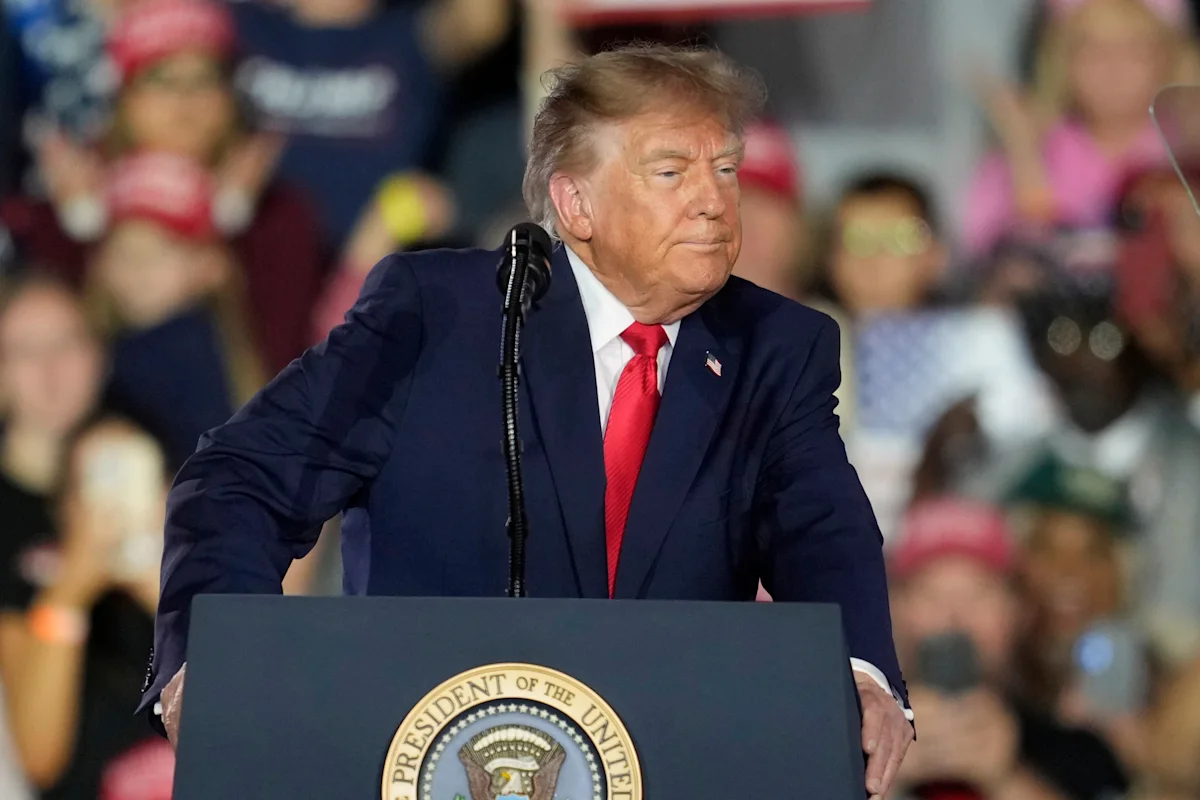
President Donald Trump spent two months urging Americans to pretend he was on the ballot. On Tuesday, they did just that.
Voters delivered a stunning rebuke to Trump's party that rivaled anything Republicans had suffered in 50 years, defeats on ruby-red turf that Trump won handily just two years ago, where he has dominated politics for nearly a decade and against candidates he had in some cases handpicked.
Not only did Democrats flip Senate and governor seats in red states, but at times by eye-popping margins.
"The message is very clear and very simple here. It was a complete repudiation of the party as defined by Donald Trump," said Mike Murphy, a Los Angeles-based Republican consultant who worked for candidates in the pre-Trump GOP, including Jeb Bush and John McCain.
"We have a little saying in show business, 'box office poison,' and that's what Donald Trump has become."
More than 41 times in recent weeks, The Washington Post found, Trump told voters to act this November as if the midterms were a referendum on him - a bold dare for a president whose approval ratings had reached historic lows as a growing number of Americans reported opposing his policies and his behavior in office.
In just two years since Trump's remarkable presidential victory campaign, in which he vowed to lower consumer prices, he has generated deep resentment of his policies. Voters blamed his decision to go to war against Iran and his tariff policies for raising prices, instead.
Trump left himself no hedge against being held responsible for voter unhappiness because he had molded the GOP into his image over the last decade. He demanded complete loyalty from Republicans and sought to cast out those who opposed him. Then he made himself the face of the party's midterm messaging, not only calling for his advisers to feature him in midterm television advertisements but demanding that the GOP host a first-of-its-kind midterm convention to tout his policies.
Trump "brought a Chernobyl-level disaster to the Republican Party," Murphy said, "the worst beating the party has taken since '74, after Watergate."
That year, Democrats gained 49 seats in the House and four in the Senate, on the heels of newly installed President Gerald Ford's pardon of Richard M. Nixon and amid a spike in gas prices and overall inflation.
So far this year, with some races left to be called, Democrats have flipped seven Senate seats and at least 25 in a House with far fewer competitive seats. They also flipped several governorships and state legislative chambers.
In Texas on Tuesday, James Talarico's double-digit lead over Trump's chosen Senate candidate Ken Paxton was particularly symbolic, taking place in a state long seen as the heartland of the conservative movement.
In North Carolina, a state Trump won three times, Democrat Roy Cooper not only flipped a Senate seat but was leading early Wednesday by nearly 20 percentage points. Democrats snatched Senate seats in other deeply red states, including South Carolina and Kansas.
In Pennsylvania, the swing state that sealed Trump's comeback victory, Democratic Gov. Josh Shapiro was winning reelection by 22 points with nearly all the vote counted.
For months, Trump's advisers insisted that he was the key to Republicans' being able to defy poor expectations in the midterms. Trump, they argued, could rally Republicans to the polls like no other and was responsible for assembling a coalition that included young and diverse voters that the GOP had never dreamed of winning.
Republican National Committee Chairman Joe Gruters dubbed the September GOP midterm convention in Dallas as "Trumpapalooza."
"Everything that the president has done regarding the economy, regarding the average American worker, I think will lead to votes in November," Gruters told Newsmax later that month.
"Midterm elections are about anger management and failed expectations. They drive the math of turnout," said Paul Shumaker, a Republican strategist in North Carolina, where Democrats flipped the seat held by retiring GOP Sen. Thom Tillis.
"Clearly, Trump failed to meet the economic expectations and also fueled the anger in doing so," he said.
By mid-October, Trump's standing with voters had fallen to levels not seen since Harry S. Truman. In a Washington Post-ABC News-Ipsos poll, the share of U.S. adults who approved of his overall job performance fell to 33 percent, with 66 percent disapproving; 52 percent said they disapproved strongly. Only 28 percent said they approved of his handling of the economy and 27 percent approved of his handling of "the situation with Iran."
An even smaller share, 28 percent, said they approved of Trump's MAGA movement. By more than 2 to 1, Americans said they felt Trump had "gone beyond his authority" as president.
The poll found that registered voters, 58 percent to 39 percent, said they would rather have a Democratic-led Congress acting as a check on Trump than a Republican one to support his agenda. That margin was roughly double what it had been a year earlier.
Unlike notable midterm defeats in 1994 and 2006, when President Bill Clinton and George W. Bush publicly accepted blame for their parties' defeats and committed to changing course in governing, Trump did no such thing.
"I don't like to consider it a defeat for me. I wasn't on the ballot," Trump told Fox News late Tuesday night, a message that was the opposite of what he spent weeks saying on the campaign trail.
"There was a mood in the air, I guess," he continued. "I shouldn't feel guilty because … no matter how good the president is, you lose" in the midterms.
Like Trump, White House advisers blamed the losses entirely on the Republican candidates, insisting that rather than being a rebuke of Trump, the outcome was merely a function of his not being on the ballot. The White House distributed a statement Tuesday night arguing Trump "did a better job promoting many of the candidates on the ballot than the candidates themselves."
"Bloodbath doesn't even begin to describe" voters' reaction to Republicans, said Barrett Marson, an Arizona-based GOP strategist. It was "a complete and total repudiation of one man and his policies," he said, by "an electorate that is upset with being told by President Trump that they are doing better than they are."
"It didn't work for Joe Biden, and Tuesday showed it was the absolute worst strategy Donald Trump could deploy."
The president had failed to explain some of his policies to the public, said Rep. Ralph Norman (R-South Carolina), who lost a primary to Sen. Darline Graham, the Trump-endorsed candidate who lost on Tuesday.
"The Iran war - he needs to explain," Norman said. "When I heard him say, 'The war will end when I say it's going to end,' I'm sorry, that's prideful."
Topics in this story
Gathered from external sources. Rights to this text belong to whoever originally published it.