Marsha Blackburn makes history as the first woman elected Tennessee governor
U.S. Sen. Marsha Blackburn is set to be the state’s 51st governor, making history as the first woman to hold that office.
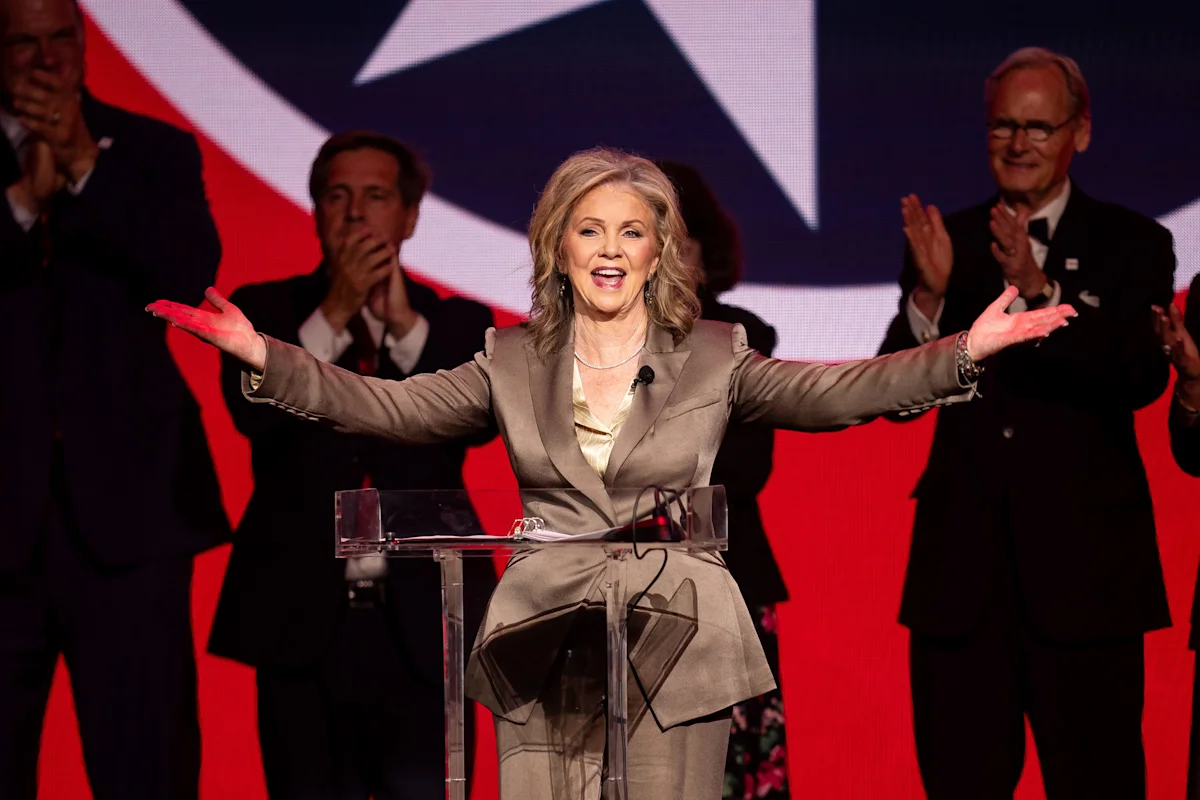
U.S. Sen. Marsha Blackburn made history Nov. 3, becoming the first woman elected to serve as Tennessee's governor, NBC News and Decision Desk HQ projected.
"My promise is pretty simple: Tennessee is going to be a state where hard work pays off, where families can put down roots, and where everyone has the opportunity to build a better future," she told supporters in Nashville.
Blackburn said her campaign's grassroots approach helped propel her to victory.
"We ran a different kind of campaign, focused on Tennesseans, not on the media's terms and not on any other candidate's terms," Blackburn said. "We ran a campaign that was for the people of Tennessee, and we have proved that this is how you win. You build a campaign from the grassroots, from the bottom up, not the top down."
Blackburn will succeed fellow Republican Gov. Bill Lee, who is term limited after eight years in office.
"Congratulations to Governor-Elect Marsha Blackburn on her victory," Lee said in a statement. "Tennesseans have placed their trust in a conservative leader who understands the importance of fiscal responsibility, keeping communities safe, and creating opportunities for every family to thrive.
"Conservative leadership has positioned Tennessee to lead the nation as a beacon of opportunity, security, and freedom, and Tennesseans have made clear that they want to see that momentum continue.
"I look forward to working with Governor-Elect Blackburn in the coming months to ensure a smooth transition and continued prosperity for our state."
Country music from the band The Austin Brothers filled the venue as Blackburn's supporters awaited election results . Some supporters wore red caps with "MARSHA" emblazoned on them.
"Tennessee has become a Christian conservative standard-bearer, and it is the place that people want to be," Blackburn said in her victory speech. "So our job is going to be to keep what we've got and to make the best better."
Democratic nominee Jerri Green conceded in the race in Chattanooga just after 10:30 p.m. CT.
Green took the stage with her family and campaign team as the crowd chanted "Jerri! Jerri! Jerri!" She told the crowd that while the votes were not yet completely counted, she did not see a path to victory.
"Tonight, I didn't win for you," Green said.
"I want you to know something, Tennessee: I'm not going anywhere – and I hope you aren't either," Green said, giving her youngest son, Wilder, a hug. "The future of this state is my flesh and blood, so I am not done fighting."
She thanked her team and her supporters for making the race "us as close as we've been in decades."
Unofficial results from the Tennessee Secretary of State show Blackburn captured about 45.5% of the vote, Green 42.9%. Fewer than 55,000 votes separated them.
No Tennessee governor has won with less than 50% of the vote in at least the last century. Gov. Phil Bredesen won with 50.65% in 2002, and Gov. Frank Clement won with 50.9% in 1962.
Independent candidate David Hatley conceded the governor's race shortly after 9 p.m. ET at his event in Johnson City. While he earned less than 10% of the vote, Hatley vastly overperformed independent candidates, who in recent decades have struggled to break 2% of the vote.
Hatley initially meant to run as a Republican. But because of a federal bank fraud charge he pleaded guilty to in 1998, he had not voted in enough recent Republican primary elections to qualify for the Republican ballot.
Instead, he ran as an independent, pouring $12 million of his personal fortune into his bid.
Hatley aligned with Republicans on issues like book bans , tax cuts and abortion, but criticized the GOP establishment on the low ranking in education funding.
"We learned a lot on this journey," he said. "We still broke a lot of records in Tennessee. We met a lot of people. We had the most money ever spent against an independent, that's a record, and we had the most votes for an independent ever."
No Democrat has won a statewide race in Tennessee since 2008 and Green came closer than any Democratic candidate since then in winning the governor's seat.
Early returns showed Blackburn ahead of Green, but Green pulled ahead several times as returns from Democratic strongholds of Memphis and Nashville came in — moments that ignited electric energy from her supporters in Chattanooga.
"It's been a very long time since there's been a governor race this close in this state," said former Tennessee Democratic Party Chair Hendrell Remus. "It's been a very long time since the governor's race hadn't been called this late on election night in a long time."
Remus thanked Green for "giving us something that no election result can ever take away: hope."
Green won Hamilton County, and easily surpassed the total statewide vote count won by former Nashville Mayor Karl Dean the last time Tennesseans elected a first-term governor in 2018. Surging independent candidate David Hatley lagged well behind both Blackburn and Green, but drew support from Blackburn.
"For years they told us that Tennessee wasn't worth the investment, that we're too red, that we're too much. It's too much hard work. That we don't vote enough. That there's not enough Democrats for that," Tennessee Democratic Party Chair Rachel Campbell told the crowd.
"Every Democrat who wins in Tennessee tonight will have been bolstered by her efforts," Campbell said of Green.
Inside the Blackburn and Green campaigns for Tennessee governor
Blackburn has made social issues like "transgender ideology" and opposition to communism central to her campaign. Her first TV ad showed her crushing fortune cookies and pledging to "crack down on China." Late in the race, she held a "Hold the Line" rally with retired Boston Celtics center Enes Kanter Freedom, who says he publicly identifies as a woman and declared himself eligible for the 2027 WNBA draft. Days before the election, Blackburn pledged on social media to "protect Tennessee from Sharia law and the spread of Islamization."
Following the failed execution attempt of Christa Pike, Blackburn said the state should bring back the electric chair. She pitched a "bell to bell, no cell" policy in public schools, and proposed a "Tennessee DOGE" to reduce state government bureaucracy , but did not identify what state departments or programs she would eliminate.
Despite long odds at the offset, Green crisscrossed the state meeting with voters and activating a Democratic base energized by a closer-than-ever special election in U.S. House District 7 and dissatisfaction with Republican incumbents. She held more than 210 public campaign stops.
Vivian Jones covers state government and politics for The Tennessean. Reach her at vjones@tennessean.com .
Topics in this story
Gathered from external sources. Rights to this text belong to whoever originally published it.