Smith fields GOP insults, questions on lawmaker subpoenas at fiery Senate hearing: 5 takeaways
Former special counsel Jack Smith fielded insults from Republicans and questions about his prosecutorial decisions as he sat before lawmakers on the Senate Judiciary Committee on Tuesday. Chair Chuck Grassley (R-Iowa) has been a leading voice in scrutinizing Smith’s twin probes into President Trump, obtaining and releasing reams of documents about the investigations while criticizing…
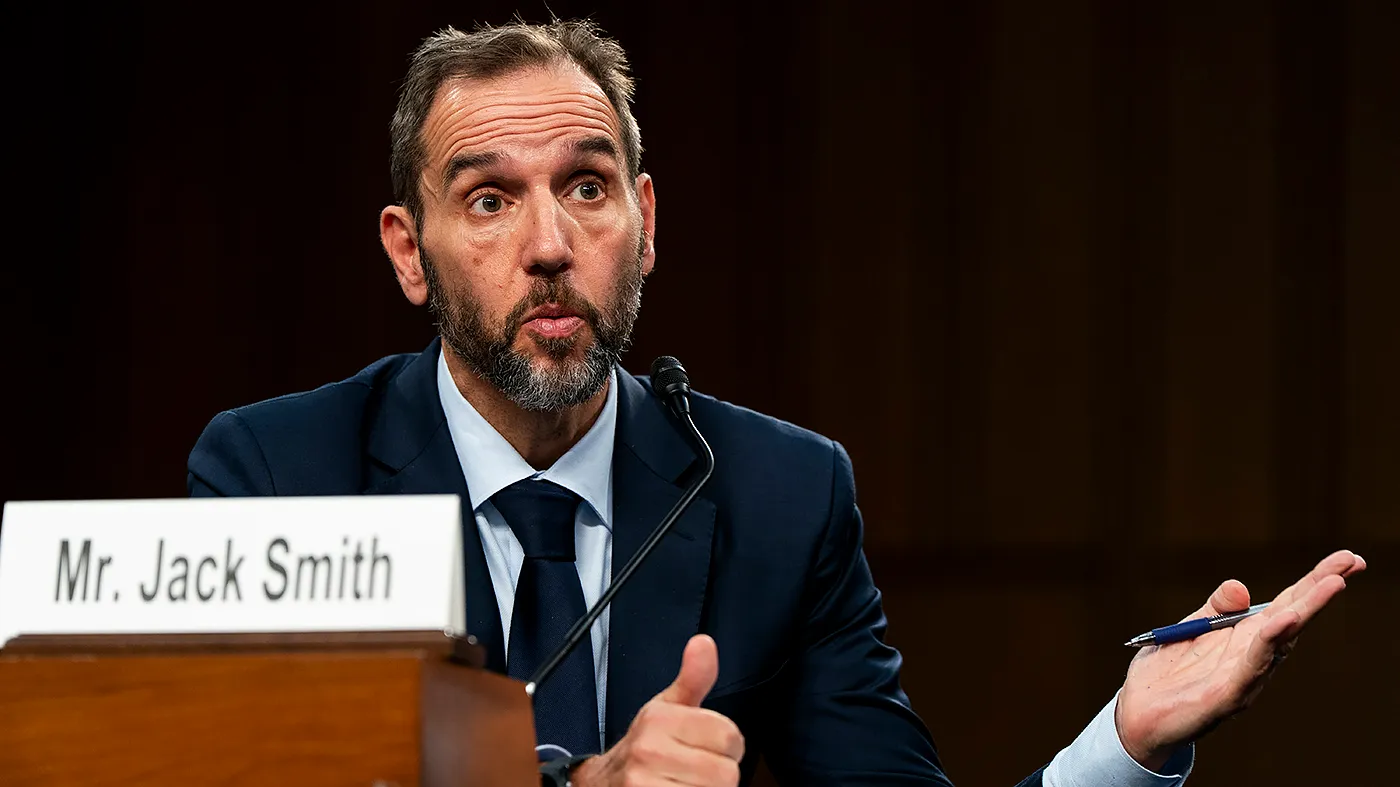
Former special counsel Jack Smith fielded insults from Republicans and questions about his prosecutorial decisions as he sat before lawmakers on the Senate Judiciary Committee on Tuesday.
Chair Chuck Grassley (R-Iowa) has been a leading voice in scrutinizing Smith’s twin probes into President Trump, obtaining and releasing reams of documents about the investigations while criticizing his decision to subpoena some lawmakers’ call logs.
Smith defended his work, saying Trump faced criminal charges related to the Mar-a-Lago classified documents case and the case tied to the president’s role in the Jan. 6, 2021, attack on the U.S. Capitol as a result of his own illegal conduct. He added that he would have brought charges against any president who committed such crimes.
Sen. Cory Booker (D-N.J.), meanwhile, accused the GOP of “gaslighting” the American public about how damaging the Jan. 6 attack was to democracy.
But Smith largely served as a punching bag for the committee’s Republicans.
“You may think you’re a hero in this story, but let me tell you something. You’re the villain. You’ve done so much damage,” Sen. Eric Schmitt (R-Mo.) told Smith.
Sen. Mike Lee (R-Utah) said Smith’s probe “makes what Richard Nixon did in Watergate look like a Sunday picnic.” Here are five takeaways from Tuesday’s fiery Senate hearing.
Smith defends accessing so-called toll records
Smith obtained the call logs of a dozen Republican senators as part of his investigation into Jan. 6 — and Tuesday was their first chance to press him on the supboenas.
Smith described toll records, which are essentially call logs, as “noncontent records” that were important for mapping out communication among different parties.
“Those records corroborated evidence that we had that the president, President Donald Trump, and his co-conspirators were seeking to exploit the violence on Jan. 6 in furtherance of their criminal scheme,” Smith said.
“It was an important part of our investigation, and it was centrally relevant to the issue of criminal intent to seek to further delay the proceedings in violation of the law, given what had happened that afternoon at Jan. 6, in my view, added to the powerful evidence we had of Donald Trump’s guilt, and the participation of his co-conspirators in his criminal scheme at his behest.”
But Republicans on the panel accused Smith of violating the Speech or Debate Clause, as well as their privacy, saying he should not have sought a gag order barring cellphone companies from disclosing the move.
Smith said he consulted Department of Justice (DOJ) experts on the constitutional limitations and got approval to pursue the records.
“You subpoenaed records associated with my phones, both personal and office, and you sought and obtained a court order to prevent me from knowing about it. For years, you were able to ask your questions in secret without me in the room. Today, the Senate gets to ask questions,” Sen. Ted Cruz (R-Texas) said.
“You willingly were conscripted as a foot soldier for the DNC [Democratic National Committee] and you know what you also did. You reelected President Donald Trump because the American people were disgusted at your willingness to abuse power in partisan ends.”
Smith said the records showed Trump’s efforts to coordinate with lawmakers to delay certification as well as those who contacted the White House in alarm.
“We gained evidence [of people] reaching out to the White House, asking, ‘Please help us. Please stop what’s happening. Please have your supporters stop attacking the Capitol,’” Smith said.
The GOP’s subpoena outrage wasn’t just limited to collection of call records but numerous compulsory demands for Republican-affiliated groups.
“In all, you issued 197 subpoenas to 34 individuals at least, and 163 businesses, and you sought records on at least 430 Republican individuals and entities,” Cruz said. “If you look at the list, there is one thing that is consistent. Every name on it is a Republican.”
Smith said the team had to follow the money to map out the financial backing for a number of groups that sponsored and organized events surrounding election challenges as well as Trump’s Jan. 6, 2021, speech on the Ellipse.
“I can tell you why we issued subpoenas, and it was to conduct a criminal investigation of one of the most serious crimes that’s ever happened in our nation’s history. I had a duty to collect facts,” Smith said.
“We had to conduct an investigation about whether any person or entity violated the law with respect to the attempt to block the peaceful transfer of power, to make that decision.”
Grassley, who first revealed the subpoenas, was not convinced.
“No matter what you say, there is no legitimate basis for what you did, especially since your staff killed an investigation into the [Hillary] Clinton campaign. Donations to Republican groups wasn’t necessary for your investigation, which is proved out by the fact that it was not mentioned in your public report,” the lawmaker said.
Smith in his opening statement said the blame for criminal charges lies at Trump’s feet and was not motivated by politics.
“The charges against President Trump were the result of the evidence. Grand juries in two separate districts reached this conclusion based on his actions, as alleged in the indictments they returned,” Smith said in his opening statements.
“Our investigation developed proof beyond a reasonable doubt that President Trump engaged in criminal activity. If asked whether to prosecute a former president based on the same facts today, I would do so regardless of whether that president was a Republican or a Democrat.”
The former prosecutor also stood up for his staff, most of whom were fired from the Trump-led DOJ given their association with the investigation.
“These are people who stood sentry for us, experts in national security, experts in corruption investigations, who were simply fired because they worked on the wrong case — that has never happened in my career. I have never seen anything remotely like it in any Republican or Democratic administration,” Smith said.
When asked later by Cruz whether he had any regrets, Smith retorted, “I regret that the people I worked with have been unfairly fired and vilified.”
Confusion over team names unwinds ‘false narrative’
One of the most widely discussed moments of the hearing came as Schmitt pressed Smith about whether he attended an Atlanta Hawks basketball game in February 2024.
Smith was clearly confused by the question , and then Schmitt provided more context, noting that the basketball game would have fallen the day after Fulton County District Attorney Fani Willis (D) in Georgia acknowledged dating one of her staffers — a drama-filled development in the state-level case against Trump.
Smith later volunteered he had attended an Iowa Hawkeyes game in Maryland, saying he had wanted to see Caitlin Clark play.
Sen. Amy Klobuchar (D-Minn.), who was next in line for questioning, posited that Schmitt may have confused the Atlanta Hawks with the Iowa Hawkeyes.
“Could it then be that University of Iowa is the Hawkeyes? … That might be the confusion over the names of the team,” she said.
The question led to heated moments between Schmitt and the committee’s Democrats — who noted that his staff swiftly swept away text messages printed on a poster that appeared to reference stadium seat numbers.
Schmitt later relented and placed the poster up for Smith’s response.
It’s unclear what Schmitt’s goal was in seeking out whether Smith had ever been to Atlanta.
During his questioning, Smith said he never met Willis.
Schmitt fumed at Klobuchar for igniting an “open session” about his questions and accused her of “trying to rehabilitate the witness.”
“I presented him with text messages about him wanting to meet with people that could have obviously been related to the prosecution that was coordinated with his office in Atlanta,” Schmitt said.
Glimmers of how Smith would have presented his case
Smith said he planned to call a number of GOP witnesses had the case further progressed in court, telling Sen. Darlene Graham (R-S.C.) he perhaps would have called her brother to testify.
The comment came as Graham questioned why Smith sought phone records of her late brother, former Sen. Lindsey Graham (R-S.C.).
“I believe your brother was a patriotic public servant. He was not a target of our investigation, and in fact, he likely would have been a witness in our case. Your brother investigated the claims that Donald Trump was making. He found them to be false,” Smith said, before Darlene Graham cut short his kudos.
Smith also said he regretted not offering more public statements while the case was ongoing, agreeing with Sen. Thom Tillis (R-N.C.) that the DOJ has to be open with the public to build support for the legitimacy of its work.
“One of the things that I was taught as a prosecutor through my career is you only do your talking in the courtroom, and that you don’t talk on the courthouse steps,” he said in response to a question from Tillis.
“One of the things that I learned from this experience is that if you stick to that and that alone, people can unfairly malign your team, and unfairly malign you and your case in a way, and you really can’t respond because you don’t want to interfere with someone’s right to a fair trial.”
Topics in this story
Gathered from external sources. Rights to this text belong to whoever originally published it.