Trump, GOP leaders look to reclaim control over AI narrative
President Trump and Republicans are seeking to reclaim control of the narrative surrounding AI as Democrats use the issue to go on offense ahead of the midterms. Numerous tech leaders joined Trump and Speaker Mike Johnson (R-La.) at a Tuesday luncheon on “superintelligence” — the president’s new term for AI — where they signed onto…
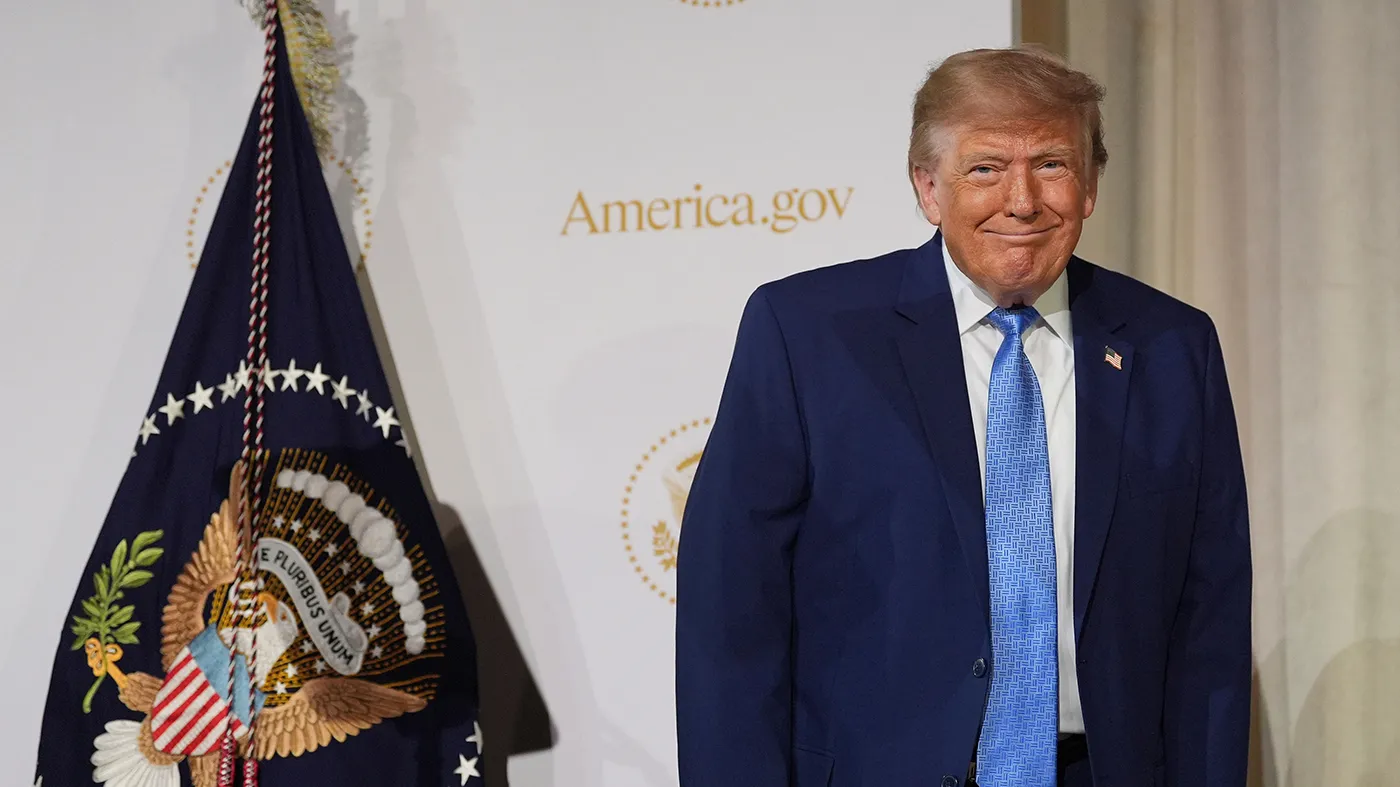
President Trump and Republicans are seeking to reclaim control of the narrative surrounding AI as Democrats use the issue to go on offense ahead of the midterms.
Numerous tech leaders joined Trump and Speaker Mike Johnson (R-La.) at a Tuesday luncheon on “superintelligence” — the president’s new term for AI — where they signed onto an accord to build controls and audits into their AI development.
Additionally, Senate Republicans are pushing to pass Ohio Republican Sen. Jon Husted’s Ratepayer Protection Act, which aims to shield taxpayers from additional costs brought on by data centers, which garner widespread disapproval.
The efforts come as polls across the board show Republicans trailing just over a month out from the midterms.
“Early voting has already begun” in some parts of the country, noted Andrew Lokay, a senior research analyst at Beacon Policy Advisors.
“With growing concern about AI and data centers on the part of voters, I think this meeting is a way for the Trump administration to show that the president is responding to the issue,” he added.
Trump has pushed for a light-touch approach to regulating AI throughout his second term. But this stance has put him and the rest of the Republican Party in a tight spot, as AI and data centers are becoming ever more unpopular.
Americans are increasingly wary of the push to rapidly develop AI amid concerns about both the technology itself and the massive buildout of infrastructure to support its computing needs.
In a CNN poll released last week, 75 percent of Americans reported some level of “fear and concern” about the development of AI. Another 87 percent said they were very or somewhat concerned about the growing number of data centers being constructed to support AI.
A series of recent incidents in which AI agents went rogue, hacking into other companies or meddling with government websites, has pushed safety concerns about the technology to the forefront in Washington.
And after several AI researchers warned earlier this month about potentially catastrophic risks to humanity, prominent tech leaders are now calling for a slowdown and urging the federal government to establish guardrails.
But Trump has continued to argue for a hands-off approach from the government, dismissing safety concerns as a “hoax” and instead warning that Washington must remain dominant in the AI race against China.
“We can’t stifle it, and we’re leading by a lot. President Xi [Jinping] knows that,” Trump said in Washington on Tuesday, speaking at the launch of America.gov , the new federal government chatbot.
“Somebody said let’s do a joint venture. Let’s work together with China,” he continued. “If we do that, we’re going to be giving a lot of secrets that we have that they would just want to have.”
“Frankly, there is nobody in this place. It’s all between us and China,” he said, noting that he and Xi did not discuss AI “that much” during his state visit to the U.S. last week.
Johnson also threw cold water on calls in the House to fast-track AI legislation, warning in mid-September that “if Congress just races in and does some sort of emergency session to try to regulate AI, we will lose the race to China.”
However, Trump notably signaled a detente with Anthropic CEO Dario Amodei over the weekend. One of the loudest voices in the industry calling to slow development, Amodei has frequently found himself at odds with the administration. The president had a late dinner at the White House on Sunday with the Anthropic CEO after returning from a day trip to the Chicago area.
Amodei was among numerous tech leaders at the White House on Tuesday, along with OpenAI president Greg Brockman, Nvidia CEO Jensen Huang, Google CEO Sundar Pichai, Meta CEO Mark Zuckerberg and xAI CEO Elon Musk.
“Despite some of the public comments from the president and others in leadership, I think that folks like Speaker Johnson, Leader [John] Thune and others in leadership positions in Congress and the administration are starting to see these risks are very real,” said Brendan Steinhauser, CEO of The Alliance for Secure AI.
“I actually feel pretty optimistic about this,” he added. “I think this is what’s been missing, is getting, especially Dario in the White House … I think it’s incredibly important for them to have the ability to have an open dialogue on this.”
The White House released a seating chart of the luncheon showing Trump flanked by Huang and Musk. Amodei, on the other hand, was six seats away from the president and out of his line of sight.
Following the luncheon, Trump and Johnson announced that the tech leaders had endorsed a series of voluntary commitments, which the president described as “morally binding.”
Zuckerberg explained that the companies are committing to building “robust” internal controls and detection capabilities, coupled with “multiple layers of auditing.”
The efforts to meet with AI industry leaders come as Republicans struggle to defend their majorities in the House and the Senate.
Husted, one of the most vulnerable Senate Republicans facing reelection in November, has faced a barrage of attacks over his record on data centers and is now trying to turn the issue around.
Polls inside and outside of Ohio show that a majority of voters hold unfavorable views of data centers.
A recent poll from Bowling Green State University found that 70 percent of likely Ohio voters said data centers were bad for the environment, while 69 percent said they were bad for energy costs. Sixty-five percent said they were bad for people’s quality of life.
“It’s no secret that data centers are unpopular. And so I think the Republican Party is looking for a way to show that it [hears] the concerns of people and that it’s doing something about this,” Steinhauser said.
The Ratepayer Protection Act, which Husted is spearheading in the Senate, is a codification of Trump’s Ratepayer Protection Pledge, which sought to ensure that electricity and infrastructure costs from data centers would be footed by tech companies. The bill would require states and some utilities to consider a standard under which data centers would pay for additional costs caused by their large power demand but would not mandate their adoption.
While the legislation initially received bipartisan support in the House, it has become a point of contention between Republicans and Democrats in the Senate.
Senate Minority Leader Chuck Schumer (D-N.Y.) accused Republicans of trying to win “an ineffectual participation trophy” on the matter, as well as “trying to score cheap political points with hollow proposals.”
One Republican strategist was skeptical Husted’s bill would give him a big enough boost in Ohio, let alone pass the Senate.
“He’s going to say I introduced a bill in the United States Senate, and Democrats blocked it. That’s the dog ate my homework excuse,” the strategist said.
“Voters don’t decide elections based on bills that have been introduced,” they said.
Trump defended his support for data centers during an unusual appearance on the White House North Lawn with tech leaders on Tuesday, accusing Democrats of creating a “false narrative” about the facilities.
“All I could tell you is that these big, powerful, very rich, very smart companies are going to be making massive contributions to communities,” the president said.
Trump also defended data centers from the perspective of the AI arms race with China.
“Elon and I sat with President XI the other day, and he will take every data center that we don’t want,” the president warned.
Topics in this story
Gathered from external sources. Rights to this text belong to whoever originally published it.