Merit-based and colorblind: The Pentagon’s cover story for purging Black officers
A veteran and academic argues that recent military leadership decisions under the Trump administration are dismantling racial equality in the armed forces by dismissing the merits of promoted Black officers.
I entered U.S. military service in 1964, right as Vietnam was escalating. Despite the Civil Rights Movement, roughly 31 percent of the hundreds of thousands mostly male recruits sent to the Marines and Army in 1965 were Black — this when Black men were just 10.8 percent of the U.S. male population.
Once in Vietnam, men like me, Black men, were killed in combat during that period at a staggering 25 percent rate — nearly twice what our population share would predict . I witnessed this firsthand as an Airman, one of the few Blacks in my unit. I was deployed to Da Nang where I worked in communications supporting Marine units, filled with Black faces that were conspicuously absent in my own Air Force Specialty Code (AFSC) classification.
That is not an accident of demographics. It’s because Black men who were facing the draft did not have access to the pathways to enlist in the National Guard, as many of my white classmates did. Instead, we were sent to the front lines during one of the bloodiest wars America has ever engaged.
Thanks to courageous military leaders who spoke out, the military eventually changed and became one where Black men and women had greater equality, access to opportunities, and could meaningfully advance their careers. Still, I carry that history with me, and it makes what I am watching now deeply disturbing.
Today, Black men in the military are once again experiencing a unique, racist danger. This time around, it’s the denial of advancement and promotion despite having served the U.S. military honorably, some for more than two decades. Such treatment is racist at its core, assuming that any promotion Black men earned before this administration took office must have been a function of DEI rather than demonstrated competence.
Upward mobility in the military is supposed to be straightforward, built on time-in-grade. At the junior levels, that might be two or three years each advancement; with no demerits during each interval, you advance once the time has elapsed. Higher levels work the same way, just with longer time intervals.
For officers, there are supposed to be oversight boards that review promotion recommendations before they move up the chain of command to the final signatories with approval authority. No single individual is supposed to hold the power to make or break a promotion.
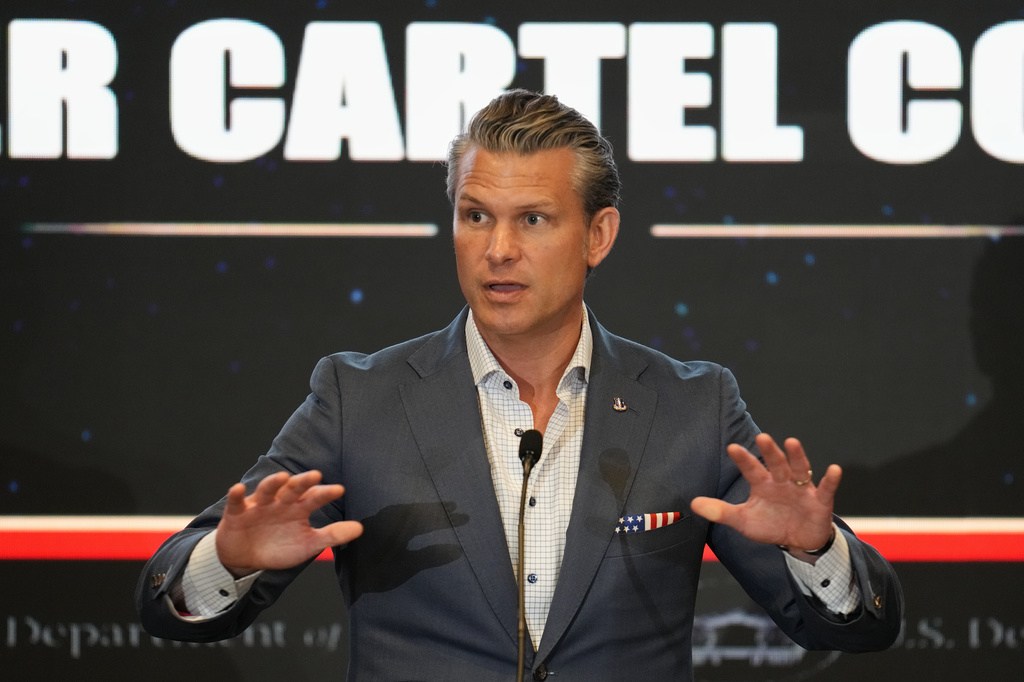
While Defense Secretary Pete Hegseth has declared that race and sex will no longer factor into these promotions, or military academy admissions — a “ colorblind and merit-based ” standard, in his words — it’s clear that they actually do, though not in the direction about which his comments indicated concern.
He fired Gen. Charles Q. Brown Jr. , only the second Black chairman of the Joint Chiefs of Staff in history, after more than 41 years of service. He forced out Col. Dave Butler , removing him from the brigadier general promotion list. And perhaps the clearest case of all is that of Rear Adm. Stephen D. Barnett — a career officer denied a promotion to vice admiral that, by every account of his record, he had earned. Meanwhile, a recently-circulated promotion list of roughly three dozen officers, overwhelmingly white men, advanced without comparable scrutiny .
What’s more, Hegseth has taken it upon himself to inflict pain on Black men and women who have earned every reward their service record entitles them to. Consider his public remarks about Gen. Lloyd Austin — a 40-year veteran, West Point graduate, secretary of Defense from 2021-2025, four-star general, and the 12th commander of U.S. Central Command, where he led military operations across the Middle East and Central and South Asia.
Hegseth’s dismissal — “I don’t know what Lloyd Austin did for four years” — is more than an insult. It is a familiar erasure, the same impulse that has long denied Black achievement its due, now voiced from the highest civilian office in the Pentagon.
But in the face of these insults and dismissals, there’s silence. There has been no public outcry among the many colonels and generals who surely know better. No one inside the military services has stood up publicly, on the record, to speak on behalf of their Black fellow service members. A few officers have spoken to reporters, but only anonymously. Of course, it’s well known what the Trump administration does to those who “speak up,” but if these actions go unchallenged, they will only continue.
Sadly, these cases do more than just damage the reputation and career trajectories of esteemed Black people who chose military service. They reverse the aspirational goal of President Truman’s 1948 Executive Order 9981 that desegregated the U.S. Military. That order offered a pathway to the middle class for millions of Black Americans and their families. A pathway that opened up access to achieve the American Dream despite the persistence of Jim Crow-style segregation that remained in both public and private institutions.
My military service in Vietnam earned me GI Bill benefits that paid for my college and graduate education and helped me buy my first home. The professional-class stability those benefits made possible went on to shape the upwardly mobile trajectory of the children I raised in that home.
Military service never guaranteed upward mobility for Black Americans — but the wholesale relabeling of decades of earned advancement as “favoritism” rather than merit is not mere neglect of that pathway. It is its deliberate dismantling, and Black families will pay the cost for generations to come.
Earl Smith, Ph.D., is professor and senior research scientist at the Center for the Study and Prevention of Gender-Based Violence, University of Delaware, and author of “Race, Sport and the American Dream.” He is the co-author with Dr. Angela J. Hattery of “Way Down in the Hole: Race, Intimacy and the Reproduction of Racial Ideologies in Solitary Confinement,” published in 2023 by Rutgers University Press.
Topics in this story
Gathered from external sources. Rights to this text belong to whoever originally published it.