Winners and losers of the 2026 midterms
Democrats pulled off the blue wave of their dreams on Tuesday, winning the House and Senate majorities in a stunning cap to the most expensive midterm election cycle on record. The midterm results are a massive victory for the party, which suffered bruising losses in the last presidential election. It gives Democrats a real chance of…
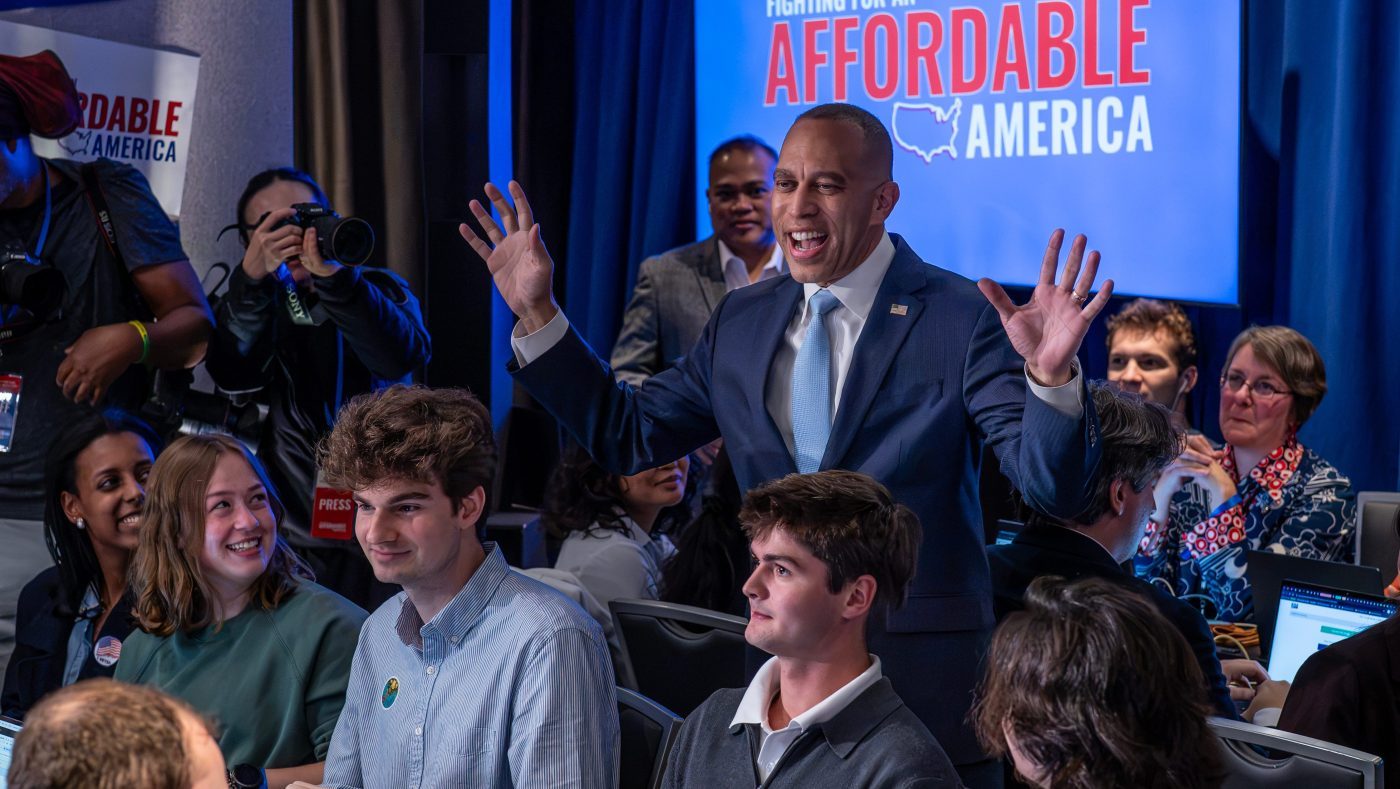
Democrats pulled off the blue wave of their dreams on Tuesday, winning the House and Senate majorities in a stunning cap to the most expensive midterm election cycle on record.
The midterm results are a massive victory for the party, which suffered bruising losses in the last presidential election. It gives Democrats a real chance of curbing President Trump’s power through the end of his second term.
It was a bleak night for Republicans, from Ohio, where GOP gubernatorial candidate Vivek Ramaswamy fell to Democrat Amy Acton after a controversial last-ditch ad, to Maine, where five-term incumbent Sen. Susan Collins was toppled by Democrat Troy Jackson.
Results were still rolling in as of 3 a.m. ET, but Decision Desk HQ (DDHQ) expected Democrats to win 258 seats in the House and 55 in the Senate — plus a string of flips in governor’s mansions across the country.
Here are the biggest losers and winners of the midterms:
President Trump received a loud repudiation from voters on Tuesday, even though he wasn’t on the ballot.
His party lost its majorities in both chambers of Congress, and by wider-than-expected margins.
It leaves Trump tangling with empowered Democrats for the next two years and will make it tougher for the president to confirm judges and other appointees. Legislative victories will be impossible without working with Democrats.
The last time Trump was president and Democrats held congressional majorities, the president was impeached twice. That’s a real possibility going forward, though one that would hold dangers for both sides.
Presidents typically lose House and Senate seats in a midterm election, but the GOP losses in this case were severe.
Trump’s decisions to mount a war against Iran, which has raised the price of gas and fertilizer, and to engage in a tariff war with Canada both faced blowback. His backing of controversial candidates, most notably Texas state Attorney General Ken Paxton, also backfired.
Trump saw midterm losses coming and pushed redistricting plans across the country in an attempt to protect his congressional majorities.
That ended up backfiring in red states such as Texas and Florida, and it looked likely to leave Democrats with majorities of a size similar to those enjoyed by former President Obama in 2009.
Republicans in the Lone Star State saw one of their worst election cycles, as they lost Sen. John Cornyn’s (R-Texas) seat to Democrat James Talarico and Texas Gov. Greg Abbott (R) conceded his reelection to Democrat Gina Hinojosa.
The two Democratic victories mark the party’s first statewide wins in Texas in decades.
Tuesday’s results mark the end of Republicans’ statewide dominance in Texas, even after the party redistricted its congressional lines to get a boost in House races.
The blue wave also looked poised to flood through the state Legislature and flip long-red state roles, including the Texas comptroller and Texas railroad commissioner .
Elon Musk also suffered a blow after spending heavily across the country, especially in Texas. On the one hand, Musk’s spending was critical for Republicans as their fundraising advantage served as one bright spot for the party in what was otherwise a challenging midterm environment.
Yet, those dollars were not enough to withstand the seismic political shifts in Texas, which has not elected a Democratic governor since 1990 or a Democratic senator since 1988.
Despite a Trump endorsement and multiple visits from the president and Vice President Vance, Ramaswamy lost the governor’s race in Ohio after running a controversial ad in the campaign’s closing days.
The billionaire biotech entrepreneur funneled millions of his own funds into the 2026 governor’s race, but he came up short against Acton, who’s now on track to become the first Democrat to hold the office in roughly 15 years.
Ramaswamy, who was also backed by term-limited Ohio Gov. Mike DeWine (R), put $4 million behind an ad featuring Acton’s estranged mother calling the Democrat a “liar,” though Acton has described a childhood of abuse, including rape charges against her late stepfather. Acton’s brother Phillip Stearns said their parents lost custody of the two of them after the stepfather was charged by a grand jury, and their mother remained married to their stepfather until his death.
The ad was seen as a last-ditch pitch from Ramaswamy’s team as he trailed in polls, and Tuesday’s results mark a stunning loss for the firebrand Republican in what had been seen as Trump territory.
Sen. Roger Marshall’s (R-Kan.) shock loss to Democrat Adam Hamilton was a blow to Republicans and a reminder that candidate quality still matters, regardless of the state.
While Marshall dealt with the same difficult political climate as other Republicans, he was also hurt by his own missteps as Hamilton became the first Democratic senator to represent Kansas since 1932.
Marshall, an OB-GYN, attracted scrutiny in September after The New York Times reported he had sued hundreds of patients over unpaid medical debt. More than 80 patients were arrested for missing their scheduled court appearances, according to the newspaper.
Marshall then cut a rogue ad addressing the issue head-on — an idea some of his staff had reportedly advised against, according to the Times .
In the ad , Marshall disputed the idea that anyone was jailed over the issue while acknowledging that “we occasionally handed some accounts over to a collection agency, just like nearly every private medical practice does.”
“My involvement in any patient’s account ended the minute it was turned over to an outside agency,” he added.
Marshall also faced scrutiny over whether taxpayer dollars were being used for campaign activity, and a bakery accused Marshall’s campaign of failing to pay a bill in 2020. Marshall’s campaign later confirmed it had rectified the unpaid bill.
Sen. Susan Collins (R-Maine) put up a strong campaign for a sixth term in the Senate but was swept up in the blue wave that delivered Democrats the upper chamber majority.
A rare Republican to win statewide in blue-leaning Maine, Collins was one of her party’s most vulnerable Senate incumbents.
She stood to benefit from disarray on the Democratic side, as Maine’s initial Senate nominee dropped out amid controversy and party leaders picked Troy Jackson to replace him. She also took pains to keep Trump at arm’s length, criticizing the president’s controversial tariff moves and touting her support for abortion rights.
But Jackson argued that Collins would mean more of the status quo for Mainers, hammering her alignment with Trump and her vote to confirm Justice Brett Kavanaugh to the Supreme Court.
Ultimately, frustration with Republican-led Washington drove voters to the polls and led to stunning flips across the country — and Collins could not escape the sweep.
She was notably trailing in DDHQ’s polling averages heading into Election Day; Jackson led Collins by 8 points with 83 percent of the vote counted as of 2:50 a.m.
When she first ran for the office in 1996, Collins pledged she would only serve two terms if elected to the Senate. Her loss deprives her of a sixth term that would have made her the longest-serving senator in Maine history.
House Minority Leader Hakeem Jeffries (D-N.Y.) and Senate Minority Leader Chuck Schumer (D-N.Y.) came out as the night’s biggest winners as their party flipped both chambers of Congress — and handily so.
A year ago, Democrats were seen as having a fighting chance to flip the House, yet the idea of the party flipping the Senate seemed unthinkable. The initial months of Trump’s second term were also rocky for Schumer, who angered members of his party when he said Democrats would threaten a shutdown over government funding only to later reverse himself.
Senate candidates like Juliana Stratton in Illinois and Hamilton in Kansas said they wouldn’t vote for Schumer as Senate Democratic leader.
And while Schumer angered members of his party for weighing in on several competitive Senate primary contests, his recruits in several of those states ended up winning, delivering the party its majority.
Jeffries will become the first Black House Speaker, and he’ll have a large enough majority that he’ll be able to lose votes on the floor and still pass legislation. It’s a shift from the very narrow majorities with which Speaker Mike Johnson (La.) and the GOP have struggled.
Ossoff’s relatively early race call, which DDHQ made less than half an hour after the polls closed in Georgia at 7 p.m., and his decisive 18-point victory in the battleground state offered an early bright spot for the party.
The Senate GOP once saw Ossoff’s seat as a prime pickup chance and hoped to recruit Gov. Brian Kemp (R) to run for it.
Kemp decided not to run, and the GOP primary became a proxy war between the president and Kemp, with Kemp backing former football coach Derek Dooley while members of Trump’s political orbit worked with Rep. Mike Collins (R-Ga.).
Republicans sought to show a unified front after Collins won a heated primary runoff, but controversies bogged Collins down, and Ossoff never looked back.
Ossoff’s dominant win is likely to reignite speculation over whether he will run for the White House. The Georgia Democrat vowed that he would finish a second term in the Senate if reelected, though the election night results are likely to encourage more chatter about his prospects.
Other Democrats rumored to have 2028 aspirations or floated as possible candidates also appear on track to have a good night. While redistricting largely backfired for Republicans, California Gov. Gavin Newsom (D) looks poised to come out on top in the Golden State as his party redrew and flipped several Republican-held seats.
Rep. Alexandria Ocasio-Cortez (D-N.Y.) also enjoyed a good night after one of her top candidates, progressive Abdul El-Sayed, won the Michigan Senate race against Republican Mike Rogers.
Democrats in states across the South achieved some notable upsets, giving the party hope it is building inroads in an area with a growing number of electoral votes.
Texas state Rep. James Talarico (D) defeated Texas Attorney General Ken Paxton (R) for Senate while Texas state Rep. Gina Hinojosa defeated Gov. Greg Abbott (R) in the governor’s race. Pediatrician Annie Andrews pulled off a major upset in South Carolina by defeating Trump-backed Sen. Darline Graham (R), and just more than 2,000 votes separate Scott Colom (D), who is currently in the lead as of 3 a.m. ET, and Sen. Cindy Hyde-Smith (R-Miss.) in the Mississippi race for Senate.
Rep. Shomari Figures (D-Ala.), whose seat was redistricted to heavily favor Republicans this cycle, defeated Alabama state Rep. Rhett Marques (R).
Polls took a lot of heat ahead of Election Day. But the pollsters had a good night, with their surveys pointing to a big Democratic wave looking spot-on.
An eye-popping set of polls from The New York Times/Siena University over the weekend, for example, showed Democratic Senate hopefuls ahead in seven battleground states — Michigan, Texas, Maine, Ohio, Kansas, Alaska and Iowa — with mere days to go until the election. As of 3 a.m. ET on Wednesday, Democrats had won in six, with just the Alaska Senate race still uncalled. The Times/Siena poll also showed a tightening race in that state.
Polls in the Trump era have notably overestimated Democratic support in the last three presidential elections, according to analysis from Nate Silver, and experts have been wary that Democrats are more likely to take part in surveys.
That fueled Election Day worries that races would break toward Republicans in margin-of-error races — or worse, add to the history books of major pollster misses.
The numbers bore out on Tuesday, though, as Democrats’ dreamed-of blue wave turned into a blue tsunami.
Democrats flipped four governor’s mansions on Tuesday with a burst of history-making wins.
Acton emerged the victor against Ramaswamy in Ohio, becoming the first Democrat elected to the office in roughly 15 years and the first woman elected as governor in Buckeye State history.
In Texas, Hinojosa joined Talarico as the first Democrats to win statewide in decades. She’ll also be the first Latina sworn in as governor in the Lone Star State, and just the second woman to serve that role.
In Iowa, Democrat Rob Sand defeated Republican Zach Lahn to become the first Democratic Iowa governor in 20 years.
And Democrat Keisha Lance Bottoms’s flip against Republican billionaire Rick Jackson in Georgia makes her the first Black woman elected governor in the country.
As of 3 a.m. ET on Wednesday, Democrats were also favored to flip the Alaska governor’s office, which had yet to be called. They were also on track to hold Kansas, while Republican-held Nevada was a toss-up.
Republicans, on the other hand, didn’t flip any blue-held governor’s offices into their column.
The results leave Democratic governors to lead in traditionally red states, promising to dramatically reshape their states’ politics and the national landscape through the end of Trump’s second term.
Gathered from external sources. Rights to this text belong to whoever originally published it.