Preschool case puts LGBTQ and religious rights at odds in Supreme Court
The intersection of religious and LGBTQ rights lands — again — on the Supreme Court’s docket Tuesday. The justices are set to decide whether Colorado can require preschools that receive public dollars to admit the children of same-sex couples. “It seems like there’s short shrift being given to religious liberty in the state of Colorado,”…
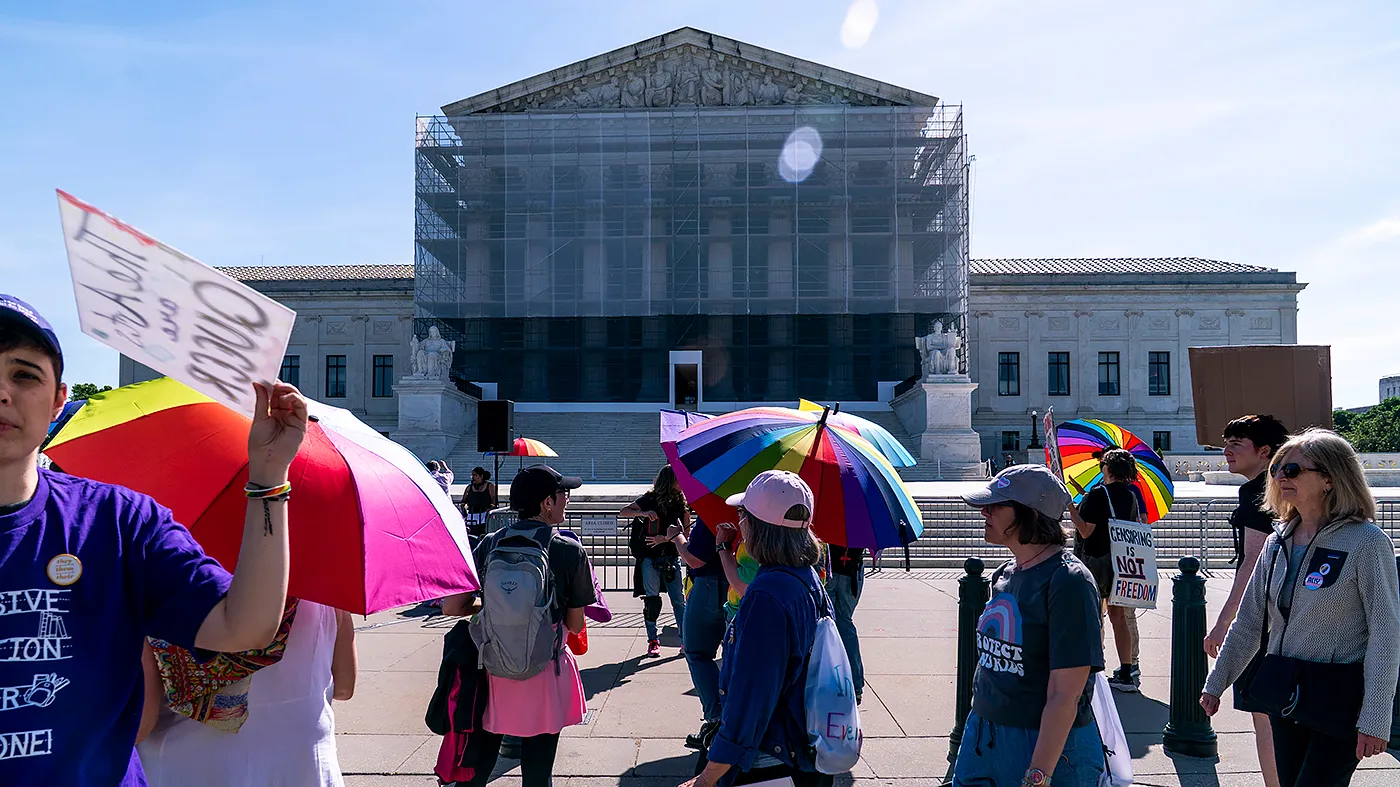
The intersection of religious and LGBTQ rights lands — again — on the Supreme Court’s docket Tuesday.
The justices are set to decide whether Colorado can require preschools that receive public dollars to admit the children of same-sex couples.
“It seems like there’s short shrift being given to religious liberty in the state of Colorado,” said Joe Davis, part of the legal team fighting the state at the Becket Fund for Religious Liberty.
The group is back before the conservative-majority court after a series of major victories, including last year when the justices agreed parents in a Maryland county could opt out their children from instruction that uses books with LGBTQ themes.
This round, Davis and his colleagues represent the Archdiocese of Denver, two parishes and parents who challenge Colorado’s antidiscrimination mandate for preschools that receive state funds under the First Amendment.
Colorado’s universal preschool program funds 15 hours of weekly preschool for a child, but the school must agree to provide families an “equal opportunity” to enroll regardless of various conditions. Sexual orientation and gender identity are among the list, which also spans things like race, income level and disability.
It’s the latest Supreme Court battle over Colorado’s efforts to enact LGBTQ protections.
Last term, the justices ruled 8-1 that the state’s “conversion therapy” ban impinged on a counselor’s free speech rights . In 2023, the court ruled the blue state couldn’t require an evangelical Christian web designer to provide same-sex wedding websites . And before that, the court on narrow grounds sided with a cake baker who launched a similar challenge to Colorado’s law.
“I don’t think there’s going to be that Colorado is going to have better luck than last time — or the last several times,” Davis said.
The newest case is a key test of a 1990 Supreme Court precedent authored by the late conservative icon Justice Antonin Scalia. It held that neutral and generally applicable laws are presumptively constitutional, even ones that burden religious rights.
It has come under criticism by some of today’s conservative justices, who say it threatens religious liberty. Three — Justices Clarence Thomas, Samuel Alito and native Coloradan Neil Gorsuch — have explicitly called for the decision to be overturned.
Colorado says its preschool mandate aligns with the 1990 decision. The state and LGBTQ advocacy groups are holding out hope that the Supreme Court will agree, even with that skepticism within the court’s current 6-3 conservative majority.
“If the court honors precedent, which it should, there is a very clear doctrine,” said Sharon McGowan, senior vice president of policy and litigation at the Human Rights Campaign.
The Supreme Court has declined to consider outright overturning the 1990 precedent in the Colorado battle. But the Catholic parishes hope the justices will use the case to take a narrow view of the precedent’s scope. They say it shouldn’t reach public benefit programs at all.
It’s an argument that has garnered support from the Trump administration, which says Scalia in 1990 was focused on criminal laws and not something like Colorado’s preschool mandate. The administration will appear at Tuesday’s arguments to make the case alongside a lawyer for the Catholic parishes.
“The substantial burden on religious schools’ ability to engage in core religious exercise is patent,” Solicitor General D. John Sauer wrote to the court.
“The law’s myriad exceptions belie any compelling state interest in uniform, even-handed admissions criteria,” he added. “And Colorado’s failure to accommodate religious preschools undermines, not promotes, its stated interest in ‘equal access.’”
Colorado says that misses the point and would create a “sweeping new rule.”
“This Court need not, and should not, redesign Free Exercise doctrine to decide this case, which involves impartial and uniform conditions on providers of publicly funded services,” the state wrote in its written brief.
It argues its mandate is not aimed at burdening religious schools and instead ensures that no family is deprived of a public benefit.
“Everyone is participating and putting money into that coffer, right?” McGowan said. “Gay people, straight people — everyone is putting into that money pot, and so the state, I think, appropriately, wants to make sure that when it is drawing money from that communal pot, it is able to benefit all of the people.”
Topics in this story
Gathered from external sources. Rights to this text belong to whoever originally published it.