Is Everyone Secretly Tanning With The “Barbie Drug?”
We unpack the rise of Melanotan and Melanotan-II.
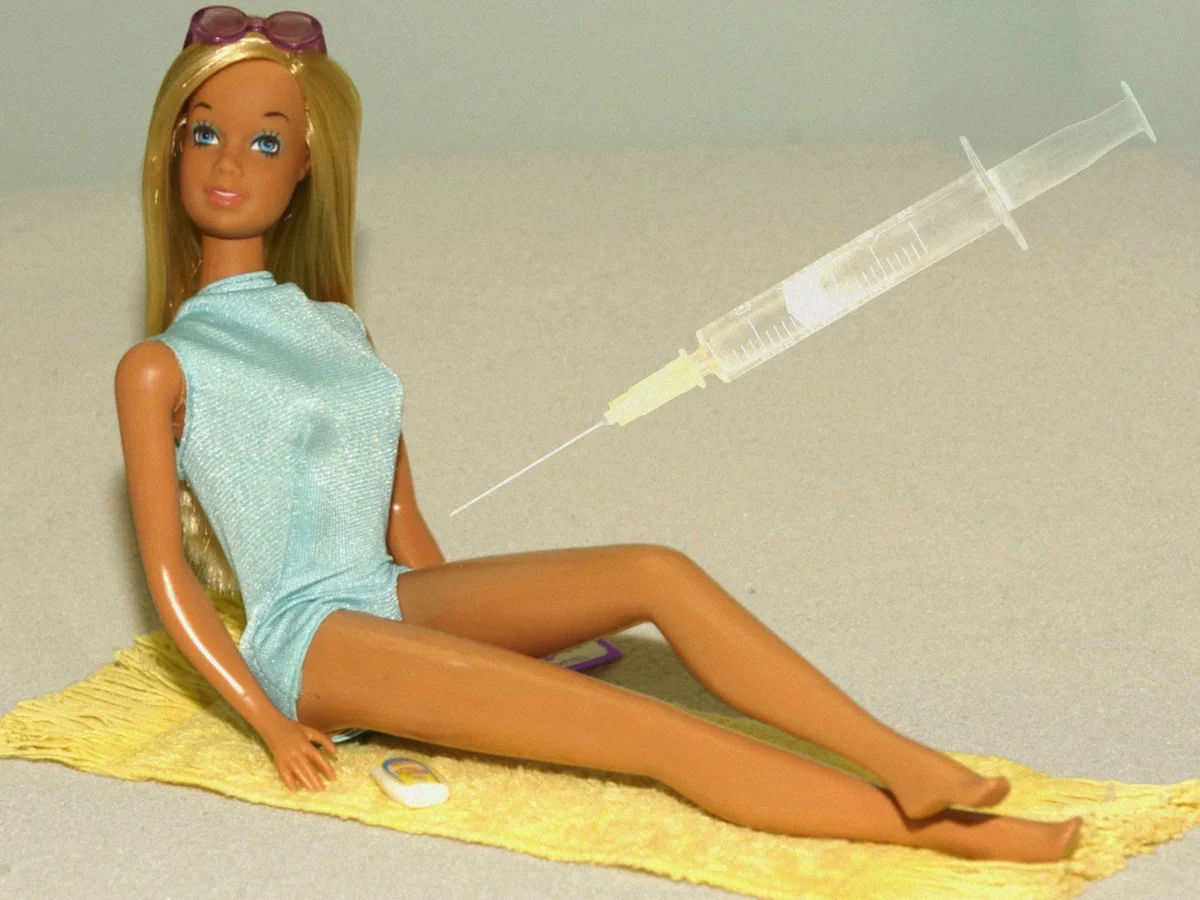
The Melanotan and Melanotan-II peptides, also called the "Barbie Drug," have taken over social media as an alternative to tanning.
The peptides help increase melanin production without UV exposure, but they may have other dangers.
Derms warn against the peptides' unregulated nature.
The Western world has seen a shocking number of aesthetic attributes come in and out of vogue over the past 100 years, but few—and maybe none—have had the staying power of a golden-bronze suntan. The look's origins have become of a legend at this point: When Coco Chanel returned to Paris from a trip to the Riviera conspicuously sun-kissed, she helped ignite a fashionable desire for what can only be described as the look of leisure. The recreational activities of the rich and famous—skiing, boating, trips to the seaside—brought with them a distinct look, and if you couldn't actually participate, at least you could fake it with a few hours in the yard and some baby oil .
The West's obsession with tanning only accelerated over the decades, cresting in the '70s and again in the 2000s despite widespread campaigns about the sun's dangers . Its latest iteration, though, is something no one could have seen coming. What if that enviable bronzed effect could be achieved with zero hours logged outdoors?
Enter Melanotan and Melanotan-II (MT2), a pair of unregulated synthetic peptides sold online and typically injected or taken via nasal spray. The peptides, often referred to as the "Barbie Drug" for its effects, mimic a naturally occurring hormone to stimulate melanin production from the inside out, darkening the skin with little to no UV exposure required. No sun damage, no problem—right? Despite their rapidly spreading popularity, science might tell a different story, and some doctors are struggling to get ahead of the booming gray market demand. Ahead, experts unpack the "Barbie Drug's" rise.
MT and MT2 work by tricking your body into producing pigment, but it's a sloppy trick. It pushes other biological buttons, too, turning on the receptors for not just melanin production, but also everything from appetite to sexual function. "This is essentially hijacking the body's natural feedback response to ultraviolet light exposure, which is the normal trigger for the production of melanin and tanning," explains Dr. Dustin Portela , a board-certified dermatologist who's created extensive online content about the drug's dangers.
Dr. Portela points to nausea, appetite suppression and sexual arousal, including sustained erections as potential side effects. Many users also share a rapid increase in moles, and there are case reports of melanoma diagnoses following Melanotan use. The real problem is, though, the drug's novelty and lack of regulation on the gray market means it's difficult or even impossible to determine if it's indeed the drug alone responsible for the cancer, especially since Dr. Portela believes that MT and MT2 give users a false sense of security around sun safety. He's personally seen patients with rapidly changing moles after starting the peptides, with biopsies revealing precancerous cells. The Skin Cancer Foundation issued a statement condemning usage of the drugs in July, highlighting their potential side effects and lack of research around what's actually happening when these receptors make your skin start to deepen.
"The Skin Cancer Foundation strongly discourages the use of Melanotan II and other unapproved tanning agents marketed as shortcuts to achieving darker skin, wrote Deborah S. Sarnoff, MD, President of The Skin Cancer Foundation. " Melanotan II is not approved by the U.S. Food and Drug Administration for any use, and its safety has not been established ."
What's extra-concerning, too, is what else could be lingering in these vials, tubes, and bottles. Melanotan's lack of federal approval or regulation means the only way to get it is via gray market vendors, almost always online, which are rife with unsafe lab conditions, contaminants, and no real oversight. There are reports of wildly varying concentrations , with no real way to verify that a consumer is ever getting the correct dosage, or even the same dosage per vial. "Most of these gray market peptides explicitly say on the label they are not intended for human or animal use and instead they are marketed as 'research chemicals only,'" Dr. Portela tells Byrdie. A number of these sellers have already been shut down, driving the acquisition process even further underground.
And yet, the Melanotan's popularity continues to grow. U.S.-based Google searches for the term "tanning peptide" saw a near-tenfold increase in the past year, and social media shows a similar trajectory: influencer analytics platform Upfluence found that Melanotan-related content grew 3.7 times over a recent nine-month period, while individual TikToks documenting the peptide have racked up hundreds of thousands of views. Interestingly enough, the demographic seems to skew male —though not especially surprising considering a number of "looksmaxxing" influencers, like Clavicular, have espoused its supposed benefits. "There are thousands of people promoting them online with a financial interest in getting consumers to purchase through their links, yet they carry no liability if a consumer is harmed by these products," Dr. Portela points out. TikToks and Reels make the administration process seem impossibly simple. A quick sniff from a pump-style nasal spray, a straightforward shot—increasingly ho-hum considering the rise of GLP-1s. Many social media users refer to Melanotan as simply "peptides" over its given name, making it all seem a bit wellness-adjacent.
"We're seeing people use the word 'peptide' almost as a synonym for 'safe, natural, or cutting-edge,'" says Dr. Sheila Farhang , board-certified dermatologist, "but that's not how it works, nor is it accurate." This rapid normalization without much (or any) oversight is a chief concern of hers. With a clinical focus on longevity, Farhang is generally pro-peptide—when they're rigorously tested, vetted, and FDA-approved—but worries about consumers experimenting on their own, especially when it comes to the dangerous-at-worst and ineffective-at-best practice of "peptide stacking." "I'm excited about the science, but I'm much less excited about the idea of treating social media as the clinical trial," Dr. Farhang tells Byrdie.
Considering the mainstream popularity of biohacking , looksmaxxing, and optimizing wellness at every turn (and on every level), it's no marvel that Melanotan caught on in such a big way. In fact, there's likely a not-small subset of users who think they're doing the responsible thing by eschewing traditional tanning methods in favor of the peptides. From a psychological standpoint, too, even having a cognitive understanding of risk can't outweigh the allure of an aesthetic shortcut.
Dr. Sanam Hafeez , New York City-based neuropsychologist, explains that beauty-based risks can be especially tempting because they offer such an immediate, socially recognized reward. "Appearance is also tied to confidence, attention, attractiveness, and belonging, which can make these choices feel more emotionally important," she says. "If someone is already insecure about a part of their appearance, they may be more willing to overlook a warning that gets in the way of changing it." And it's not like this is anything new. Just look at more traditional bronzing methods, like laying out or the tanning bed—Americans writ large have understood that UV exposure causes skin cancer for decades now, yet tens of millions of us still admit to intentionally seeking a suntan every year.
Melanotan might feel extreme because of its unusual administration methods, but really, it's just another dangerous iteration of a century-old practice. The same way those There's Something About Mary -style aluminum visors of the '60s and '70s gave way to indoor tanning beds, MT and MT2 are yet another shortcut—and just like their predecessors, their inherent (and still unknown) risks don't seem to outweigh the desire for a golden-goddess tan. The look of leisure, as it turns out, might end up costing everything.
Topics in this story
Gathered from external sources. Rights to this text belong to whoever originally published it.