A nosy polar bear and a lucky squirrel: Wildlife Photographer of the Year 2026 shortlist
The polar bear image taken by Audun Rikardsen was among the 'highly commended' entries in this year's competition.
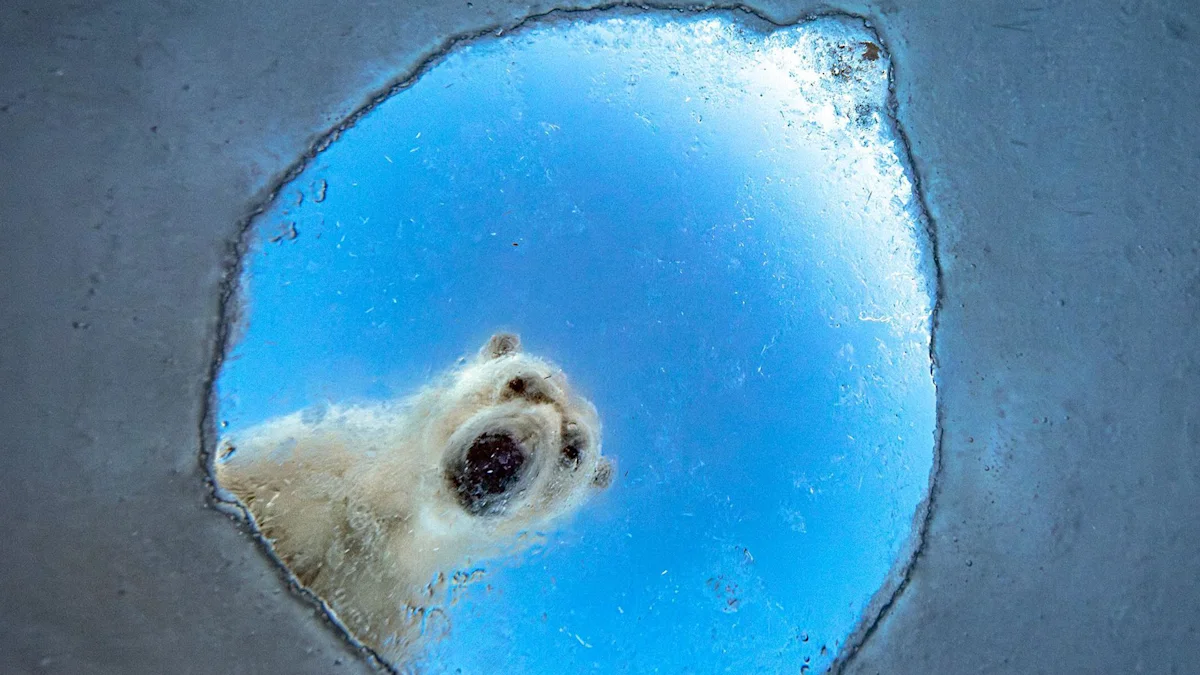
How would it feel to find yourself face to face with one of the Arctic's most formidable predators?
This stunning image captures life from a seal's perspective. Taken by Norwegian wildlife photographer Audun Rikardsen, it was among the 'Highly Commended' entries in this year's Wildlife Photographer of the Year competition.
While working as a guide with Arctic Wildlife Tours, Rikardsen rigged an underwater camera with a motion sensor beneath a seal's breathing hole, and then waited. At 4am, a female polar bear approached and peered down.
Rikardsen then waited eight hours for the bear to move away before retrieving the camera and reviewing the images.
When he saw what he had captured, he said: "I was so extremely happy. I was screaming, so I probably woke up all the polar bears for miles."
Rikardsen has previously won two Wildlife Photographer of the Year categories: Birds in 2019 and Oceans: The Bigger Picture in 2025 .
The overall winners will be announced on Tuesday 13 October 2026, followed by an exhibition at the Natural History Museum in London from Friday 16 October 2026.
Scroll down to explore other highly commended works from the competition.
Living alongside polar bears in the Canadian Arctic - BBC World Service
Crockford watched swifts return to London after their annual migration from Africa, filling the air with their high-pitched calls. Most flew too high to photograph, but a few lower-flying ones gave Crockford the opportunity to capture the picture he wanted.
Swifts spend almost their entire lives in the air, usually landing only to nest.
After rainfall, Miyazawa came across an Eastern Japanese toad making its way along a city street. He used a slow shutter speed to photograph it before it hopped back into the bushes.
Eastern Japanese toads are typically found in forests, grasslands and other terrestrial habitats across eastern Japan, but they have also proved remarkably adaptable to urban environments.
Photographer: Vegard Byrkjeland Aasen (Norway)
Category: Highly Commended, Behaviour: Mammals
Location: Kvænangen, Troms County, Norway
Aasen was flying a drone for the Norwegian Orca Survey when he noticed an adult orca carrying the body of a deceased calf through a Norwegian fjord.
The orca repeatedly allowed the calf to sink before bringing it back to the surface, a difficult moment to watch but one that Aasen felt was important to record.
The behaviour may have been an attempt to revive or protect the calf. Killer whales have previously been observed carrying deceased calves, including a case where a female Southern Resident killer whale carried her dead calf for at least 17 days.
A 2026 study suggests that this type of behaviour may be more widespread across the species than previously thought.
Photographer: Andrea & Maceo Grammatico (France)
Category: Highly Commended, Animal Portraits
Location: Sierpe, South Puntarenas, Costa Rica
Only when they reviewed the images did the Grammatico twins realise they had captured a mosquito resting on the head of a fer-de-lance viper. They described it as "one of the most demanding focus stacks we've ever created".
Highly venomous and responsible for more fatal snake bites in Central America than any other species, the fer-de-lance is well camouflaged and can blend into plantation habitats, sometimes going unnoticed by workers.
Location: Meeting of the Waters State Park, Northern Pantanal, Brazil
Parkinson photographed a black vulture perched over a dead yacaré caiman in Brazil's Pantanal wetlands, keeping his boat at a distance and using a long telephoto lens to capture the shot.
A jaguar waiting out of frame emerged after the vulture flew away to claim the carcass. Only then did Parkinson notice a suspiciously clean, straight wound on the back of the caiman's head, possibly caused by a blow from a speeding boat, he suspects.
Photographer: Dewald Tromp (South Africa)
Category: Highly Commended, Animals in their Environment
Location: Namib Desert, near Swakopmund, Namibia
Tromp was photographing a Namaqua chameleon in the Namib Desert when the wind suddenly intensified, bringing a sandstorm that quickly reduced visibility and made breathing difficult.
These chameleons are desert specialists and can obtain moisture directly from the air. Dew gathers on their skin and is channelled towards their mouths through microscopic grooves, while their tongues can also collect fog water condensed on plants, sand and rocks.
Photographer: Bence Máté (Hungary) - 2010 Wildlife Photographer winner
Category: Highly Commended, Behaviour: Birds
Location: Ashnil Aruba Lodge, Tsavo East National Park, Kenya
Máté was watching birds gather at a small pond when tens of thousands of red-billed queleas swept down to drink in the golden late-afternoon light. The movement of so many wings created a rush of air that, he says, could be felt from 30m (98ft) away.
Red-billed queleas can gather in flocks of up to two million and are considered the most abundant wild bird on Earth, with an estimated 1.5 billion breeding adults.
Photographer: Ernest Porter (South Africa)
Location: Manyeleti Game Reserve, Mpumalanga, South Africa
While searching the reserve for wildlife, Porter photographed a red-billed oxpecker rubbing its bill against a white rhino's skin in the afternoon light. The birds feed on insects living on rhinos and can also act as sentinels - calling to warn their hosts when danger approaches. In Swahili, the red-billed oxpecker is known as askari wa kifaru, meaning "the rhino's guard".
Hutton had watched a young leopard pursue a squirrel into a tree, having earlier seen the cat unsuccessfully attempt to stalk a rabbit. The squirrel escaped by climbing higher, leaving the leopard clinging on before it eventually made an awkward retreat.
For young leopards, survival is far from guaranteed: fewer than half reach independence, with male leopards, lions and other predators among the threats they face.
Category: Highly Commended, Behaviour: Amphibians and Reptiles
Location: Central Kalahari Game Reserve, Botswana
An African bullfrog lunges for a babul butterfly but misses.
Cullmann had noticed tadpoles on a previous visit after heavy rains and returned the following month to find ponds and puddles full of young bullfrogs. He spent more than two weeks watching the young frogs "eat everything that moved".
As adults, African bullfrogs can reach 12cm (4.7in) in length and spend around 10 months of the year dormant underground, emerging after the rains to breed and feed voraciously.
Category: Highly Commended, Behaviour: Invertebrates
Location: Wildsumaco Biological Station, Napo Province, Ecuador
Wizen was photographing a lichen dragon katydid measuring just 15mm long, making it difficult to distinguish from the lichen around it. He spotted the insect when it moved, but even then struggled to separate it from its background through the viewfinder.
Found only in Ecuador's Andes Mountains, its spiny armour helps protect it from eagle-eyed predators that can see through its disguise.
Photographer: Shane Gross (Canada) - 2024 Wildlife Photographer winner
Category: Highly Commended, Oceans: The Bigger Picture
Gross was photographing a school of bigeye trevally near the shore at sunrise as a storm approached. To create a split-level image, he turned his camera upside down to aid buoyancy distribution and slowly moved towards the curious fish.
Bigeye trevally are fished in many parts of the world, but here they are relatively safe. In 2023, the waters surrounding D'Arros Island were made a Marine Protected Area and designated as a no-take zone as part of the worldwide initiative for governments to protect 30% of Earth's land and ocean by 2030.
Category: Highly Commended, Urban Wildlife
Elliott spent hours watching through the kitchen window of a local resident's home, hoping to photograph black bears that frequently pass through the garden. He observed one stopping for a dip in the garden pool, highlighting the increasingly common overlap between wildlife and residential life in Los Angeles County, where housing developments have spread into bear habitat.
Photographer: Ralph Pace (USA) - 2025 Underwater category winner
Category: Highly Commended, Wetlands: The Bigger Picture
A sea hare glides through an eelgrass meadow in the shallows of Monterey Bay, where Pace was photographing in the evening light. He saw the encounter as a hopeful image of "a gentle giant safeguarding the last green meadows of the sea".
By grazing on red algae, that can prevent sunlight reaching the meadow, sea hares play a role in restoring eelgrass, which is vital to coastal ecosystems and an important carbon sink.
Category: Highly Commended, Photojournalism
After learning that a circus featuring animal acts was in town, Rojas went to document it and saw a brown bear riding a small motorcycle, muzzled and secured to the apparatus. For him the scene highlighted the contrast between the animal's wild nature and the human environment imposed upon it.
More than 50 countries around the world have now banned or restricted the use of wild animals in circuses, over concerns it causes them distress .
Wildlife Photographer of the Year is developed and produced by the Natural History Museum, London.
Topics in this story
Gathered from external sources. Rights to this text belong to whoever originally published it.