Dolly Parton for beginners: How the Queen of Country wrote the playbook for Taylor Swift
Explore how Dolly Parton shaped the music industry and influenced artists like Taylor Swift, breaking barriers in country and pop music with her extraordinary talent, business acumen, and cultural impact.
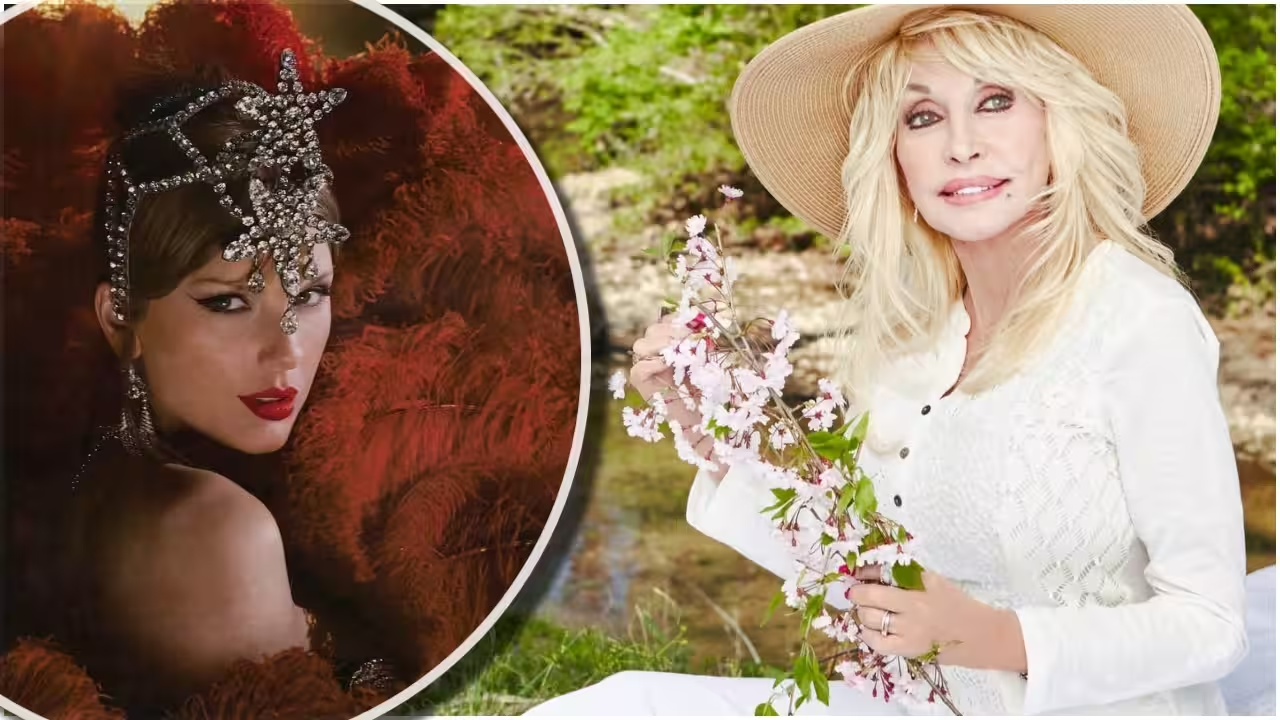
Dolly Parton’s status as the Queen of Country never quite explained the scale of her influence. A better measure came from Marshall Mathers, better known as Eminem, who after her death shared a handwritten note she had sent him following his induction into the Rock & Roll Hall of Fame. Parton had congratulated him, admitted she knew little about rap and told him that he was “very special” and touched people in ways he probably did not even realise.Eminem’s response said even more about her reach. “Even for a kid who mostly listened to rap music, she was an icon. A superstar in every sense.” It was an unlikely exchange on paper: the blonde, rhinestone-clad queen of Nashville and the enfant terrible of Detroit rap. Yet that was precisely the point. Dolly’s influence had long escaped the boundaries of country music.After her death on August 25 at the age of 80 following a brief battle with cancer, the tributes stretched across generations and genres. Taylor Swift said a world without Dolly did not feel “possible, real, or right”. Paul McCartney, Jane Fonda, Kacey Musgraves, Reba McEntire and Carrie Underwood were among those who mourned her. Eminem Stanned her.Dolly had stopped being merely a country star decades ago. She had become something closer to an American institution.The rags before the rhinestonesDolly Rebecca Parton was born on January 19, 1946, the fourth of 12 children, and grew up in a one-room cabin in Locust Ridge in the Great Smoky Mountains. Her father, Robert Lee Parton, worked as a farmer and labourer and could not read or write. Her mother, Avie Lee, filled the house with songs and stories.Music became Dolly’s exit route. She was performing on local radio and television as a child, writing songs while other children were still learning multiplication tables, and appeared at the Grand Ole Opry at 13. The day after graduating from high school in 1964, she left for Nashville.“Coat of Many Colors”, one of her greatest songs, tells the story of a coat her mother stitched together from scraps. Dolly is proud of it until her classmates laugh at her.That is the trick in so many Parton songs. The language is simple, but the emotional equation is not. “Coat of Many Colors” is about maternal love, but it is also about class, humiliation and the moment a child discovers that other people can make poverty shameful.Porter Wagoner and the great escapeDolly’s breakthrough came in 1967 when Porter Wagoner recruited her for The Porter Wagoner Show. Wagoner was already a major country star; Dolly was the newcomer. Their television partnership made her famous, produced hit duets and gave her the platform from which her solo career could grow.Eventually, however, the protégé outgrew the mentor.Dolly wanted to leave. Wagoner did not want her to go. So she wrote him a song.“I Will Always Love You” is now inseparable from Whitney Houston, whose 1992 version became one of the biggest singles in pop history. Dolly’s original is very different: quieter, smaller and more intimate. More importantly, it was not fundamentally a romantic breakup song. It was a farewell to Wagoner, telling a man she loved and respected that affection did not require permanent professional dependence.Then there was “Jolene”. Instead of attacking the beautiful woman she fears may steal her man, Dolly’s narrator begs her. She admires Jolene almost as much as she fears her. Jealousy, vulnerability, fascination and desperation coexist inside one of country music’s simplest melodies.How do you become the Queen of Country?Dolly’s distinction was that she made country portable.Her early catalogue established her as one of Nashville’s great storytellers. “Joshua” gave her a solo No. 1. “The Bargain Store” turned emotional damage into the metaphor of second-hand goods still worth buying. “Light of a Clear Blue Morning” captured the feeling of emerging from professional turmoil.Then “Here You Come Again” pushed her decisively towards pop in 1977. She carried the accent, the hair, the humour and the Tennessee mythology with her.In 1980 came 9 to 5, opposite Jane Fonda and Lily Tomlin. Dolly played a secretary dealing with a sexist boss and also wrote the title song, turning the click of her acrylic nails into part of the rhythm.“9 to 5” became a No. 1 pop hit and a working-woman anthem. The casting was almost too perfect. Dolly had spent years being underestimated because she looked like exactly the kind of woman powerful men were conditioned not to take seriously. Now she was playing one.Three years later, “Islands in the Stream”, her duet with Kenny Rogers, became another enormous crossover success. By then Dolly could move between Nashville, Hollywood and mainstream pop without ever appearing to be visiting any of them.Dolly IncThe most revealing Dolly Parton story may involve a song she did not allow Elvis Presley to record.Elvis wanted “I Will Always Love You”. His manager, Colonel Tom Parker, demanded half the publishing rights. Dolly refused. She kept the song, a decision vindicated when Whitney Houston turned it into a global phenomenon nearly two decades later.This is where the road from Dolly Parton to Taylor Swift becomes particularly interesting.Swift’s battle over her masters involved a different part of music copyright, but the philosophy is remarkably similar: fame is useful, ownership is better. Understand what you have created, understand what rights attach to it and do not assume the men in suits know more about the value of your work than you do.Dolly understood that lesson when female performers were often treated as voices and faces attached to songs, contracts and catalogues controlled by other people.Dollywood turned her East Tennessee roots into a major tourist business. Dolly was a brand before celebrity branding became an industry.The woman behind DollyFor someone who made herself visually impossible to ignore, Dolly protected her private life with astonishing success.She met Carl Dean outside a Nashville laundromat on her first day in the city. They married in 1966 and remained together until his death in March 2025, nearly 59 years later.Dean wanted virtually nothing to do with show business. While Dolly became one of the most photographed women in the world, her husband largely stayed away from cameras, premieres and interviews.They had no children. Dolly instead became famously close to nieces, nephews and her goddaughter Miley Cyrus.The audience got Dolly Parton. Carl Dean got Dolly.From Dolly to TaylorThe line from Parton to Taylor Swift is not that Swift copied Dolly. It is that Dolly helped widen the space in which later female stars could operate.Both arrived in Nashville young. Both insisted that songwriting was central to their identity. Both crossed from country into pop. Both turned apparently conventional femininity into something commercially powerful rather than something for which they had to apologise. Both understood that control of intellectual property mattered. And both faced the strange assumption that a woman cannot simultaneously be a serious artist and an exceptionally clever businessperson.Dolly’s response to that problem was particularly ingenious.She exaggerated everything.The wigs got bigger. The heels got higher. The clothes got tighter. She joked constantly about cosmetic surgery and her appearance. Instead of trying to persuade people not to see a “dumb blonde”, she gave them the most spectacular dumb-blonde costume imaginable and then quietly owned the songs, the publishing and eventually much of the business underneath the spectacle.That is perhaps her largest contribution to the women who followed her. She showed that femininity did not have to be surrendered to acquire authority. Her influence also travelled in less obvious directions. Beyoncé could rework “Jolene”, Miley Cyrus could inherit the mixture of country roots and pop spectacle, and Swift could turn songwriting ownership into part of her public mythology because Dolly had already demonstrated that a female star did not need to choose between commercial calculation, humour, glamour and artistic seriousness.The beginner’s playlistIf you know Dolly but not the music, start with “Coat of Many Colors” for the storyteller; “Jolene” for vulnerability; “I Will Always Love You” for the songwriter and businesswoman; “The Bargain Store” for her gift for metaphor; “Here You Come Again” for the crossover star; “Light of a Clear Blue Morning” for independence; “9 to 5” for the working-woman icon; and “Islands in the Stream” for Dolly at maximum mainstream wattage.Then go deeper into “Joshua”, “Love Is Like a Butterfly”, “Two Doors Down”, “Old Flames Can’t Hold a Candle to You” and her Trio recordings with Linda Ronstadt and Emmylou Harris.In 1995, partly inspired by her father’s inability to read, Dolly launched the Imagination Library, which mails free books to young children. It eventually expanded across several countries and distributed hundreds of millions of books.That may be why the mourning extended so far beyond Nashville.Dolly Parton spent a lifetime looking artificial and being remarkably real. She escaped poverty without disowning where she came from, escaped Nashville’s restrictions without abandoning country, crossed into Hollywood without giving up songwriting and turned a deliberately exaggerated image into armour.Most importantly, she understood the difference between fame and power. Fame was having everybody recognise the hair. Power was owning the song.Give your child the gift of confidence! Claim your exclusive TOI Masterclass spot today!
Topics in this story
Gathered from external sources. Rights to this text belong to whoever originally published it.