Western Balkans truck drivers threaten EU border blockade
Drivers demand an exemption to 90-day limit to stay in Schengen area, saying current rules stop them from working.
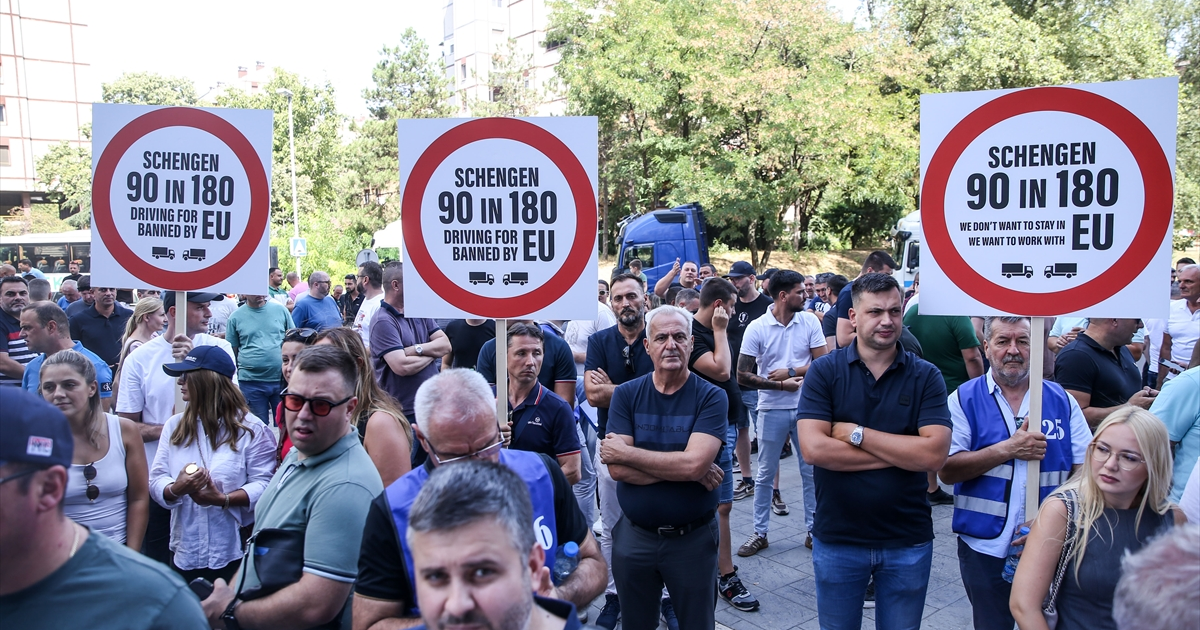
Truck drivers from the Western Balkans have protested European Union rules on entry and exit, and threatened to block regional border points next month unless their grievances are heard.
Hundreds of truckers gathered at locations across four Western Balkan states on Monday, demanding changes to rules that limit drivers from outside the Schengen area to 90 days in the border-free zone within any 180-day period.
The drivers, hailing from Bosnia and Herzegovina, Serbia, Montenegro and North Macedonia, warned they will block border crossings with the EU on September 14 if Brussels fails to exempt them from the Schengen limits.
The dispute has intensified with the rollout of the EU’s Entry/Exit System, operational as of April, which electronically records the entry and exit of non-EU nationals. The system makes it easier to track how long drivers spend inside the Schengen zone, which includes 25 EU states. Iceland, Liechtenstein, Norway, and Switzerland are also part of the zone despite not being EU members.
The European Commission said earlier this year that it was in contact with partners in the Western Balkans in an effort to find a solution to the issue.
One option under discussion is a system of bilateral agreements between individual Western Balkan countries and EU member states. North Macedonia, for example, has agreed to bilateral arrangements with Croatia, Switzerland and Romania, with other such agreements expected in the future.
But the drivers say Brussels has yet to offer an acceptable proposal, and are calling for a solution that would cover all of the Schengen countries.
The European Union is the biggest trading partner of the Western Balkans, accounting for more than 60 percent of the region’s total trade last year, according to the European Council.
Serbia, the region’s largest economy, recorded total foreign trade worth over 39 billion euros ($45bn) in the first half of this year. Of that, 58 percent was trade with EU countries.
Bosnia and Herzegovina also relies heavily on trade with the EU, with trade in the first quarter of 2026 totalling 5.6 billion euros ($6.5bn).
Any potential border blockade could therefore have consequences extending far beyond the transport sector itself.
It is feared that a prolonged blockade could delay exports and imports, including food, fuel, medicines, industrial components and consumer goods, while leaving trucks stranded at border crossings and raising costs for businesses and consumers.
For example, Bosnia and Herzegovina’s meat supplies depend heavily on imports.
The region’s truck drivers have already demonstrated their ability to disrupt trade. In January, drivers from Bosnia and Herzegovina, Montenegro, North Macedonia and Serbia staged a coordinated blockade of freight border terminals leading to the Schengen zone.
For drivers who cross into the Schengen area on a daily basis for work, the restriction of staying 90 days in any 180-day period poses a serious challenge.
Adis Casevic, a truck driver specialising in international transport, told Al Jazeera that he regularly transports goods from Bosnia and Herzegovina to Germany, France, the Netherlands and other EU countries.
He said that current Schengen rules effectively limit the number of hours that non-EU drivers can work.
“Being allowed to stay for 90 days in six months is practically half of our working time,” Casevic said. “We cannot support our families that way.”
Nikola Brkovic from lobby group Logistika BiH said the rule affects around 5,000 drivers in Bosnia and Herzegovina alone, adding that the number of drivers affected across the entire Western Balkans is considerably higher.
The Montenegrin Association of Transport Companies announced that there have already been recorded cases of professional drivers from Montenegro who were turned back at EU borders after hitting the 90-day limit, according to regional news outlet Antena M.
The drivers are calling on the European Commission and EU member states to introduce a specific arrangement for professional drivers.
Their argument is straightforward: they do not enter the EU as tourists or migrants, but to work, transporting goods between European markets and the Western Balkan countries.
Zijad Saric, president of Logistika BiH, said drivers from the Western Balkans hold international permits and work for registered companies.
“We are asking the European Union to extend the amount of time our drivers are allowed to spend in the [Schengen area],” Saric said.
The problem has united drivers from across the region. Having previously demonstrated a willingness to protest against the limits set by Brussels, they now warn that if no agreement is reached with the European Commission, they could block the borders again on September 14.
Topics in this story
Gathered from external sources. Rights to this text belong to whoever originally published it.