Warsh under pressure as Fed considers rate hike
Federal Reserve Chair Kevin Warsh finds himself in a tricky position as the central bank commences its September meeting, as rising expectations of an interest rate hike clash with President Trump’s demands for cuts. Warsh gave himself wiggle room for a rate hike in late August, saying the central bank had “work to do” if underlying inflation was not moving toward its 2 percent target. But Trump, who…
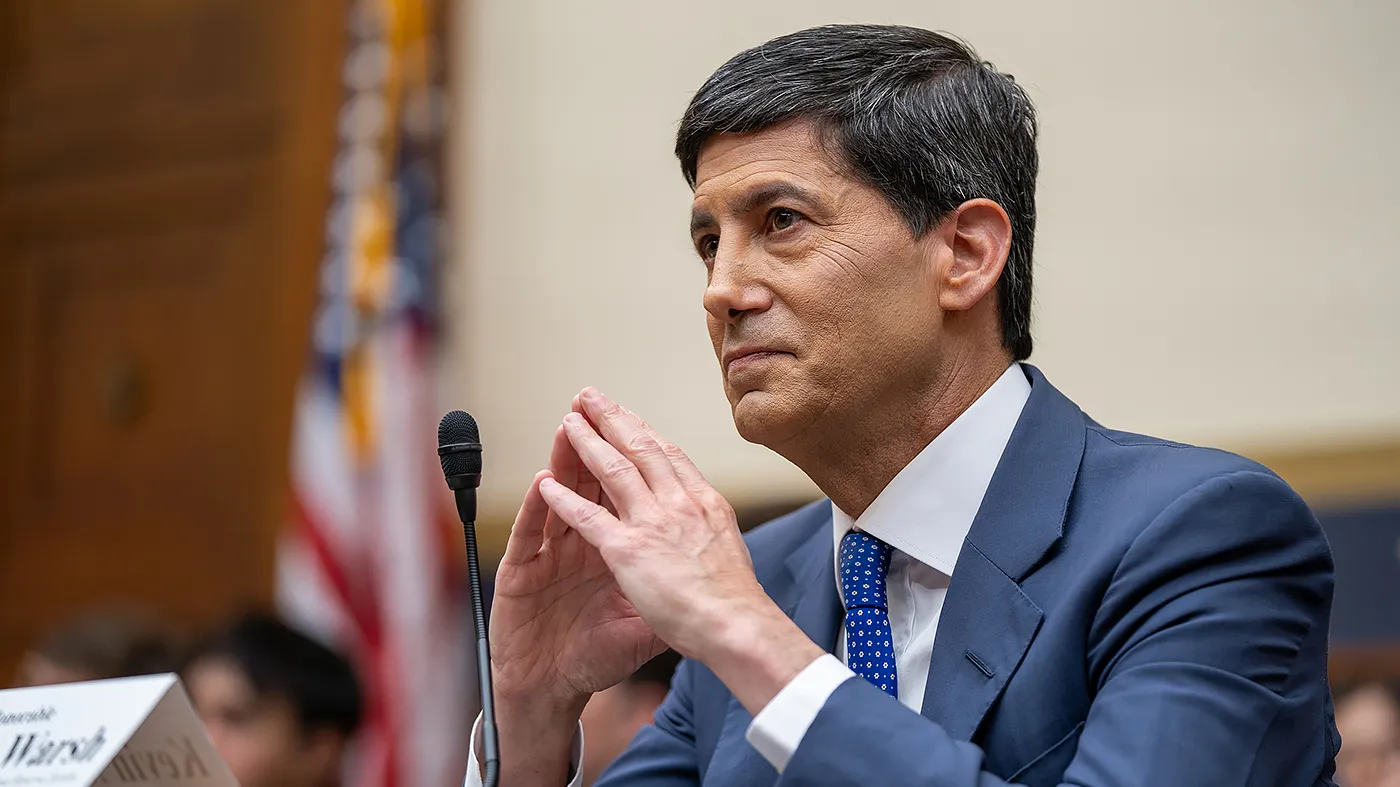
Federal Reserve Chair Kevin Warsh finds himself in a tricky position as the central bank commences its September meeting, as rising expectations of an interest rate hike clash with President Trump’s demands for cuts.
Warsh gave himself wiggle room for a rate hike in late August, saying the central bank had “work to do” if underlying inflation was not moving toward its 2 percent target.
But Trump, who has long kept up the drumbeat for rate cuts, appears increasingly impatient for his Fed pick to lower rates.
“The Fed Board, with its great new leader, must get smart — BE PATRIOTS for a change,” Trump wrote on Truth Social earlier this month, after strong jobs numbers came in for August .
The president also warned that if the Federal Open Market Committee (FOMC) does not lower rates, he would cut off trade with countries the U.S. has a deficit with.
Inflation has long remained above the Fed’s target rate of 2 percent. Annual inflation, as measured by the consumer price index (CPI), was unchanged in August at 3.4 percent, according to data released Friday .
Roughly 85 percent of economists Reuters surveyed after the inflation report predicted a quarter-point rate hike, an increase from the roughly 70 percent of economists who said so before the latest CPI release.
Alongside the better-than-anticipated jobs report last month , investors widely expect the central bank to hike rates Wednesday. Traders were pricing in a nearly 93 percent chance of a quarter-point increase on Tuesday, according to the CME FedWatch tool .
“A September Fed rate hike is almost locked in now,” Heather Long, chief economist at Navy Federal Credit Union, wrote Friday on the social platform X .
“It’s the right call,” she added. “The risks are growing that inflation remains entrenched (or keeps broadening). Fed Chair Warsh doesn’t want to make the same mistake [former Fed Chair Jerome] Powell did of waiting too long to hike.”
But Stephen Myrow, managing partner of Beacon Policy Advisors, suggested the decision is “not as much of a fait accompli necessarily as the market sees it,” adding he believes it is “more dependent on the politics than the actual data right now.”
“Even though we don’t believe the internal dynamics have gotten to a point where enough of the FOMC is pushing him to hike, clearly the market wants him to do it now,” Myrow told The Hill, referring to Warsh.
The Fed has held rates steady within a range of 3.5 percent to 3.75 percent at its past five meetings, two of which Warsh helmed . At both meetings he oversaw, the first-year Fed chair voted for a hold.
Warsh has been closely attuned to inflation. He underscored last month at an annual gathering of central bankers in Jackson Hole, Wyo., that the “responsibility for 65 months of sustained, elevated inflation sits squarely with the central bank.”
Analysts and investors widely viewed the Fed chair’s remarks as “more hawkish than anticipated,” noted Jerry Tempelman, vice president of economic and fixed income research at Mutual of America Capital Management.
Following this, Warsh “will be hard-pressed to explain the Fed’s monetary policy stance if it does not raise short-term interest rates at this week’s FOMC meeting,” Tempelman added in a statement.
Trump, by contrast, is focused squarely on slashing rates. This has been a longtime priority for the president, who began feuding with Powell about a year after nominating him to lead the Fed during Trump’s first term.
So far in Warsh’s term, Trump has continued to argue for rate cuts but has refrained from directly criticizing him.
When asked about the central bank’s decision to maintain rates at their current level in June, Trump replied, “Whatever,” and acknowledged the prospect of future rate hikes.
“It could happen,” he told reporters at the time. “It’s just hard to believe. It just keeps the country down. It’s so unusual. But we have a very good guy over there now, so I’m guided by what he wants.”
But Trump has ramped up his pressure campaign in recent weeks, saying Sunday the U.S. “should be paying the lower interest rate in the world” no matter what the Fed’s “formulas” indicate.
Kevin Hassett, the director of the National Economic Council, noted Sunday that Trump is “not going to be super happy” if the Fed hikes rates, but he will still respect Warsh’s independence.
“If I look at the momentum for inflation, that has basically gone down to almost nothing over the last three months, I’d be wary of a rate hike,” Hassett told host Shannon Bream on “Fox News Sunday,” adding the Fed should not raise rates less than two months before the midterms.
Warsh could “take a hit at least in the short term to his credibility” if the Fed bucks market expectations and opts not to hike, Myrow said.
“On the other hand, if he does hike, he runs the risk of getting crosswise with President Trump and potentially opening up the argument that he impacted the outcome of the elections,” he added.
But Ian Katz, managing director at Capital Alpha, underscored in a Monday note that Trump’s rhetoric appears not to have “meaningfully influenced FOMC decisions” since his first term.
Further complicating matters for Warsh is that inflation is not the only metric squeezing Americans financially. Bond yields, which set the benchmark for borrowing costs on an array of products, have risen due to mounting government debt and economic uncertainty amid the Iran war .
The yield on the 10-year U.S. Treasury bond , in fact, hit 5.041 percent during Tuesday trading, the highest intraday mark since July 2007. Mortgage rates closely follow the 10-year Treasury bond yield.
Adding to the pressure on Warsh are the implications if the Fed errs on interest rates and fails to contain inflation. With the average 30-year mortgage rate hitting its highest level since June 2025 last week and annual inflation above 2 percent for four-plus years, ordinary Americans are feeling an economic pinch.
The Fed chair understood the stakes last month, acknowledging what will occur if the central bank “gets inflation wrong.”
“Who gets the worst of it? Not the financial high-fliers,” Warsh said in Jackson Hole. “Hard-working Americans are the ones left to deal with inflation that is too high or jobs that suddenly appear less secure.”
Topics in this story
Gathered from external sources. Rights to this text belong to whoever originally published it.