What is IMEC? The India-Europe corridor in focus after Trump’s push amid Iran tensions
India Business News: US President Donald Trump has thrown his weight behind the India-Middle East-Europe Economic Corridor (IMEC), linking the ambitious connectivity proje.
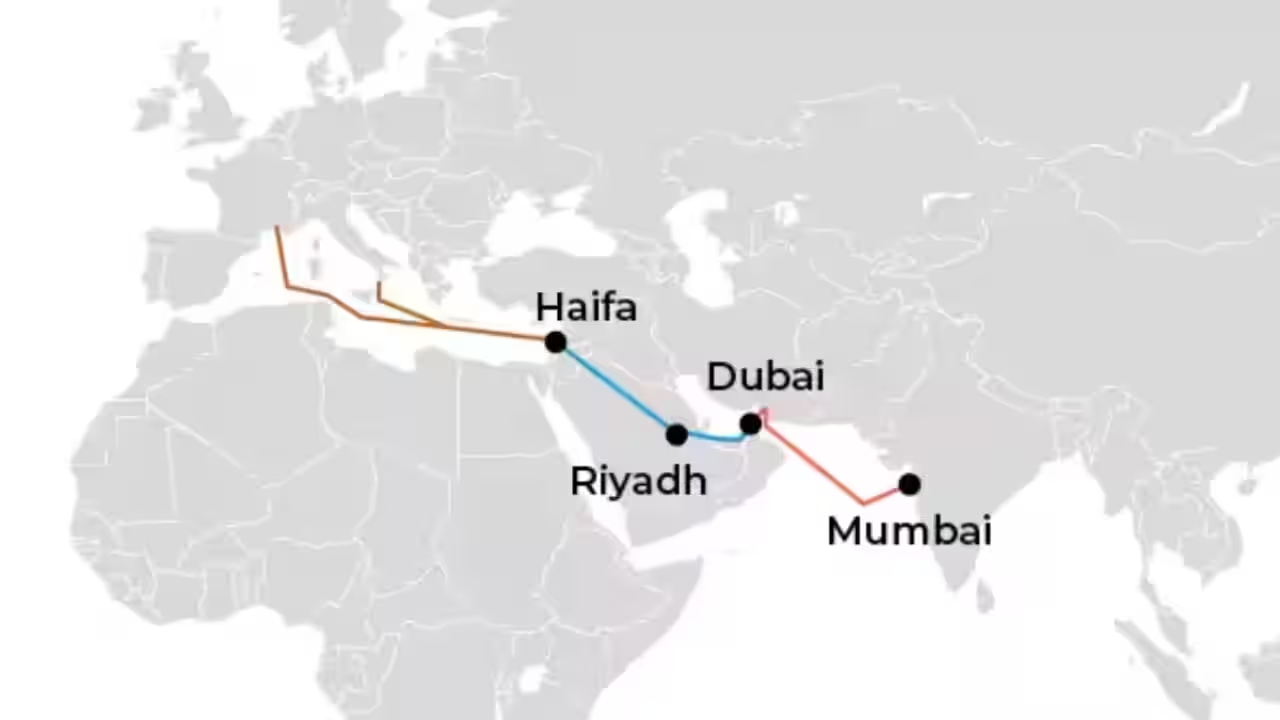
US President Donald Trump has thrown his weight behind the India-Middle East-Europe Economic Corridor (IMEC), linking the ambitious connectivity project to a broader push to move Middle Eastern energy infrastructure away from routes vulnerable to Iranian pressure.Speaking at a meeting with Gulf Cooperation Council and Arab leaders on the sidelines of the UN General Assembly, Trump said attacks on commercial shipping had shown the need to shift energy infrastructure away from “Iranian checkpoints”. He said his administration “strongly supports” IMEC and other efforts to create alternative routes for moving oil and energy.Trump’s comments have brought fresh attention to a project announced with considerable fanfare at the G20 Summit in New Delhi in 2023, but whose progress has since been slowed by wars and instability across West Asia.What is IMEC?The India-Middle East-Europe Economic Corridor is a proposed multinational connectivity network designed to link India with the Gulf and Europe through a combination of sea, rail, road, energy and digital infrastructure.The project has two broad sections: an Eastern Corridor, connecting India to the Arabian Gulf, and a Northern Corridor, connecting the Gulf to Europe. The proposed network would combine maritime shipping with rail and road links rather than relying entirely on a single mode of transport.The plan also envisages electricity infrastructure, digital connectivity and potentially hydrogen-related infrastructure alongside the transport network.The corridor was announced at the September 2023 G20 Summit in New Delhi. Its core participants include India, the US, Saudi Arabia, the UAE, Israel, Jordan, France, Germany, Italy and the European Union.At its core, IMEC is intended to make the movement of goods, energy and data between India, the Middle East and Europe faster and more resilient.How would the corridor work?Instead of sending cargo entirely by sea from India to Europe through existing maritime routes, IMEC would combine shipping with overland rail connections.Goods from India would move by sea to the Gulf. From there, the proposed rail network would carry cargo across the Middle East towards the Mediterranean, where it could again move by sea into Europe.The plan also envisages supplementary road links and infrastructure for electricity, digital communications and clean energy.The Middle East Institute says the corridor could potentially reduce shipping times by up to 40% compared with traditional routes, although the eventual gains would depend on how much of the planned infrastructure is actually built and how efficiently the network operates.That multimodal design is also central to its strategic appeal: if one shipping route becomes vulnerable, cargo could have alternative land-based connections.Why has Trump linked IMEC to Iran?This is where the corridor has acquired a new significance.The Iran war has disrupted major energy and shipping routes across West Asia, including the Strait of Hormuz. Trump has argued that the region needs infrastructure that is less exposed to such chokepoints and to Iranian pressure.The proposed corridor is designed to provide an alternative route for goods and energy, although it would not simply replace the existing maritime system. Much of IMEC's infrastructure still has to be developed, and the route itself passes through a politically volatile region.The Middle East Institute notes that IMEC was originally designed to bypass vulnerable sections of the Bab al-Mandab and Suez routes through a combination of rail, ports, electricity grids and subsea cables.What does India gain?For India, IMEC is primarily about improving access to the Gulf and European markets while making supply chains more diversified.A functioning corridor could give Indian exporters another route into Europe and reduce their dependence on long maritime journeys. It could also deepen India's economic links with the UAE, Saudi Arabia and European economies.The planned digital infrastructure could connect India more closely with data networks in the Gulf and Europe, while the energy component could create new avenues for electricity and clean-energy cooperation.The corridor also fits into India's wider effort to expand its role in global connectivity and supply chains.Why isn't IMEC already operational?The biggest problem is geography, and geopolitics.The proposed route passes through a region that has been repeatedly hit by war and instability. The original concept also depended heavily on improved Saudi-Israeli ties and a stable connection through Israel and Jordan.The October 2023 Hamas attack and the wars that followed disrupted that political environment and slowed progress on the corridor. The Middle East Institute says the original form of IMEC is effectively on hold amid regional instability.There are also major infrastructure gaps. Rail links need to be developed or connected across several countries, while ports along the proposed route have different capacities and ownership structures.And there is competition. Other proposed routes, including the Iraq-Turkey-Europe Development Road, are also seeking to connect Asian and Middle Eastern markets with Europe.So Trump's endorsement does not mean IMEC is ready to start carrying cargo. The project still faces questions over funding, construction, regional security and political coordination.Why does IMEC matter now?When IMEC was announced in 2023, it was presented largely as a major trade and connectivity project linking India, the Gulf and Europe.The Iran war has given it another layer: route security.As wars and attacks expose the vulnerability of traditional energy and shipping chokepoints, the logic of having multiple routes for moving goods, energy and data has become more prominent.For India, that makes IMEC relevant not just as an infrastructure project but as a possible long-term alternative for connecting its economy with the Gulf and Europe.Trump's latest backing gives the project fresh political attention. Whether that translates into construction, however, will depend on whether the countries along the proposed route can overcome the geopolitical and infrastructure hurdles that have slowed IMEC since its launch.Get the latest Business News and Live updates. Download the TOI app.
Topics in this story
Gathered from external sources. Rights to this text belong to whoever originally published it.