Ballooning US debt is a ticking time bomb, billionaire investor David Rubenstein says
Carlyle Group co-founder David Rubenstein offers a key warning on the country's bloated debt position.
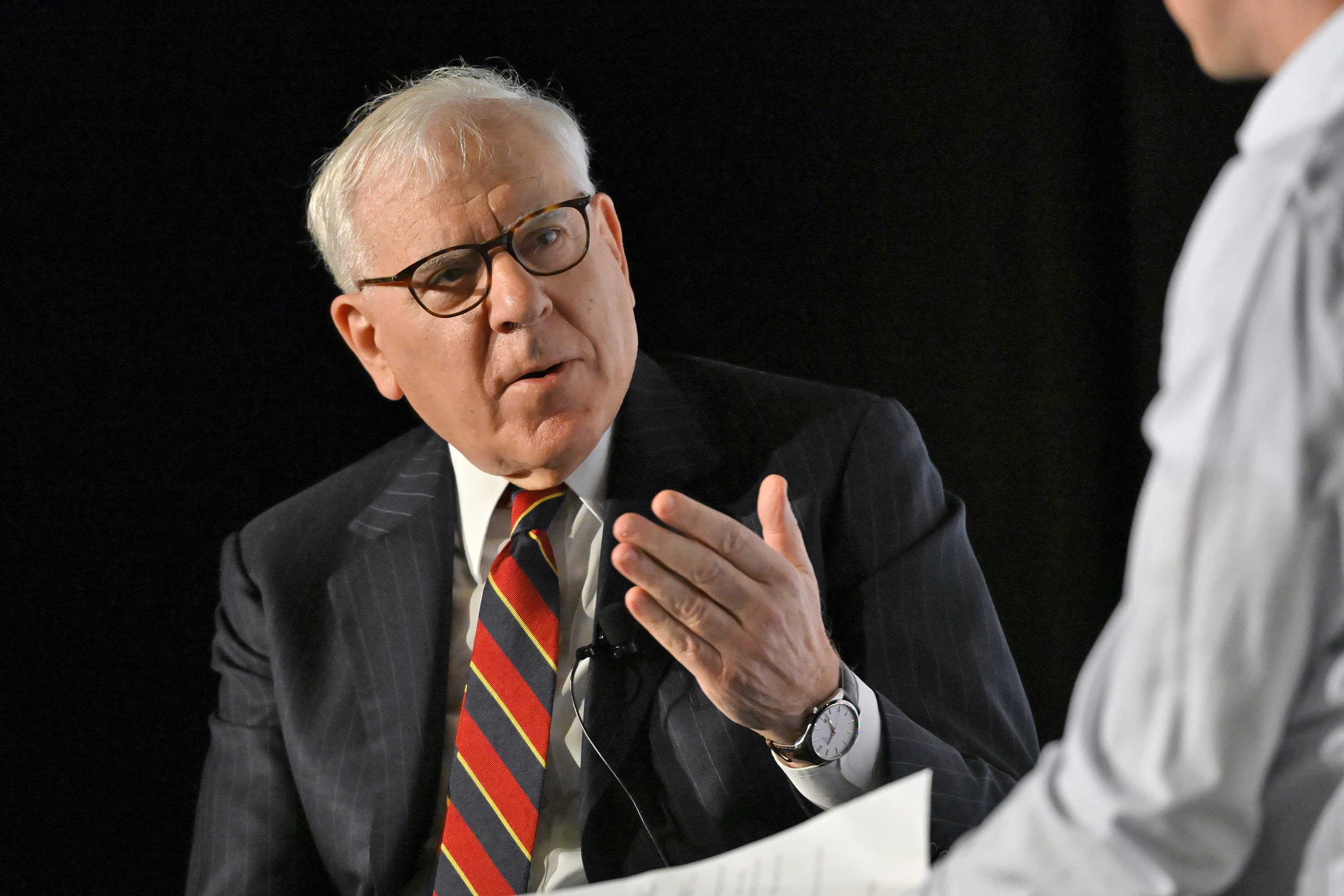
Listen and subscribe to Power Players with Brian Sozzi on Apple Podcasts , Amazon Music , Spotify , YouTube , or wherever you find your favorite podcasts.
The ballooning US debt pile is akin to a ticking time bomb for the country, in part because it weakens national security, billionaire Carlyle Group ( CG ) co-founder David Rubenstein warned.
"We have, as everybody now knows, $40 trillion of debt. Now, historically, if you go back over the last, let's say, 300 or 400 years, whenever a country paid more interest on its debt than it did for its national security, that's a sign of weakness in the country. Right now, we've crossed that threshold," Rubenstein said in a new episode of the Power Players with Brian Sozzi podcast (see video above or listen below).
"We're now paying more in interest every year than we are paying on our national defense, and we're paying a trillion dollars in interest, a little bit more than that now, but we pay about a trillion dollars in national defense," he added. "And as that continues, the interest goes up, and the money available for defense goes down. That tends to weaken your national security."
The numbers surrounding the debt situation are ever more staggering.
US annual interest expense is up to a record 18.5% of federal government revenue, according to new analysis from bond investment firm DoubleLine. This is now officially above the previous record of 18.4% set in 1991.
The percentage has more than quadrupled over the past four years. The US annual interest expense currently stands at a record $1.25 trillion, more than four times the level seen in 1991.
To be sure, the surge in interest expense fundamentally threatens long-term fiscal stability.
It effectively means that nearly $1 out of every $5 collected by the government now goes strictly toward servicing existing national debt. That is money that could fund productive economic investments like defense, as Rubenstein noted, as well as infrastructure and social safety nets, such as Social Security.
As debt service costs surpass major federal programs, mandatory spending risks crowding out discretionary spending. In turn, it creates a negative feedback loop where the government must issue additional debt simply to cover its interest costs.
The structural burden also reduces the federal government's flexibility to deploy fiscal stimulus during future recessions.
Not helping matters at the moment are rising interest rates as seen on the 10-year and 30-year Treasurys.
On the consequences of the country's enormous debt, Rubenstein added, "I'd say in the end, what you're going to have is interest rates go up. It makes it more expensive for housing, more expensive to borrow money, more expensive for credit cards."
Topics in this story
Gathered from external sources. Rights to this text belong to whoever originally published it.