Bessent grilled on AI, bond market in tense House hearing: 3 takeaways
Treasury Secretary Scott Bessent faced lawmakers on the House Financial Services Committee on Tuesday, amid concerns over rapidly developing artificial intelligence (AI) and surging bond yields. During the nearly three-hour-long hearing, Bessent brushed off concerns about AI and defended his department’s intervention in the bond market. But that did not stop Democrats on the panel from taking him to task on…
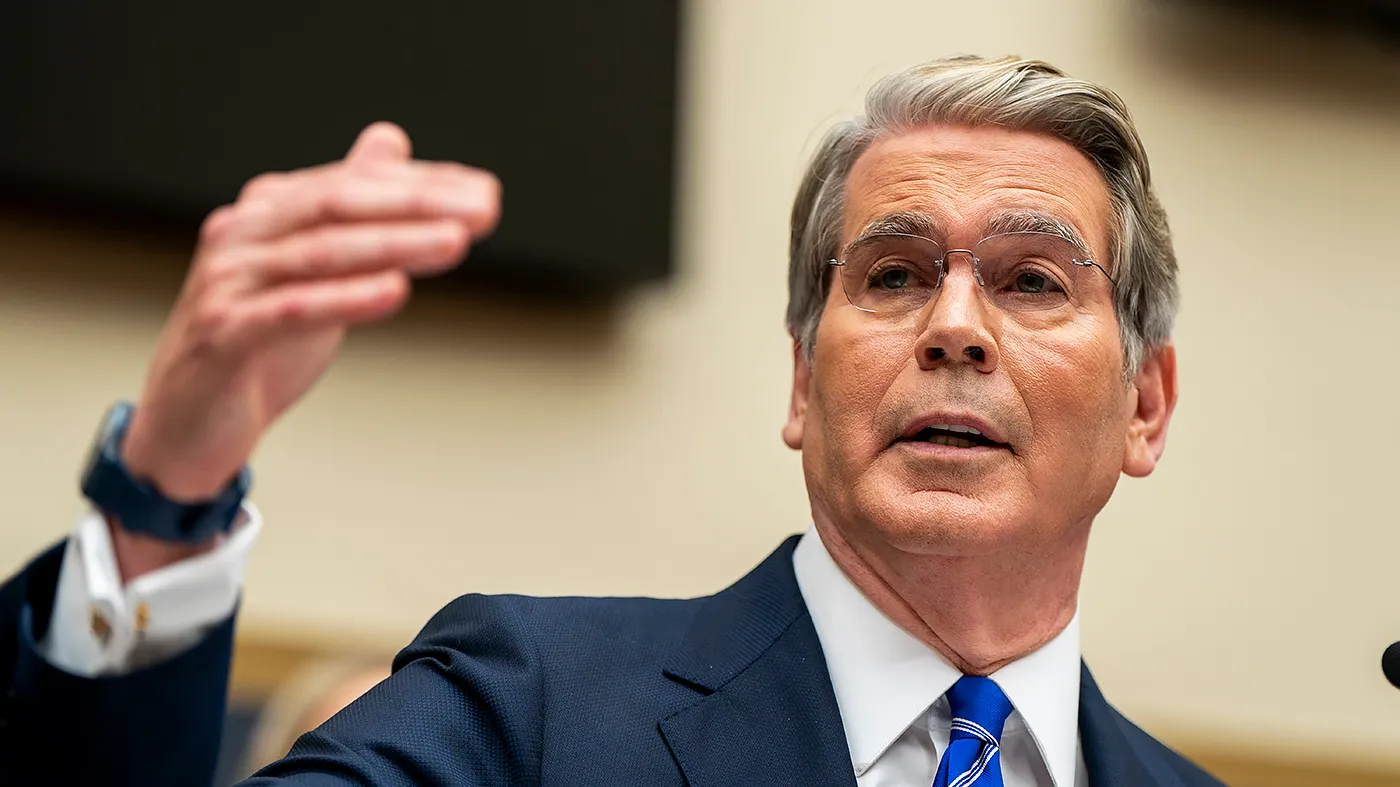
Treasury Secretary Scott Bessent faced lawmakers on the House Financial Services Committee on Tuesday , amid concerns over rapidly developing artificial intelligence (AI) and surging bond yields.
During the nearly three-hour-long hearing , Bessent brushed off concerns about AI and defended his department’s intervention in the bond market. But that did not stop Democrats on the panel from taking him to task on both.
Here are three takeaways from the hearing.
A hot topic on Capitol Hill in the last week has been AI’s rapid advancement , as industry leaders have called for a slowdown of model development.
The concerns spilled over into Tuesday’s hearing, as multiple Democrats questioned Bessent on the Trump administration’s plans to reign in the technology.
“Did you hear what Bill Gates had to say? Did you hear what Elon Musk had to say? Did you hear about Anthropic, did you hear about [Anthropic CEO Dario] Amodei?” Rep. Maxine Waters (D-Calif.), the panel’s top Democrat, asked Bessent .
In response to Waters, the Treasury secretary said AI companies “could stop” developing AI models “anytime they want to,” before the California Democrat cut him off.
“Did you hear what your friends had to say? What the big billionaires had to say? Did you understand that they said, ‘We’re moving into a dangerous period of time. We need to watch it. We need to slow down.’ Did you hear that?” she asked.
Bessent said the Trump administration “has been at the forefront of examining” AI models under a voluntary testing framework firms have entered into with the Commerce Department’s National Institute of Standards and Technology.
President Trump has in recent weeks dismissed the need for further regulation of the AI industry, doubling down on his view that the U.S. must beat China in the AI race.
“There is a SICK conspiracy going on against AI and Data Centers, and the only one that is happy about it is China,” the president wrote Monday on Truth Social.
But Rep. Stephen Lynch (D-Mass.) said during the hearing it “probably doesn’t matter” if the U.S. or China lead on AI, adding, “If you don’t have control of [an AI model], and it has preferences and goals that are inimical to the existence humanity, it won’t matter.”
Bessent argued otherwise, saying which country leads in the U.S.-China AI race “matters a great deal.” But Lynch cut him off, saying “the entity itself is what is the danger” to humanity.
“What I’m saying is, I hope there’s a way that you might be able to talk sense to the president about AI and the threat that you and I know it presents,” the Massachusetts Democrat later told Bessent.
Himes blasts Bessent’s ‘communist’ intervention in bond market
The hearing also came against the backdrop of bond yields rising to highs not reached since before the 2008 global financial crisis.
Bessent has tried to tamp down yields by increasing how much in government bonds the Treasury can repurchase — tripling the limit in the 10- to 20-year sector from $2 billion to $6 billion.
The Treasury put the plan into action on Thursday, buying back nearly $5.2 billion worth of 10- to 20-year securities. Rep. Jim Himes (D-Conn.) took issue with the operation, telling Bessent it equated to an unnecessary intervention in the bond market.
“I can think of no administration in the last 50 years that is quite as communist as the Trump administration,” Himes said.
The 10-year U.S. Treasury bond yield topped 5.04 percent on Tuesday morning, the highest intraday mark since July 2007. The yield, which 30-year mortgage rates closely track, closed at above 5 percent, marking the first time it has done so since April 2007.
Noting the 10-year bond yield has risen by nearly 20 basis points since the start of trading on Wednesday, Himes asked Bessent if his bond market intervention was “successful.” When the Treasury secretary replied affirmatively, the Connecticut Democrat pushed back.
“Wait, wait, wait. … The 10-year went up by 20 basis points,” the Democratic lawmaker remarked with his arms outstretched. “How can you say it was successful?”
Bessent defended his actions, saying the last two Treasury auctions were “the two most successful” such operations in the last 20 years.
“The U.S. bond market, it continues, during [the] past month … since President Trump has come in, it has been the best-performing bond market in the developed world,” the Treasury secretary added.
Protesters demonstrate against Iran sanctions, Cuban oil blockade
Just as Bessent was getting into his opening statement , a woman from the gallery interrupted him and yelled, “Stop the sanctions that are killing Iranian civilians.”
The demonstrator, holding a sign reading, “Sanctions kill Iranians,” got within a few feet of Bessent and told him he was “murdering our families.” The Treasury secretary has targeted the Islamic Republic and its benefactors with stringent sanctions — focusing on the aviation , banking and oil industries.
The woman was not the only protester to interrupt Bessent’s opening statement. After a U.S. Capitol Police (USCP) officer escorted her out of the hearing room and the Treasury secretary resumed his remarks, a man seated behind him stood up and called Bessent a “war criminal.”
“Stop the sanctions on Iran,” said the man, donning a shirt that read “No war on Iran” and holding the same sign as the first protester. He was one of four total anti-Iran war protesters law enforcement officers removed from the hearing room, while the first woman kept chanting from the hallway in the Rayburn House Office Building.
A fifth protester, holding a sign that read, “Sanctions kill Cubans,” called Bessent a “murderer” during his opening statement. The Trump administration has since January blockaded Cuba from receiving Venezuelan oil, sparking widespread blackouts on the Caribbean island.
A spokesperson for the USCP told The Hill the five protesters were arrested for violating Washington, D.C., law against crowding, obstructing and incommoding in public places.
“The United States Capitol Police has a responsibility to ensure each individual’s rights under the First Amendment of the U.S. Constitution are protected,” the spokesperson noted, adding there are “multiple locations” outside Capitol office buildings where individuals can legally demonstrate.
If convicted, the protesters could face up to $500 in fines and up to 90 days in prison.
Topics in this story
Gathered from external sources. Rights to this text belong to whoever originally published it.