Larry Fink on the lost ‘bedrock of America’ and ‘a big divide’ between wages and investment wealth
The BlackRock CEO's father "essentially had one job in his career," he said at Ford Accelerate. "I think we lost that."
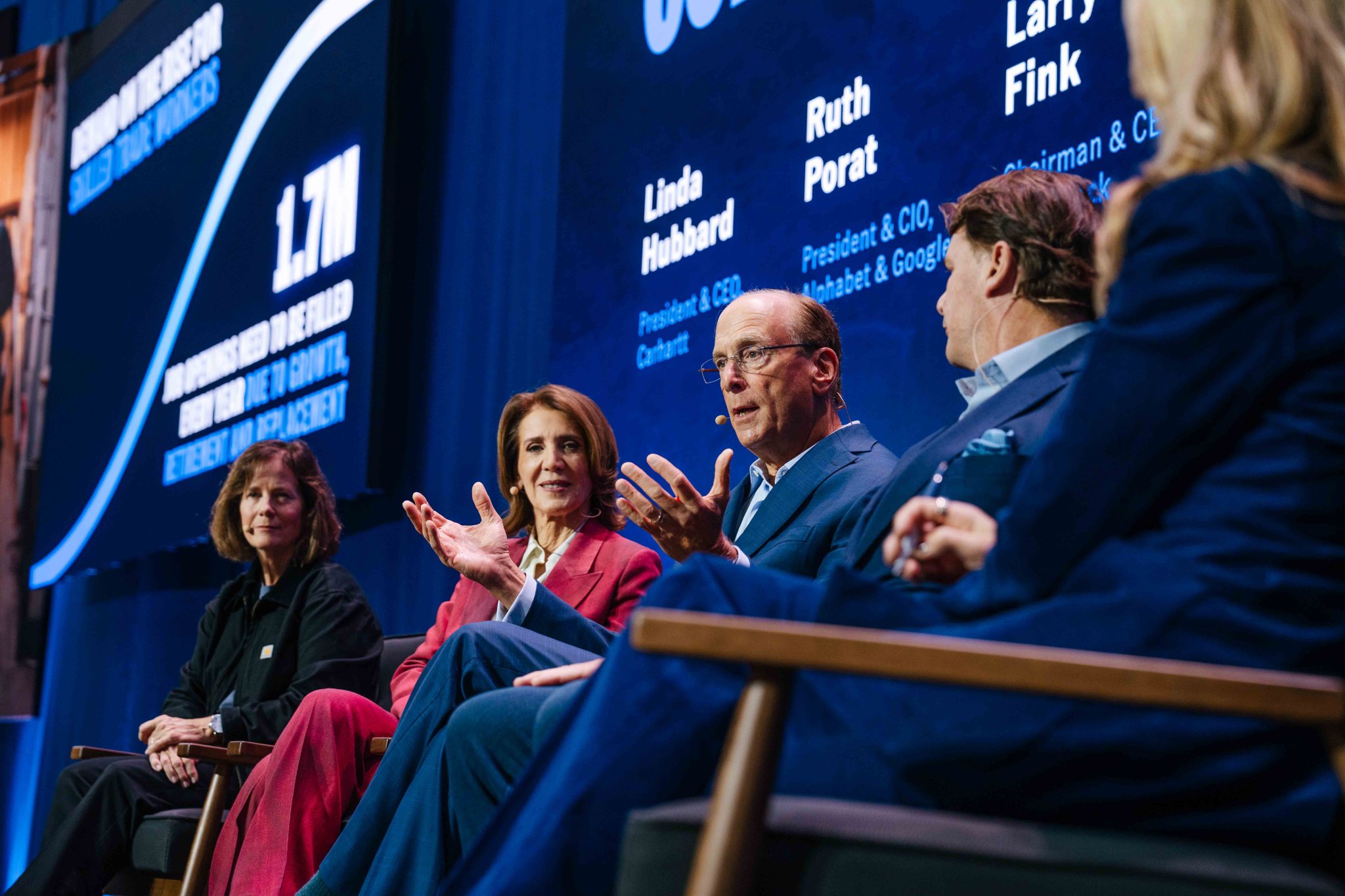
Larry Fink remembers a time when a career was something a person kept for life. That time is gone, he said.
"When you think about what the bedrock of America was, it was about having a career," the BlackRock chairman and CEO said Wednesday at Ford's Accelerate forum at Michigan Central . "I think we lost that." He described how people then began "jumping around to jobs and jobs and jobs," and it became rare to have a "connection to where you work."
Fink said the churn weakens the tie between a worker and an employer. "It doesn't create the stability in life," he said, arguing that "we all need to focus on how to rebuild that foundation." That has to be rebuilt "on trust" but also the certainty that if you choose a career, that career can take you throughout a life journey through raising a family, building your children's careers, ultimately to retirement. "This is more of a fantasy than a reality for too many families," he said, "and we've got to bring those values back."
His model was his father. "My father essentially had one job in his career, and that was a foundation of America," Fink said. His father owned a shoe store, where Fink started working at 11. Asked whether that was legal, Fink joked, "I don't think anyone was paid minimum wage."
Fink spoke on a panel called "America's Skilled Trades Resurgence: A Call for Collective Action" with Ford CEO Jim Farley, Carhartt President and CEO Linda Hubbard, and Alphabet and Google President and Chief Investment Officer Ruth Porat. Journalist Poppy Harlow moderated. The panelists drew on " The State of America's Skilled Trades: A National Report ," released this week by the Alliance for America's Skilled Trades, which Fortune revealed in July was formed by Ford, BlackRock, Google and Carhartt.
The report projects about 1.7 million skilled-trades openings a year through 2035. Harlow said it found only 55 people being trained for every 100 jobs available. She also said only about half of those who start training programs finish, compared with about 90% in high-quality apprenticeship programs.
The overall numbers only partly back up Fink's argument about the lost bedrock of careers in the U.S. economy. The median wage and salary worker had been with their current employer 4.1 years in January 2026, according to the Bureau of Labor Statistics . In January 1983, the earliest year in the series, it was 3.5 years, according to earlier BLS data .
Break the data out by sex, and Fink's argument holds up—but only for men. In 1983, men 55 to 64 had been with their employer a median 15.3 years. By January 2026, that was 9.6 years. Men aged 45 to 54 fell from 12.8 years to 7.7 years. The figures cover wage and salary workers only, so a shop owner like Fink's father wouldn't be counted at all. The job-for-life that Fink remembers looked a lot like the one Farley went on to describe about his own grandfather, who worked for Ford.
Topics in this story
Gathered from external sources. Rights to this text belong to whoever originally published it.