Transmission delays behind RE curtailment, not excess capacity: MNRE secy
New Delhi: Rejecting concerns that India was adding renewable energy capacity beyond what the power system can absorb, new and renewable energy secretary
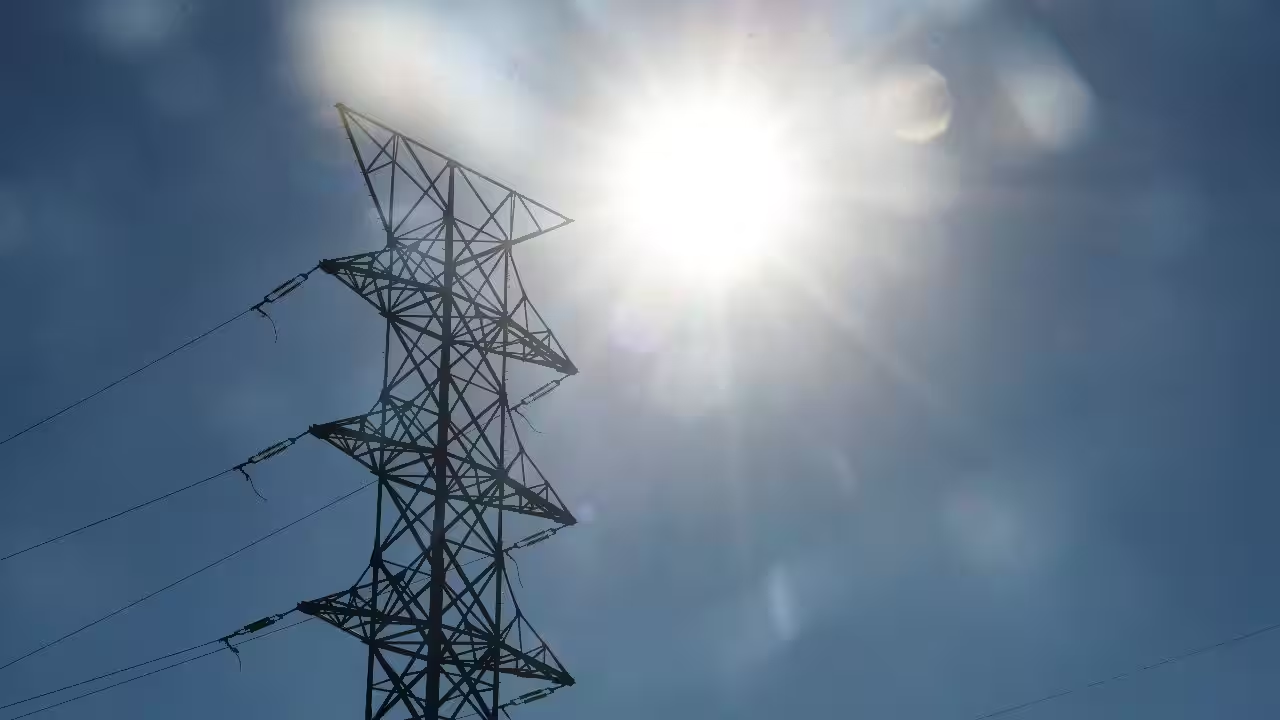
New Delhi: Rejecting concerns that India was adding renewable energy capacity beyond what the power system can absorb, new and renewable energy secretary Santosh Kumar Sarangi said delays in transmission infrastructure were primarily responsible for curtailment of renewable power.Talking to TOI, Sarangi said renewable capacity is generally developed against identified demand - through power purchase agreements, contracts with commercial and industrial consumers, or distributed renewable energy schemes such as PM-KUSUM and PM Surya Ghar. Curtailment has largely resulted from delays in transmission lines needed to evacuate renewable power. In some cases, projects are using temporary general network access, but the additional transmission capacity available under such arrangements cannot be assured round the clock.“So, from that point of view, you can’t claim that we have more RE capacity than is needed,” Sarangi said. “The solution is to expedite the transmission lines and complete them, and the second is to use more and more battery energy storage.”Curtailment of renewable energy - the intentional reduction or restriction of electricity output from sources such as wind or solar when generation exceeds the grid’s transmission capacity or local demand - has emerged as a major challenge for developers as well as the govt. In the first quarter of the ongoing financial year, nearly 8,133 gigawatt-hours of solar power was curtailed, which is estimated to be equivalent to 1.5 days of the country’s total electricity consumption.Sarangi said battery storage could also help improve utilisation of transmission infrastructure in renewable energy-rich regions. Solar-heavy transmission lines are typically used for only six to eight hours during the day. If sufficient battery storage is available, the same transmission network can be used to evacuate stored power during night hours.This could increase transmission capacity utilisation and allow more renewable energy to be connected to the same substations. Sarangi said the ability to expand and utilise renewable energy along with battery energy storage has much greater potential, with transmission utilisation potentially increasing almost two-fold in some solar-dominated areas.According to a Rubix Data Sciences report, India needs over 236 GWh of battery energy storage systems by FY 2031-32 to enable seamless integration of the increasing share of renewable energy into the grid. The cumulative installed BESS capacity currently stands at about 13.5 GWh, with over 150 GWh in the pipeline.Sarangi said both co-located and standalone BESS projects would be required. While co-located storage would be preferable for renewable energy projects as it would improve utilisation of transmission lines, standalone systems would be useful for managing surplus power and peak demand.On nearly 45GW of renewable energy projects that have received connectivity but are unable to sign power purchase agreements, Sarangi said a proposed amendment by the Central Electricity Regulatory Commission could provide an exit route for developers, allowing them to surrender connectivity without losing the bank guarantee furnished for it.You use AI every day. Now get your AI Quotient. Take the AIQ test.
Topics in this story
Gathered from external sources. Rights to this text belong to whoever originally published it.