Trump tariff taxes Republicans: What US midterm results mean for Indian H-1B visa holders, Russian oil & trade deal
US President Donald Trump has suffered a major blow in midterm elections with Republicans losing control of both the House of Representatives and the
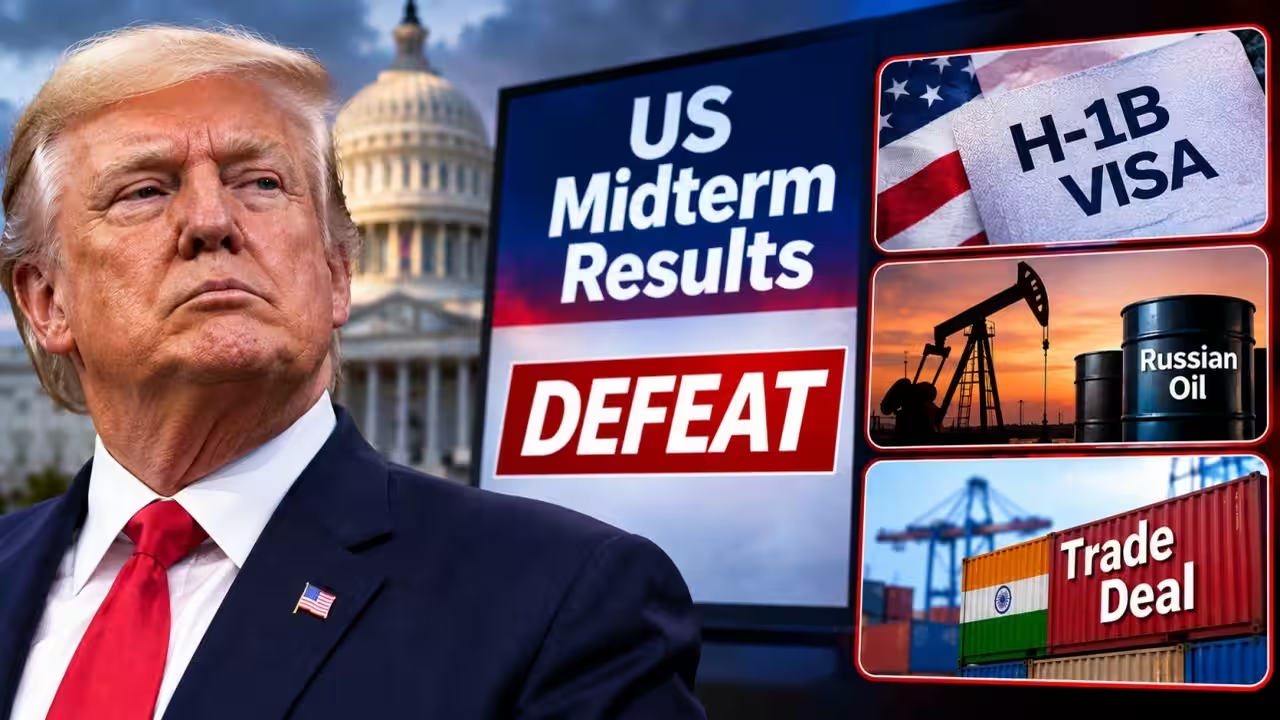
US President Donald Trump has suffered a major blow in midterm elections with Republicans losing control of both the House of Representatives and the Senate.In a significant rebuke to Trump, American voters on Tuesday handed control of the US Congress to the opposition Democratic Party and shifted several key gubernatorial positions in closely watched elections.Trump's Republican Party suffered major defeats in its strongholds, including Texas, Georgia and Iowa, losing the governors' offices to Democratic candidates.Trump’s policies are being blamed by many as the reason for the loss - with tariffs and inflation in focus.The results are expected to have implications extending beyond the US - so what does this mean for India? Let’s take a look:What it means for H-1B visa holders and green card aspirantsUS President Donald Trump has tightened access to H-1B visas through a $100,000 fee and a wage-weighted selection system, making it harder for Indian professionals to secure US jobs. His administration has also suspended eight technology companies from the PERM green card programme, disrupting some workers’ routes to permanent residency and green cards. So will the midterm results change that attitude?No. Not much is expected to change on this front, despite Trump’s loss. This is because both Democrats and Republicans prioritise domestic employment.According to Ajay Srivastava, founder of Global Trade Research Initiative (GTRI), tighter immigration policies find bipartisan support.“Be it the Biden administration or the Trump one, policies are increasingly becoming restrictive and that approach is unlikely to change,” Srivastava tells TOI.Also Read | ‘Death by restriction’: As Trump sours H-1B visa dream, which Indian IT professionals face the biggest hit?According to Rajiv Dabhadkar, Founder, National Organization For Software and Technology Professionals, the H-1B debate has moved beyond party politics to a fundamental US policy challenge: protecting American jobs while retaining access to global talent.“Regardless of the outcome of the midterm elections, the US is looking to address long-standing flaws in the immigration system, including wage protections, worker displacement and how employers use foreign professionals,” he tells TOI.What fundamentally needs to be understood is that H-1B reform is now a bipartisan American policy imperative, not merely a political reaction to one administration, he adds.India’s purchase of Russian oilEarlier this year, the Donald Trump administration managed to get support for the Lindsey O. Graham Sanctioning Russia and Iran Act of 2026. The Act allows the US President to impose tariffs of up to 100% on countries importing oil from Russia and Iran in a big way.India and China lead the lot of Russian oil buyers. Recently, Trump announced a waiver on those tariffs for India. But, it’s important to note that the waiver was only for a period of 60 days.Also Read | Does Trump’s 60-day tariff waiver really give relief to India? What it means for US trade deal & oil pricesThe Republicans losing control of the Congress is unlikely to change the Trump administration’s stance on buyers of Russian crude oil. This is because the bill enjoyed bipartisan support - both Democrats and Republicans appear keen to penalise buyers of Russian oil.However, what may work in India’s favour for now is America’s own diesel deal with Russia and the need by the Trump administration and even the Democrats to keep oil prices in check. Sanctioning Russian oil or penalising buyers of Moscow’s crude will not help that cause.So, for now India continues to enjoy relief from the prospect of 100% tariffs for its crude oil procurement from Russia, but this may work as a pressure tactic by the US to finalise a trade deal.India-US trade deal & tariffsFor India, which is still negotiating a trade agreement with the United States, the outcome of the midterm elections could strengthen the case for taking a cautious, wait-and-watch approach.Earlier this month, Commerce minister Piyush Goyal said the first phase of the India-US trade agreement was in the final stages of drafting. However, he stressed that New Delhi would move ahead only if the terms gave Indian exporters an edge over their competitors.India and the US have already finalised a framework for the first phase of the Bilateral Trade Agreement. However, changes in the US tariff environment have led to further negotiations. India is seeking tariff rates on its exports that are more favourable than those faced by competing countries.In the meantime, experts believe the midterm setback could prompt Trump to pursue an early trade agreement with India. They said that with Washington struggling to exercise foreign policy leverage over Russia, China and Iran, Trump may look for quick success on the trade front.However, the economic think tank GTRI said the unfavourable midterm outcome was unlikely to fundamentally alter Trump's trade policy. Both Republicans and Democrats, it noted, support economic nationalism, domestic manufacturing and robust supply chains."With foreign policy leverage failing against Russia, China, and Iran, Trump needs a quick win. Expect heightened pressure on India for a trade deal to prove American clout and the midterm losses may push Trump to seek a quick India trade deal," said Ajay Srivastava.Federation of Indian Export Organisations (FIEO) president SC Ralhan said the US continues to be an important destination for Indian goods and services."What will matter to Indian exporters in the months ahead is how US policy on tariffs and market access takes shape. MSMEs in particular need predictable trading conditions to price orders confidently and plan shipments months in advance," he told PTI.You use AI every day. Now get your AI Quotient. Take the AIQ test.
Topics in this story
Gathered from external sources. Rights to this text belong to whoever originally published it.