We Build LEGO Hubble Space Telescope: a Miniature Homage to Cosmic Discovery
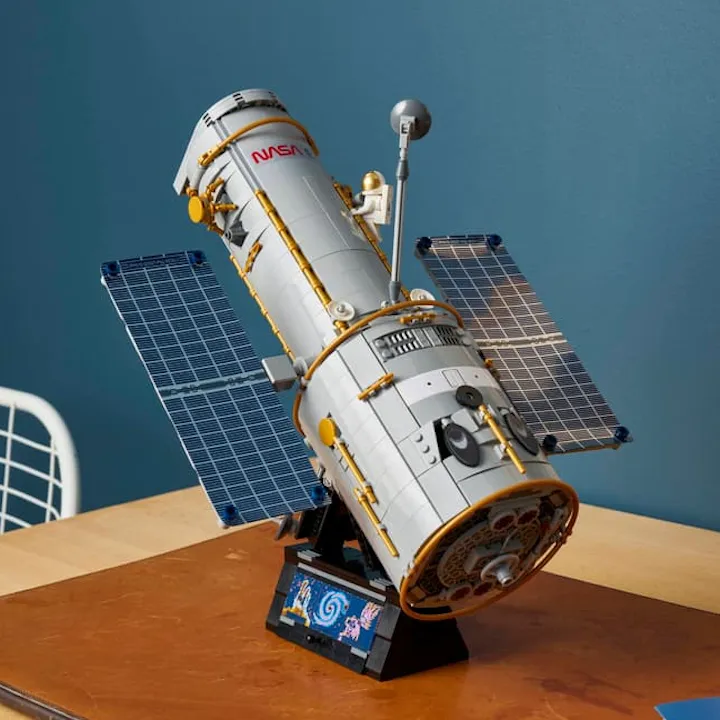
Ever since I was a child, I've always been fascinated by space. I would look up at the night sky and dream of one day becoming an astronaut, endlessly exploring the cosmos. Then I got older and decided that being stuck in a small spacecraft for months on end probably wasn't a great idea (thanks, anxiety). But my love for space still lives on, and when I saw that LEGO announced a replica of the Hubble Space Telescope, I knew I had to have it.
LEGO partnered with NASA and the European Space Agency (ESA), the two agencies responsible for building the Hubble Space Telescope, to create an accurate replica commemorating the 35th anniversary of its launch. You can purchase the LEGO Hubble Space Telescope now from Amazon and the LEGO Store .
LEGO is no stranger to making space-themed sets , with plenty of other NASA replicas available including the massive Artemis Space Launch System and the Mars Rover Perseverence, as well as sets based on popular space franchises like Star Trek and the recent Project Hail Mary . But, what I really want is for LEGO to bring back some of the classic 90's space sets like Exploriens and Spyrius – those were the best.
LEGO Hubble Space Telescope is built in three major sections spread across nine bags: the stand, the back portion that houses the instrument bay, and the narrower shaft on the front. This was a very relaxing set to put together, and pairs rather nicely with a space-themed synthwave playlist.
You begin by putting together the stand on which Hubble will be displayed. Unlike most LEGO stands, this one uses some interesting techniques with interlocking Technics pieces to create an angled post that allows the Hubble to "dock" when it's on display, helping to stabilize the unit.
At the base of the display are three translucent printed pieces depicting some of Hubble's most iconic Deep Field images: Pillars of Creation, the Whirlpool Galaxy, and the Butterfly Nebula. These are some of the coolest unique pieces I've seen LEGO make, and they look great integrated into the stand. It also includes a small plaque (which is unfortunately a large sticker on a flat piece) on the side of the support arm that provides information about Hubble, including its overall dimensions, weight, launch date, and the dates of key service missions.
While building this set, I actually learned quite a bit about the Hubble and its inner workings. Over the last three decades, it has recorded more than 1.7 million observations of our universe, producing some absolutely stunning imagery , as it circles in low-earth orbit. The instruction manual includes quite a few interesting facts about the Hubble Telescope, as well as a diagram of all of the scientific instruments recreated inside this LEGO model.
After finishing the stand, you move onto what is arguably the most important section of the Hubble: its large bottom half that houses many of its critical systems and instruments. While I expected this portion to be interesting to put together, it was fairly repetitive, as it's a lot of symmetrical sections and repeated instructions.
It didn't help that much of what I was putting together wasn't recognizable. If it weren't for the diagram in the instruction manual, I would have no concept of what I was building until the outer panels were attached. After all, most of the important components of the advanced camera and spectographs are represented by just four brown corner wall panel pieces.
Because each side is nearly identical, it's easy to get the orientaton mixed up if you're not careful. I think this is why LEGO added (what seemed to be) a random green piece on only one of the sides to help ensure you don't misplace any pieces.
After building the interior and some of the instruments, you add the panels to three of the four sides. The final side is intended to be removable, so you can look inside the bottom section and see the camera, mirrors, sensors, and baffle.
Building Hubble's upper shaft is mostly just putting together four long outer panels. Like the bottom half, the outer paneling is mostly rounded grey pieces and can get quite repetitive. These panels are all long and not very thick, so attaching them to the rest of the build requires some tact, as pressing too hard can cause them to break apart.
One interesting portion of the upper section, though, was the suspended secondary mirror, which clicks into to the panels as they are attached. These panels also lock into one another in a very satisfying way. Additionally, there's a single removable panel here that allows you to peek inside at some more of the components.
At the very end of the upper shaft is the aperture door, which features a hinge that allows you to open or close it, just like on the real Hubble Telescope.
Once the two halves of the Hubble's body are put together, all that's left is the finishing touches. This includes attaching the two communication antennas, which can be folded down or extended and rotated in any orientation, as well as building the two large solar arrays.
Thankfully, the solar arrays aren't giant stickers, as I feared when I saw the initial photographs of this set. Instead, they are thin plastic sheets with the printed solar panels on one side, and shiny silver on the back. Once attached to the telescope's body, they can be easily articulated to face any direction.
The entire time I was putting this set together, I kept wondering just how it was going to rest on the stand. It turns out, there's a small hole in the center of the body that the stand inserts into. But, because this set is a bit top-heavy, it can be slightly wobbly when on the stand when it's not stationary.
Overall, the finished product looks great on display. LEGO did an excellent job recreating the Hubble Space Telescope's iconic design and this set is a must for space enthusiasts.
LEGO Hubble Space Telescope, Set #11382, retails for $139.99 and is composed of 1,252 pieces. It is available to purchase from Amazon and the LEGO Store .
Matthew Adler has written for IGN since 2019 covering all things gaming, tech, tabletop games, LEGO, and more. You can follow him on the site formerly known as Twitter @MatthewAdler and watch him stream on Twitch .
Topics in this story
Gathered from external sources. Rights to this text belong to whoever originally published it.