Sonos Play review: The Sonos to add first
The first thing the Sonos Play teaches you is where to hold it.
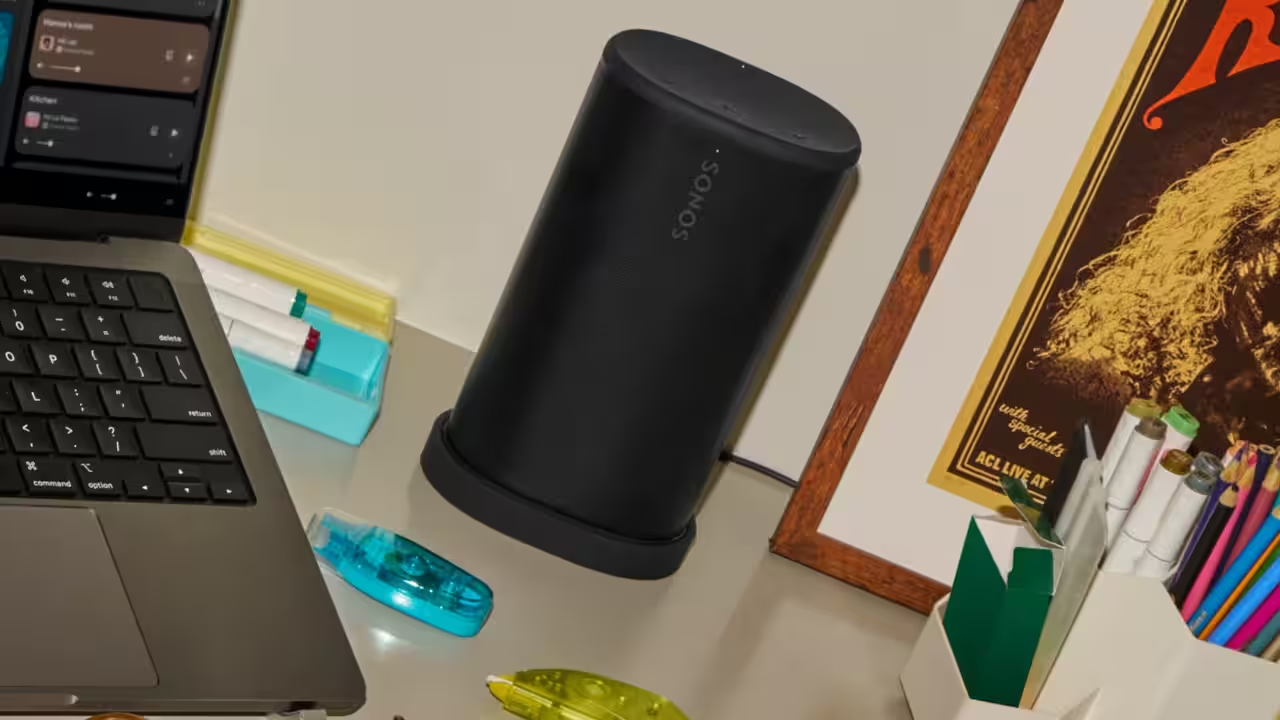
The first thing the Sonos Play teaches you is where to hold it. Pick it up by the sides, the way the oval shape invites you to, and your fingers land on the power and Bluetooth buttons at the back. I cut the music twice on the first evening, carrying it from the living room to the kitchen. By day three I was reaching for the rubber loop without thinking, which is probably why the loop is there.It's a small thing, but it says a lot about the speaker. Sonos has never made much that you hold. Its speakers sit on shelves and under TVs and stay there. Even the Move 2, the one with a handle, weighs over 3kg, and most people only ever carried it as far as the balcony. The Play is 1.3kg and about the size of a hardback, and it's the first Sonos that seems designed to be picked up several times a day.And then Sonos gave it a job that needs it to sit absolutely still.I had a pair. By evening they sat at either end of the console table behind my sofa, filling in the rear channels for an Arc Ultra and a Sub 4. By morning, one of them had usually gone somewhere else. Rs 35,999 apiece is a lot to ask of a speaker doing three jobs at once, and I spent three weeks waiting for it to slip up at one of them.The job that needs it to sit stillThe first evening went mostly into finding a charger. Each Play comes with a charging base, its USB-C cable fixed in place, but no adapter in the box, and it wants at least 18W, or 45W to fill up quickly. The second base ended up running off my laptop charger and stayed that way for the rest of the review.The surround setup itself took a few minutes. Until recently, that console-table job wasn't on offer at all. Rear speakers for a Sonos soundbar meant speakers that stayed plugged in behind you for good. Sonos 27, the software update Sonos rolled out this autumn and now calls an audio operating system, changed that, and it lets a matched pair of Plays or Move 2s sit behind any of Sonos's current Arc or Beam soundbars. I picked the two Plays in the soundbar settings, set them down behind me, and they worked out between themselves which was left and which was right, using their microphones and a high-frequency signal I never heard. Everything talks over the home Wi-Fi, so the only cables behind my sofa were the ones going into the two bases. The app walking me through it is new too, rebuilt for Sonos 27 around three plain tabs after the 2024 redesign went badly, and it got me from unboxing to surround sound without once asking me to try again.The Daytona sequence early in F1 is where I stopped thinking about setup. The cars come from behind you, and the engine note travelled from the Plays to the Arc Ultra in one sweep, with no gap where one speaker handed over to the next. The sandworm ride in Dune: Part Two did something similar with sand instead of engines, the hiss and rumble closing in from behind before the Sub 4 took the floor out from under it. A couple of nights later I loaded Forza Horizon 5 on the Xbox and spent an hour checking my mirrors less. The car closing in on my rear-left was audible before it showed up in them.Even a Sunday morning Test match got better. Commentary stayed planted at the front with the Arc Ultra, while the crowd noise and the odd roar after a boundary wrapped around from behind, which made the living room feel a few rows closer to the ground.The Plays have it easy back there, and that suits them. Neither digs very deep into the bass on its own, but with a Sub 4 in the room, they never have to. All they need to do is place sound clearly at ear height, and by the end of the first week I'd stopped noticing them at all, which is about the best thing anyone can say about rear speakers.Then the film ends, and one of them goes to the kitchen. Lift a Play off the console table and it quietly drops out of the home theatre and becomes a regular speaker wherever you set it down. Bring it back, pause whatever's playing, and it rejoins as a surround. I kept expecting this to need a trip into the app at some point over the three weeks. It never did.The kitchen at 11pmThe kitchen is where I found out what a single Play sounds like, mostly late at night, mostly over the washing up. Arooj Aftab's "Mohabbat" is mostly voice and empty space, and the two angled tweeters left that space alone, which cheaper speakers rarely manage. Lucky Ali's "O Sanam" came through warm and close, his voice pushed forward the way Sonos tunes almost everything, with the guitar clean around it. Amit Trivedi's "Iktara" had the same intimacy, Kavita Seth's voice sitting right at the front with the strings unhurried behind her.Bass is tight and well timed rather than deep. The bassline on Khruangbin's "Maria También" kept its bounce off the single midwoofer, but the bottom of it fades out sooner than the room asked for, and the Move 2 goes noticeably lower if that matters to you. The two passive radiators push against each other, so even at higher volume the speaker never buzzed or crept across the counter. I nudged the bass slider up two notches and left it there. Bass and treble are the only two sliders Sonos gives you, and that would matter later.One night I'd started "Iktara" from the Sonos app, walked to the bedroom with my phone, and only realised halfway there that the kitchen hadn't gone quiet. On Wi-Fi, the Play pulls music straight off the internet itself, from the Sonos app, Spotify Connect or AirPlay 2, rather than streaming it from your phone, so the song carried on without me. The controls followed me anyway. Sonos 27 puts them on the iPhone lock screen and in the Dynamic Island, and by the second week I was turning the kitchen down from the bedroom without opening anything.Most of those evenings it sat a foot from the sink, and the IP67 rating turned the splashes into a non-event. There were more of them than I'd like to admit. Moving it from the tiled counter to the bedroom bookshelf changed nothing I could hear, which is Automatic Trueplay listening to each room through the microphones and adjusting on its own. I only caught it working when I flipped the mic switch on the back and the kitchen version turned thin and slightly brittle. The same microphones run Sonos Voice Control and Alexa, and with dough on both hands, "Hey Sonos, skip" earned its keep. There's no Google Assistant, though, and for all those microphones, no speakerphone either. When my phone rang mid-song, I was still drying my hands to answer it.Where one runs out of roomThose two EQ sliders came back to bother me on the second Sunday, with friends over. Coke Studio Bharat's "Khalasi" is loud and busy by design, and somewhere past 80% volume the Play's upper mids turned hard and shouty, the kind of edge that makes people raise their voices instead of enjoying the song. A midrange slider would have fixed it. Without one, I brought the volume back to around 60%, where it settled and still filled the living room with room to spare.By evening I'd paired the two in stereo, and the afternoon's complaint stopped mattering. Pink Floyd's "Money" finally did what it's supposed to, the cash register sounds walking from one side of the room to the other, something a lone Play can't do however its tweeters are angled. Tame Impala's "Let It Happen" was better still, the synths swirling across the full width of the room while Kevin Parker's voice held the middle. Two Plays at 50% did more for the room than one at 80% ever could.From then on, weekend mornings were stereo pair and weeknights were surrounds, and switching between the two never took more than a tap.The furthest it wentThe furthest either Play went was a friend's terrace the last week, and it was there that it made the best case for itself as a portable speaker. One press of the Bluetooth button on the back took it off my home Wi-Fi and onto my phone in a few seconds, and holding play/pause on the second one pulled it into the same song. Sonos now lets up to four Plays or Move 2s group this way, which it never allowed before. The phone talks to one speaker over Bluetooth while the speakers keep each other in sync over a direct Wi-Fi link of their own, and I couldn't hear any lag between them. They play the same signal rather than splitting into left and right, and outdoors nobody could tell.Automatic Trueplay kept up there too. Out in the open, where most speakers turn thin, Bayaan's "Maand" kept its warmth, and Diljit Dosanjh's "Born to Shine" had enough low end to carry across the terrace without anyone asking for it to go up. For a speaker this size, it filled the space comfortably, and that evening nobody once asked whose speaker it was because it sounded small.Sonos rates the 35Wh battery at 24 hours at moderate volume. At the couple of hours a day I played it away from the base, that worked out to almost a week, and the Play went back on charge on Saturday mornings more out of habit than need. Someone's phone got topped up from its USB-C port that night on the terrace, the same port that takes Sonos's Line-In Adapter if a record player needs a speaker. And since the owner can replace the battery, a few years from now a tired cell means a new battery rather than a new speaker.Back home, the same songs sounded a touch cleaner on Wi-Fi than on Bluetooth, which only offers SBC and AAC, though I had to switch back and forth to be sure. It's heavy enough that it went in the car, never in a bag. For everywhere it actually went, that was enough.Still behind the sofaOn its own, the Play is a portable I’d happily live with. It sat by a kitchen sink for three weeks without complaint, held its own on a terrace with nobody asking for it to go louder, and only went back on charge on Saturday mornings. The compromises are small ones you work around rather than live with: a charger you have to find yourself, a weight that keeps it out of your bag, and a top end that wants the volume kept under 80%.Still, Rs 35,999 is a lot for one speaker, but it’s a price you can live with. Two cost Rs 71,998, which is a lot to spend on rear speakers, except rear speakers usually do nothing for the rest of the day, except rear speakers usually do nothing for the rest of the day, and a portable usually does nothing for your home theatre. This pair did both. If they were never going to leave the room, two Era 100s would be more affordable and slightly smoother choice. The Play makes sense because it moves, and in my house it moved almost every day.Three weeks later, I was still waiting for it to slip up at one of those jobs. The pair went from rear surrounds to a stereo pair to a kitchen speaker to someone else’s terrace, and every evening both were back on their bases behind the sofa before the film started. Sonos 27 is what gave the Play that third job, and in a house already running an Arc Ultra or a Beam, that makes it the Sonos to add first. Just hold it by the loopOur rating: 4/5You use AI every day. Now get your AI Quotient. Take the AIQ test.
Topics in this story
Gathered from external sources. Rights to this text belong to whoever originally published it.