The Developers of Upcoming 'Espresso MOBA' Project Zeta Want It to Feel Like a Formula 1 Race
Project Zeta is a mashup of multiple live-service genres, but for developer Nirvanana, it’s best described as an “espresso MOBA.”
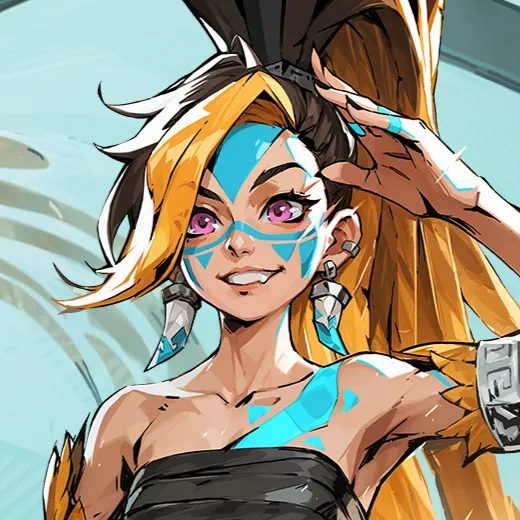
Project Zeta is a mashup of multiple live-service genres, but for developer Nirvanana, it’s best described as an “espresso MOBA.”
This four-teams-of-three ‘Tactical Hero Arena’ third-person action game is, essentially, a race involving as many teamfights as possible. The game actively encourages teams to fight each other, scrapping over objectives throughout each phase of a session. MOBAs typically focus combat down lanes, but in Project Zeta, around three minutes into each session, the focus becomes fighting over objectives. You have to seek out teamfights to win. This is not a game about hiding in bushes.
Each session is made up of seven phases. The first phase sees players defeat ordinary monsters to level up — all very MOBA. It’s a warmup phase meant to give players breathing room to develop a strategy. Generally, you’re on the hunt for prisms, which drop from prism bosses. Grab one then take it to one of the ballasts in the center of the map to score a point. The first team to score five points wins, exiting the game in first place.
“What we're aiming to deliver is a removal of the lane-ing in traditional MOBAs,” Nirvanana CEO Namseok Kim told me at gamescom 2026. “It's objective-driven with a lot of teamfights. So that compressed experience is what we're looking for. As fans of the MOBA genre, we believe that the fun of MOBAs comes from playing smart and winning the teamfights. And we need it so that you can enjoy an endless supply of that kind of experience in the compressed 20-minute time of a session. It's going to be a very dense experience. So we wanted to propose a new kind of MOBA.”
Another unique aspect of Project Zeta is its lack of a crosshair at the center of the screen, which you typically see in hero shooters and 3D MOBAs. This means basic attacks always land. More accurate aim does not factor into fights; instead, the idea is that success comes from your understanding of the each hero's abilities, mind games, and positioning. Combat is a sort of dance between dodging enemy attacks and making sure your attacks land.
Reducing downtime, players in eliminated teams are immediately revived with their cooldowns and HP restored. Battle royale MOBAs typically restrict players to a limited number of lives, so players play passively in order to survive. Project Zeta has a score race with unlimited respawns and a quick time-to-kill. The game wants players to take risks to eliminate other teams, and because everything is restored once a team is eliminated, the hope is that players won’t shy away from getting into scraps.
“We wanted the sessions to feel like a Formula 1 race,” Namseok Kim said. “Everyone is racing toward these objectives. That is what Project Zeta is.”
Like a racing game, Project Zeta displays a scoreboard on the top left that fluctuates as teams turn prisms in. “Everything needs to happen in 20 minutes,” Namseok Kim explained. “So everything that makes a MOBA fun is compressed into that short time. Yesterday, one journalist said that if other MOBAs are coffee, then Project Zeta could be like instant espresso. And we agreed, that was a great analogy. We had made up the term ‘multi-team tactical arena’ to describe Project Zeta, but personally I like ‘espresso MOBA’ better.”
Namseok Kim said that one of the reasons he made Project Zeta is because his daughter thought a game of Riot Games’ League of Legends took too long. “There's too much to learn,” he said. “There's too much to memorize. And I played League of Legends with her 10 times and every time she didn't like it. I made Project Zeta to help her approach MOBAs, and I think that would maybe make the concept accessible.”
It’s also worth noting that Project Zeta was built from the ground up to be playable on a controller, with the goal that PC and console players can compete on a level playing field. There’s also an auto-itemization scheme. Outside of a session, you can set up your skills in advance to focus more on aggression, support, or defense, and then when you enter a session, Project Zeta will automatically purchase the necessary skills for you.
Reinforcing the focus on quickfire combat, Project Zeta has no pure tankers or pure healers. “Personally, I think pure tankers and pure healers are kind of boring!” Namseok Kim said. “And if we had these kinds of characters, it drastically increases the time-to-kill. And if you have a longer time-to-kill, in a session, the third team that joins is usually the most advantageous because A and B are already engaged in combat. And even if A… they won, if their HP is already low, they're tired. And if the third team comes in, they're probably going to have the upper hand. In order to guarantee the proactiveness of a multi-team, we have to have a short time-to-kill. And that's why we don't have pure tankers or pure healers.”
The question for Nirvanana, of course, is will Project Zeta have enough of a pull to drag MOBA fans away from their current favorite game. Will players ditch League of Legends or Dota 2, for example, to give it a try, at a time when most video game companies are finding it increasingly difficult to make a dent in the established players? The fast-paced nature of the game, its streamlined design, and its availability on console may help it stand out.
Project Zeta, developed by Nirvanana Studio and published by PUBG company Krafton, is currently confirmed for PC via Steam and PlayStation 5.
Wesley is Director, News at IGN. Find him on Twitter at @wyp100. You can reach Wesley at wesley_yinpoole@ign.com or confidentially at wyp100@proton.me.
Topics in this story
Gathered from external sources. Rights to this text belong to whoever originally published it.