Murphy takes fight against Iran war to Middle East
Sen. Chris Murphy (D-Conn.), this past week took his fight against the Iran war to the Middle East, seeking to expose damages caused by the conflict that he has repeatedly accused the Trump administration of trying to cover up. Murphy, who sits on the powerful Senate Foreign Relations and Appropriations committees, traveled to Qatar and…
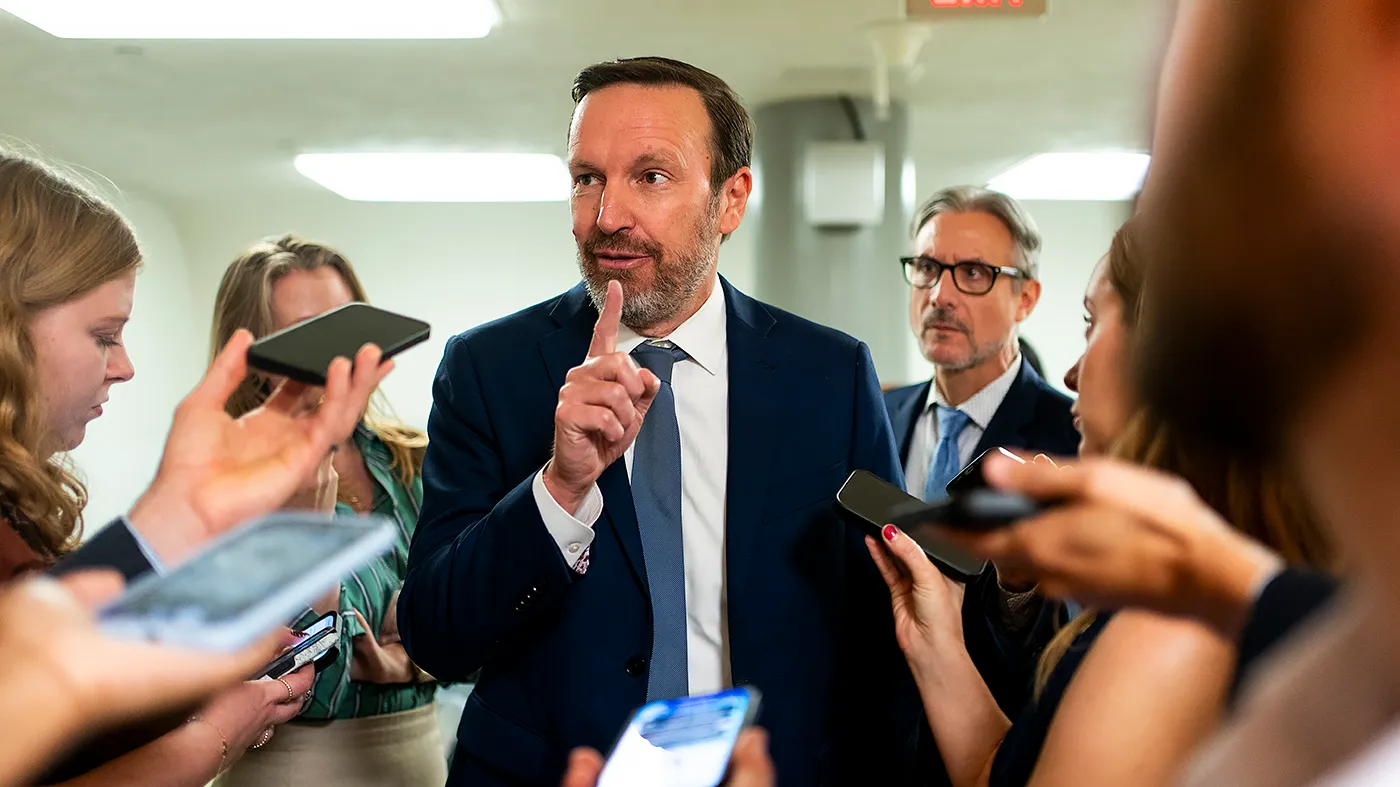
Sen. Chris Murphy (D-Conn.), this past week took his fight against the Iran war to the Middle East, seeking to expose damages caused by the conflict that he has repeatedly accused the Trump administration of trying to cover up.
Murphy, who sits on the powerful Senate Foreign Relations and Appropriations committees, traveled to Qatar and Saudi Arabia, where he met with high-level officials and saw firsthand the “extraordinary” damage to the U.S. embassy in Riyadh caused by a drone attack in early March, he told reporters in a call Thursday.
But there was one place he said he was barred from entering during his Congressional Delegation trip: Al Udeid Air Base, Qatar, the largest U.S. military installation in the region that houses up to 10,000 troops. Iran has repeatedly attacked the base since the Trump administration began its war on Iran on Feb. 28.
Murphy, an outspoken critic of the Iran war, says the Pentagon has barred him and other lawmakers from accessing the base or even meeting with defense officials in the region in a deliberate attempt to hide the true toll of the nearly eight-month conflict.
“They are using every tool they can, including withholding information about damages, slow-walking the pace of reports about casualties and denying us access to see the damage as part of a campaign of cover-up, so as to mask the true cost of the war,” said Murphy, who asked to access the base with a formal written request as well as speaking personally with U.S. Central Command head Adm. Brad Cooper prior to the trip.
The rejection is notable as he said it marked the first time in Murphy’s 20-year career on Capitol Hill that he was barred from accessing a military base to conduct oversight. He pointed to his travels to Iraq and Afghanistan at the height of each war in both countries as a stark contrast.
“I was flown by the military to a forward operating base in Afghanistan at the very moment that base was under attack by the Taliban. Why? Because it’s Congress that decides whether to fund a war or whether to defund a war, whether to authorize a war, and we can’t do our job without seeing in person the consequences of the war,” he said.
Murphy also had sought to receive a briefing from U.S. military leaders while in the Gulf region, but was denied access by the Pentagon, an issue he said he raised with Cooper.
“He promised to go back and see if it would be possible to at least provide a briefing,” Murphy said. “My impression was that he didn’t support either policy — the policy to deny access to the bases, nor the policy to refuse briefings. But apparently, he couldn’t change [Defense] Secretary [Pete] Hegseth’s mind.”
The Pentagon says the senator’s office was informed prior to the trip that he would not receive permission to access Al Udeid, pointing to Hegseth’s March directive on travel restrictions in the region.
“That decision was communicated in advance by the Office of the Secretary of War for Legislative Affairs. The Department applies the Secretary’s guidance evenly,” a senior Pentagon official told The Hill in a statement.
Murphy’s trip came as new details emerged about the extent of damage wrought by Iran amid the war, which started more than seven months ago.
At least 81 U.S. military aircraft and drones have been damaged or destroyed since the war began, according to a new report prepared for lawmakers by the Congressional Research Service (CRS). That includes 45 MQ-9 Reaper drones, three MQ-1 Predator drones and one MQ-4C Triton long-endurance aircraft.
The war has badly depleted U.S. stockpiles of long-range missiles and missile interceptors, forced the U.S. to consider downsizing its military footprint across the region, and damaged U.S. diplomatic facilities in four Persian Gulf countries — Iraq, Kuwait, Saudi Arabia and the United Arab Emirates. Centcom told Congress in mid-September that the price tag of the conflict was $43.6 billion.
Murphy’s visit also coincided with an escalation in the fight between Saudi Arabia and the Iran-backed Houthi rebels in Yemen. A Houthi attack on the international airport in Riyadh on Saturday killed 12 people, including an American, and injured hundreds more.
The veteran senator is among a long list of Democrats seen as potential contenders for the Democratic presidential nomination for 2028. An effective communicator on social media and a frequent guest on cable news, the center-left lawmaker has been a leading Democratic voice in pushing back on Trump’s second-term foreign policy, often traveling the world to make his point.
On Thursday, Murphy relayed conversations he had with Saudi Crown Prince Mohammed bin Salman, who the senator has often criticized for human rights abuses. He said the two spoke on “Trump’s foreign policy corruption.”
“The problem is that Trump is shaping our foreign policy in order to try to get deals in the region,” Murphy said, pointing to the president’s willingness to sell Saudi Arabia F-35 fighter jets and accept a Boeing 747 from Qatar to be a new Air Force One.
“These were hard conversations, but I think that they were very important, especially since most of the dialogue our leaders in the Middle East are having is with corrupt members of the Trump administration who often have their hand out, looking to monetize American foreign policy,” he said.
He also said the Iran war “is a moment for the United States to reconsider its footprint in the region,” as the country is seeing that its bases “are sitting ducks for the Iranians.”
“They are not protecting us because the minute a war erupts, they get immediately taken offline. What good is a base if you can’t protect it longer than the first few days of a war with an adversary?” Murphy told reporters. “We may have a need to keep some personnel there. It’s not clear it’s in our best interest to build those bases up to what they were before.”
Looking ahead, Murphy said that in the coming days he would draft language requiring the Pentagon to give lawmakers access to overseas bases under all circumstances and would seek to include the language in next year’s appropriations and defense authorization bills.
“I don’t have any illusions that that’s going to pass between now and the end of the year,” he said of the bill.
And should the Iran war not be over by early next year, Congress should not appropriate funding for the Pentagon unless lawmakers include a provision to end the conflict in the annual defense authorization bill.
“I’m glad I made the trip because I was able to see things and see damage that I wouldn’t have been able to see otherwise,” Murphy said. “But this is a really dangerous moment when the administration is giving its middle finger to the Congress, pretending as if we are totally irrelevant, and they can get away with that for the next few months because Republican leadership in the Senate and the House are not going to draw a line and require that we be able to see for ourselves the damage that’s been done overseas.”
Topics in this story
Gathered from external sources. Rights to this text belong to whoever originally published it.