What would the new bipartisan permitting reform bill actually do?
This week, a bipartisan group of senators announced a major permitting reform bill aimed at speeding up the build-out of the nation’s infrastructure, especially energy projects. While it’s not clear if the bill will become law, it appears to have the backing of a significant number of legislators as well as leaders in both parties.…
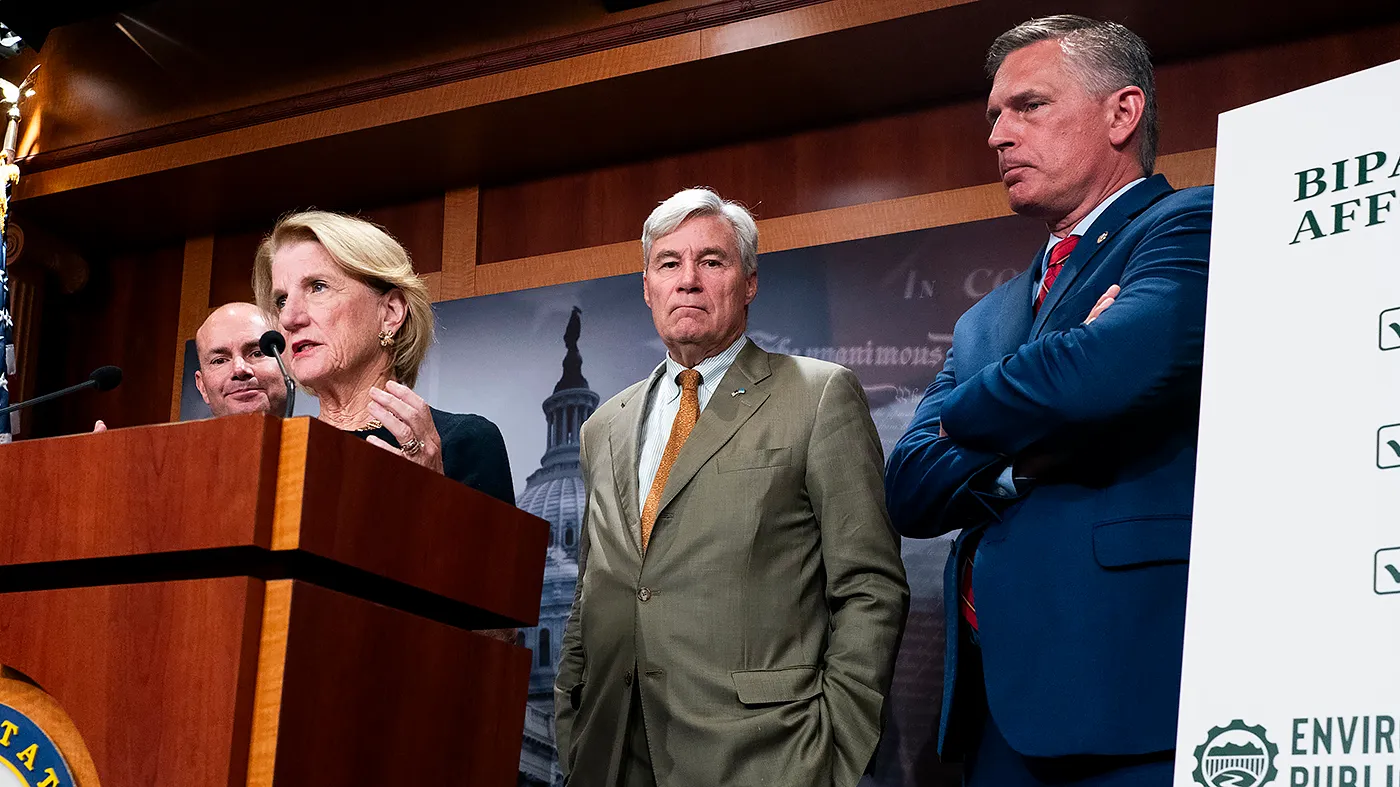
This week, a bipartisan group of senators announced a major permitting reform bill aimed at speeding up the build-out of the nation’s infrastructure, especially energy projects.
While it’s not clear if the bill will become law, it appears to have the backing of a significant number of legislators as well as leaders in both parties.
Here’s what the bill, known as the Bipartisan American Affordability and Jobs Act, would actually do:
Limit environmental laws that hold back projects, while restricting lawsuits
A major component of the legislation is changes to the nation’s environmental laws that could make it easier to build projects and make it harder to block them, either with lawsuits or other legal mechanisms.
One of the biggest changes is limits that restrict lawsuits against projects, mandating that they be filed within 150 days of a project’s approval. It also limits lawsuits to only those who weighed in publicly if the project has a public comment period and those who may be directly harmed by a project.
The changes are contentious, with supporters saying they will cut down on lawsuits that can interrupt a project years after it is approved, while opponents say the short window could stymie legitimate complaints.
The legislation also aims to make it harder for states to block projects such as pipelines that run through their waters, limiting the reasons states can invoke the Clean Water Act to deny approval.
Similarly, it could make it harder for the Environmental Protection Agency (EPA) to block projects.
John Nagle, federal policy manager at the libertarian-leaning Pacific Legal Foundation, said that current law “really gives the EPA administrator more or less carte blanche to cancel projects” under the Clean Water Act, while the bill would “reform the window by which the EPA administrator could exercise that … veto authority to get rid of either preemptive or probably even worse, retroactive vetoes.”
Nagle added the change, which he supports, would make it easier for projects “to have the certainty necessary to move forward.”
However, critics say this measure could prevent the EPA from blocking projects that have the potential to harm the environment.
“When we think about the biggest, worst projects like Pebble Mine and how EPA has been [in] this multidecade long fight to stop this mine that would destroy one of the world’s greatest salmon runs … You would never be able to stop Pebble Mine in the future because of the changes made today,” said Brett Hartl, government affairs director at the Center for Biological Diversity, pointing to a contentious project in Alaska .
The law would also make changes to the Endangered Species Act that environmental advocates argue could put species in danger.
Hartl particularly pointed to a change in the definition of “best available science” that’s required to be used to determine whether a species should get legal protections, saying the proposed definition creates too high a threshold and could prevent truly threatened creatures from being protected.
“It’s impossible to meet these standards,” he said.
As a whole, these provisions are the basis for some Democrats and environmentalists opposing the legislation, arguing that the changes could mean more harm than good.
“We can’t throw states, tribes, impacted communities, and threatened and endangered wildlife under the bus. And as we streamline and cut red tape, we must make sure the American people — not just powerful corporate interests — have a say in government decisions about what happens to our air, water, and public lands,” top House Natural Resources Committee Democrat Jared Huffman (Calif.) wrote in a post on social platform X , saying that Democrats should renegotiate after the election.
However, supporters say the reforms are crucial to speeding up construction of important infrastructure.
“It takes like 29 years to build and permit a mine here in the United States, so we’re really excited by the fact that this bill will make it easier to build things in America,” Nagle said.
The bill also has provisions that are expected to make it easier to build and approve power lines in particular, which is key to getting more power onto the grid. Democrats have pushed for such reforms, saying they believe they will particularly bolster renewable energy.
“The bill overall has a particularly strong impact on getting transmission built and otherwise expanding transmission capacity with new technologies,” said Rob Gramlich, president of consulting firm Grid Strategies LLC.
“I would expect very significant clean energy growth if this passes,” he added.
In particular, the legislation contains provisions that allow the Federal Energy Regulatory Commission (FERC) to approve power lines if states do not.
Gramlich said it’s possible with this provision that “the threat of the FERC decision leads to changes in routes or configuration of the proposals to get to yes at the state and local level.”
He added that it’s not clear how many projects are held up at the state level because “who’s going to propose projects where there’s no pathway to a future approval?”
The bill also contains a provision requiring regional electricity transmission planners to adopt a “consolidated” process that Gramlich said could help speed up lengthy queues of projects waiting to connect to the grid.
“What that would do is provide a lot more cost certainty, so the generators know what the cost is, and they don’t have to debate and argue about it for years with the transmission provider,” he said, adding that in recent years, more natural gas plants have entered those queues, though in the long term he expects the majority of new power coming online to be wind, solar and batteries.
Make data centers cover their electricity cost impacts
The bill says that incremental power costs associated with large data centers must be allocated to those data centers, not to other power users.
It describes this policy as a “floor” rather than a ceiling and doesn’t prevent states from seeking additional costs from data centers. It also says electric companies need to get financial assurances from data center companies to cover the costs of upgrades before moving ahead with construction.
Jane Flegal, senior fellow at Searchlight Institute and a former Biden White House official, told reporters that the bill “doesn’t just make them pay their fair share. It will generate what is likely to be billions of dollars a year in ratepayer savings.”
She said that if the grid is like a shared highway that we all pay tolls to use, “When a data center needs a new on-ramp, the old rules before this bill said it could pay for the ramp itself, or pay the toll, whichever costs more, this bill basically says, ‘No way, Jose! You’ve got to pay both.’ So, the cost of the ramp itself never shows up on anyone else’s bill, and now the toll the data center pays helps fund the highway the rest of us use.”
Protect existing projects — renewable and fossil fuel alike
President Trump has gone after renewable energy projects, and the bill contains measures that would protect those that are already approved.
This could prevent Trump or other Republicans from trying to cancel renewable projects. It could also prevent future Democratic administrations from targeting fossil fuel ones.
Specifically, the bill says that permits for projects approved before Sept. 16 can only be revoked in limited circumstances such as a court order, breach of agreement or new national security concern.
It contains additional language saying that companies can sue the government if their project is denied and they believe it is because of a pattern of “disparate treatment” against a specific type of energy project.
Topics in this story
Gathered from external sources. Rights to this text belong to whoever originally published it.