Top Army general reassures defense industry after Driscoll, George exits
The Army’s acting chief of staff, Gen. Christopher LaNeve, assured the defense industry on Tuesday that the military’s largest branch is not walking away from modernization after losing top brass earlier this year, but is in fact “sprinting towards it.” “And to our industry partners in this room, we need you to hear this: the…
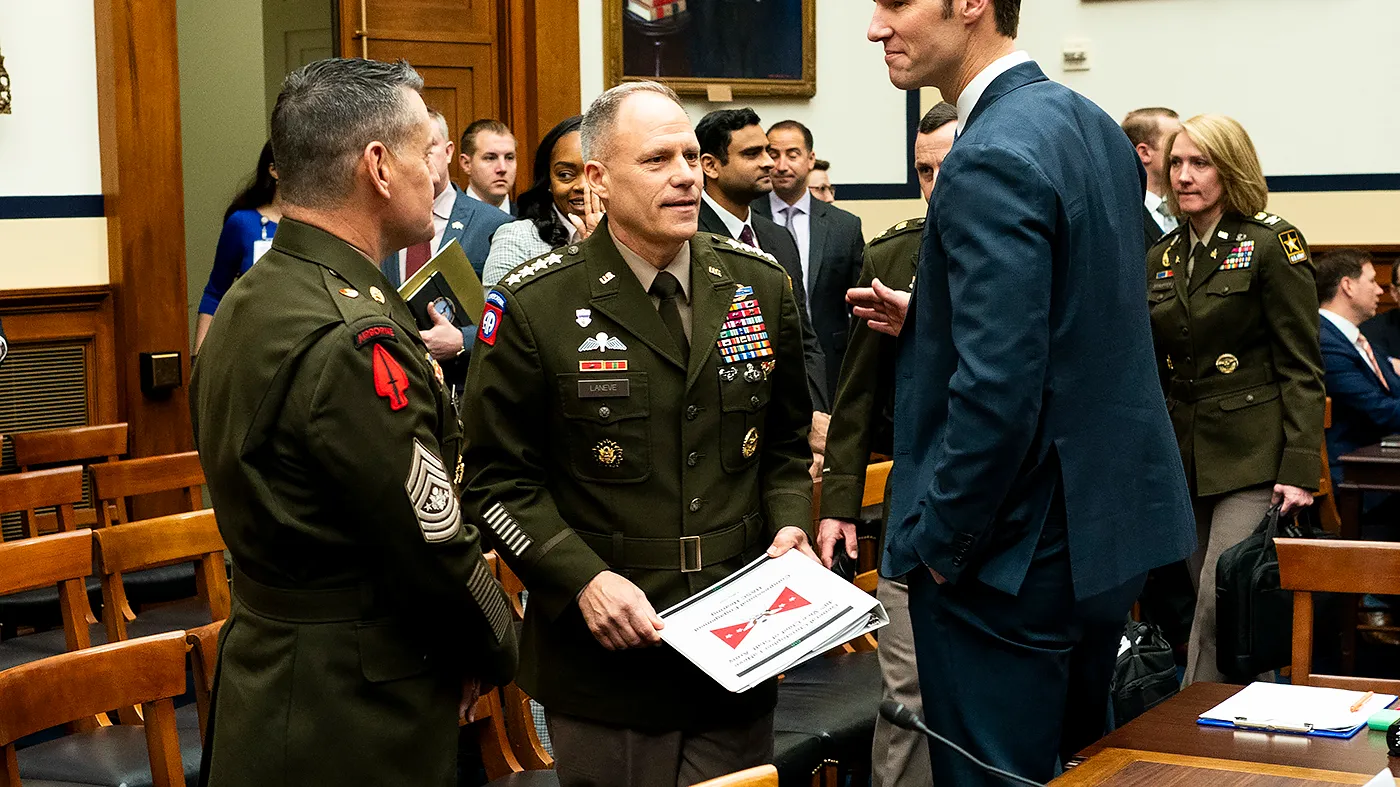
The Army’s acting chief of staff, Gen. Christopher LaNeve, assured the defense industry on Tuesday that the military’s largest branch is not walking away from modernization after losing top brass earlier this year, but is in fact “sprinting towards it.”
“And to our industry partners in this room, we need you to hear this: the secretary and I are not walking away from modernization. This is clearly captured in the Army Azimuth, where I lay forth the requirements to outpace our adversaries, and I hope that after yesterday’s remarks from Acting Army Secretary [Adam] Telle, you can see that our Army values American ingenuity to help us with this,” LaNeve said during the Dwight D. Eisenhower luncheon at a military conference in Washington, D.C.
“No, the Army’s not turning its back on modernization. In fact, quite the opposite. We are sprinting towards it,” LaNeve, who was picked for the role after Defense Secretary Pete Hegseth fired Army Chief of Staf f Gen. Randy George, said at the Association of the United States Army (AUSA).
LaNeve, also the Army’s vice chief of staff, made the remarks as the new Army leadership looks to refine priorities for modernization efforts advocated by George and former Army Secretary Dan Driscoll, who resigned in late August after months of clashes with Hegseth.
“Our investments must strengthen the Army as a collective warfighting system rather than attempt to make every platform technologically superior or equip every formation with every capability. We will concentrate resources on the capabilities essential to Convergence, Strike, Close Battle and Endurance,” the branch said in the “How the Army Fights,” a 46-page framework , signed by LaNeve, which was published last week.
The Army Transformation Initiative, which was rolled out last April, encouraged technological experimentation across the force, cut bureaucracy and redirected resources to top-priority operational capabilities.
“The Army cannot and should not modernize everything at once,” the branch said in the framework. “The answer is focused modernization.”
Adam Telle, the Army’s acting secretary, said on Monday that the Army has to move at the “speed of business” and not the speed of government as the Trump administration continues to rearrange how the branch operates and innovates.
“We were taking too long to find and fund good ideas. That’s because we based who we did business with not on how well they could deliver equipment or innovation to our soldiers, but based on whether their bureaucracy was big enough to interface with our big bureaucracy,” Telle said during his Monday appearance at AUSA. “Agile, hungry companies with brilliant ideas were starved while we forced them to wait.”
Army leaders have said the recent push to spur investment and innovation is necessary to shake up the status quo, but it is now up to leadership to make “threat-informed investments,” LaNeve said on Tuesday.
The Army will decide which technologies need funding and where they will be implemented as the service branch’s resources are not “endless,” LaNeve said.
“This means making thoughtful decisions over where investments are made. And when I think of Army capabilities, I bend them into three categories, and I’ve talked to you a lot about this on the floor: legacy, enduring, and modern,” the acting Army chief of staff said. “We’re going to divest legacy equipment with the intention to unburden our units as fast as we can from the old and failing equipment that distracts us from meaningful training.”
“We will purposely invest in our enduring capabilities that halve the bridge time for us to get the modern equipment into the force,” he said on Tuesday. “But we will also make intentional investments for modern capabilities that can be scaled and directly contribute to how the Army fights within the joint force.”
Topics in this story
Gathered from external sources. Rights to this text belong to whoever originally published it.