Republicans warn that Pentagon funds will hinge on Trump getting tougher with Russia
A growing chorus of House Republicans is warning President Trump that they’re ready to block additional Pentagon funding unless the administration gets tougher on Russia. Behind Defense Secretary Pete Hegseth, the administration is pushing Republicans on Capitol Hill to approve at least $350 billion in new military spending as part of a partisan reconciliation package…
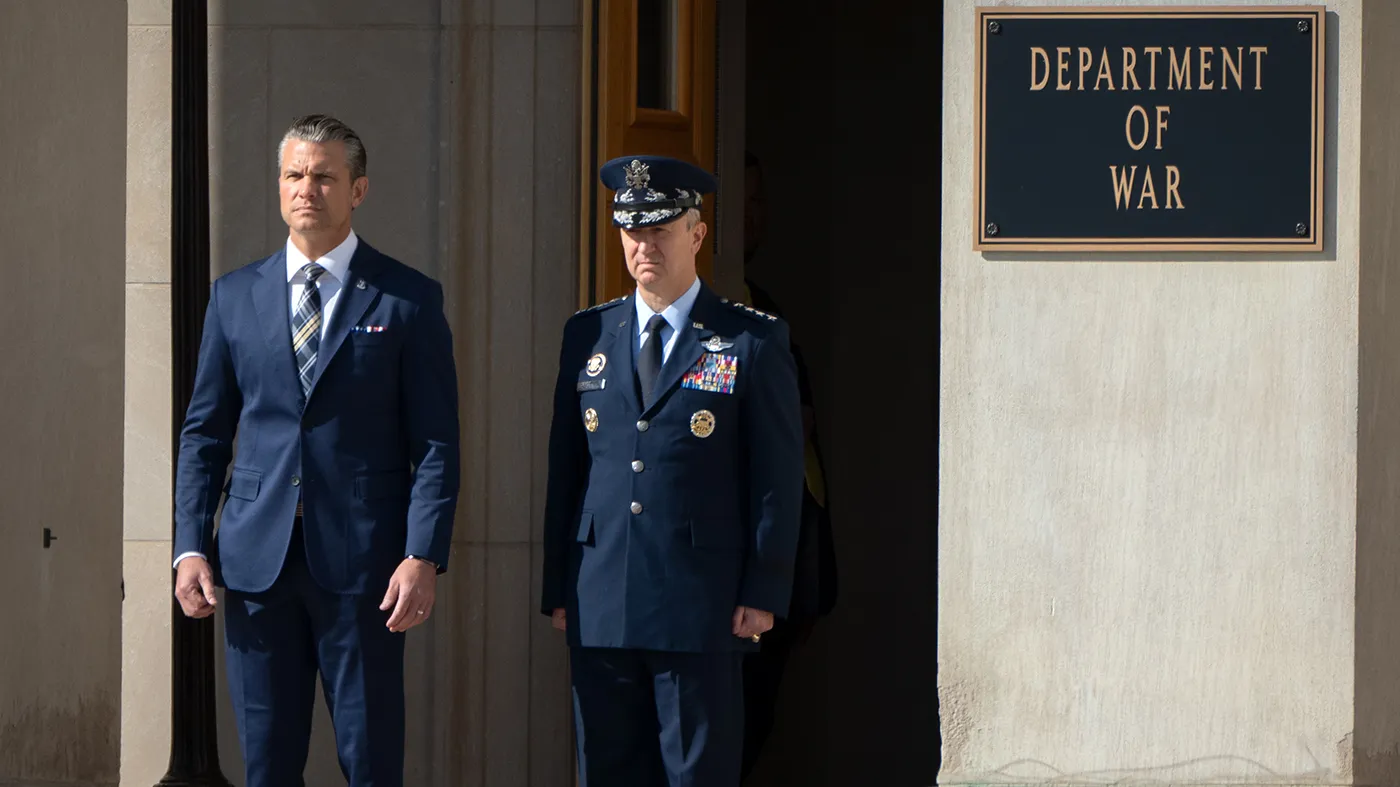
A growing chorus of House Republicans is warning President Trump that they’re ready to block additional Pentagon funding unless the administration gets tougher on Russia.
Behind Defense Secretary Pete Hegseth, the administration is pushing Republicans on Capitol Hill to approve at least $350 billion in new military spending as part of a partisan reconciliation package in the postelection lame-duck session.
But several of Ukraine’s GOP allies are furious with Trump’s latest foreign policy moves, chief among them a deal with Russian President Vladimir Putin to import Russian diesel to America in an effort to curb rising fuel costs.
That agreement, combined with reports that the U.S. has restricted Ukraine’s use of strategic satellite systems, has set the stage for a pitched internal fight in the lame-duck session, pitting Kyiv’s staunchest Republican allies — who want the Russian sanctions restored and the satellite limits removed — against the administration as it races to secure the boost in Pentagon funds.
Fueling that clash is legislation , sponsored by the late Sen. Lindsey Graham (R-S.C.) and signed by Trump just last month, which was designed to tighten sanctions on Russia and put additional pressure on Moscow to reach a peace deal with Ukraine. Trump’s move to waive those sanctions instead has boosted Putin’s ability to fund the war, frustrating the bill’s supporters in both parties.
Rep. Don Bacon (R-Neb.) warned this week that no part of Trump’s legislative agenda will pass through Congress in the lame-duck session unless Trump takes steps to punish the Russian war machine, rather than feeding it. Rep. Brian Fitzpatrick (R-Pa.) told The Wall Street Journal that there will be “consequences” if the administration doesn’t take steps to restore the satellite technologies that Ukraine says have been restricted.
“Agencies won’t get funding if they’re not doing their jobs,” Fitzpatrick said.
And other Republicans on Capitol Hill say those warnings have teeth, not only because of the anger Trump’s decisions have stirred, but also because many Republicans won’t be back in Congress next year — either due to retirement or defeat — which will liberate them to vote against the president without fear of a political backlash.
“There’s going to be enough pressure from the Hill that the admin recognizes that they need to back off, to some degree, if they actually want to get something done,” a House GOP aide said. “There are enough members who are either not returning, or who are going to — after the elections who [have] lost — who are going to feel, maybe, unshackled from their responsibility to be in lock step with the president.”
The Pentagon chief for months has pushed Congress to authorize Trump’s record $1.5 trillion defense budget request, dubbing it a “one-time generational investment” paramount to achieving Trump’s national security priorities.
And the Defense secretary said this past week the Pentagon will forcefully push for the $350 billion reconciliation package, which remains stalled on Capitol Hill over differences on how to fund it.
“We’re running fast immediately with the committees to ensure that that reconciliation bill, at a minimum of $350 [billion], potentially more, ultimately fills up what this department needs in order for the president to ensure that we reestablish deterrence and rebuild the military around the world,” Hegseth said Wednesday at an Army conference in Washington, D.C., noting the Pentagon is working with the White House to make it happen “regardless” of the midterm results.
The package includes funds for several of Trump’s priorities, including $17 billion for the Golden Dome homeland missile defense system, drones and $47 billion for expanded munitions production.
Of the $113 billion designated to boost the defense industrial base, more than $48 billion is for critical minerals. About $103 billion is set for low-cost autonomous systems, artificial intelligence and counterunmanned systems. Some $14 billion would go toward modernization, sustainment and production of F-35 fighter jets, Boeing B-52 Stratofortress strategic bombers, the next generation of the Navy’s fighter plane and Lockheed Martin KC-130J transport aircraft.
The Pentagon is also asking for $36 billion for a “Warrior Ethos” category that would include investments in housing and facilities for service members.
With Democrats near-united in opposition to Trump’s Iran war, GOP leaders will need virtually every House Republican to support the package to have any chance of moving through the lower chamber.
But Bacon, who’s retiring at the end of the term, predicted that Trump’s soft-glove approach to Russia has alienated enough Republicans that Speaker Mike Johnson (R-La.) will struggle to pass not only the Pentagon funding, but everything else GOP leaders are hoping to pass in the lame-duck session.
“The Administration’s decision to reduce intel sharing to Ukraine & access to Starlink equates to aiding the invader & the war criminal who bombs cities,” Bacon, who sits on the House Armed Services Committee, wrote on the social platform X . “Does the Administration think it will get ANY support for the remainder of the 119th Congress? Their agenda is dead unless they change paths.”
The diesel deal is getting even more blowback.
In a letter to Trump last week, a group of bipartisan lawmakers denounced the agreement , suggesting it violated the spirit, if not the letter, of the new Russian sanctions law. They urged the president to reverse course by installing the law’s sanctions “to their fullest extent and without delay.”
“We urge the Administration to revoke this license and not issue further general licenses that reopen Russian energy transactions and restore revenue to the Kremlin’s war chest,” the lawmakers wrote.
Five Republicans endorsed the letter: Reps. Michael McCaul (Texas), Dan Newhouse (Wash.) and Joe Wilson (S.C.) along with Bacon and Fitzpatrick.
Wilson, a co-chair of the House Ukraine Caucus, issued a subsequent statement that gave Trump another nudge by pointing out that the president had championed the brand new sanctions bill.
“President Trump supported these robust sanctions championed by the late Senator Graham,” Wilson said. “I believe implementation of the Graham sanctions passed by Congress and signed by President Trump remains critical to advancing American interests.”
Other Republicans, speaking anonymously, were much more forceful, even placing the blame for the diesel cost crisis on Trump for launching the Iran war.
“He needs to drop this decision,” the House GOP aide said.
“Like, A, it’s illegal. We passed a law saying there’s an energy ban on Russia,” the aide continued. “But at the same time, why did we get ourselves into a war in the Middle East to upset fuel prices? You want to lower fuel prices, figure that out.”
To quell the skepticism over the Trump administration’s defense spending plans, the Pentagon officials recently embarked on a series of closed-door briefings to carve out a lane for the $1.5 trillion budget request.
But Democrats and some Senate Republicans worry the late-stage barrage of classified sessions so close to the end of the year won’t yield the necessary coalition of lawmakers to move the needle.
Gathered from external sources. Rights to this text belong to whoever originally published it.