Trump’s nuclear opening with Xi and Putin faces a reality check
In a summit light on concrete takeaways, President Trump touted commitments by China and Russia to engage in dialogue over nuclear threats as a key outcome of his meeting with Presidents Xi Jinping of China and Vladimir Putin of Russia last week. But the stated common ground on nonproliferation seems disconnected from geopolitical realities, given…
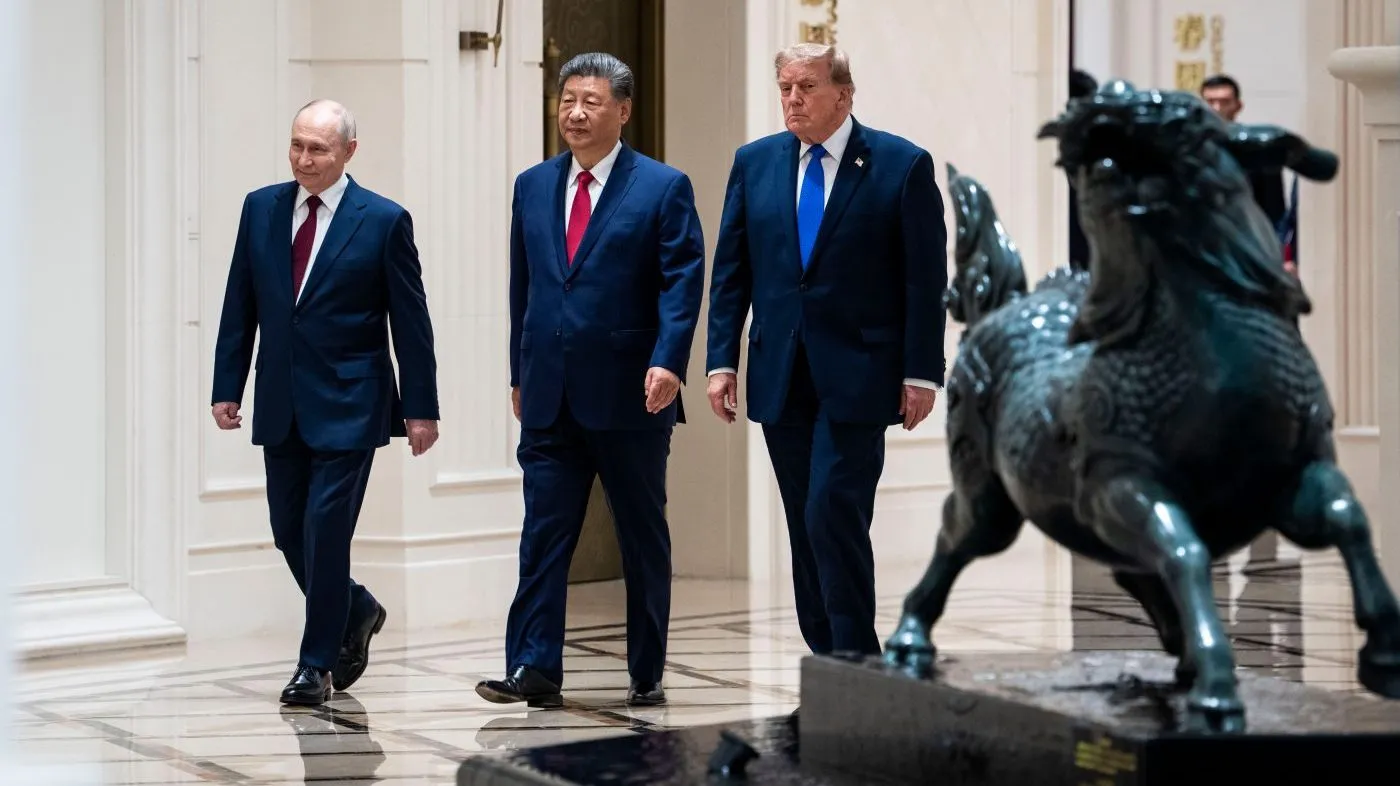
In a summit light on concrete takeaways, President Trump touted commitments by China and Russia to engage in dialogue over nuclear threats as a key outcome of his meeting with Presidents Xi Jinping of China and Vladimir Putin of Russia last week.
But the stated common ground on nonproliferation seems disconnected from geopolitical realities, given China’s strategic intransigence on the issue and a lapse earlier this year in the last remaining treaty between Washington and Moscow governing limits on nuclear arsenals.
Trump himself admitted that a mutual agreement to limit nuclear weapons will be hard to achieve, even as he called the amount of nuclear arms possessed by the three nations “unacceptable.”
“I’d like to get rid of them. But you know, it’s very hard to put a president in that position. It’s very hard for me to say let’s cut them in half,” Trump told reporters Friday in the White House press briefing room.
“I’m not sure that can ever happen. So I view it more as a deterrent, perhaps. But it’s very, very difficult to say ‘let’s get rid of our nuclear weapons. Let’s not have any more nuclear weapons.’ I don’t know.”
In a joint declaration after the trilateral meeting on the sidelines of the Asia-Pacific Economic Cooperation summit, the leaders included a vague agreement to reduce the risk of nuclear war, with Xi referring to nuclear weapons as a “sword of Damocles” hanging over humanity.
As of 2023, China had an estimated 410 or so nuclear warheads, according to the Bulletin of the Atomic Scientists. Trump on Friday said Beijing now has 600 warheads.
That’s still far below the 5,420 warheads Russia possesses as of March, and the roughly 3,700 the United States has in its arsenal.
But the number of new warheads can now climb unchecked after the February lapse of the New Strategic Arms Reduction Treaty, or New START, between Washington and Moscow. The treaty, which limited U.S. and Russian strategic nuclear weapons for more than half a century, expired after Trump rejected the Kremlin’s proposal to extend it by another year to allow time to negotiate how to move forward.
In refusing the offer, Trump insisted Beijing be included in a “new, improved and modernized” agreement.
Secretary of State Marco Rubio at the time said Trump made it clear that “to have true arms control in the 21st century, it’s impossible to do something that doesn’t include China because of their vast and rapidly growing stockpile.”
Beijing, however, has been reluctant to address nuclear arms control as it looks to build up its arsenal to catch up with Moscow and Washington.
“The Chinese believe that there is a disparity between China on one hand and the U.S. and Russia on the other hand on nuclear capability,” said Yun Sun, the director of the China program at the Stimson Center think tank. “Their argument is: ‘Even if we have 1,000, you guys each have 5,000. So it’s nonsensical that we should come together and talk about arms control, because are we talking about us building up to five or you guys bring it down to one?’”
Sun told The Hill that the agreement the three leaders made this week is simply a deal to talk, not act, making it unlikely the nations can achieve much progress in the two years Trump has left in office.
“What the Chinese have committed to talk about is nuclear risk reduction and nuclear nonproliferation. That’s a caveat. Nuclear risk reduction doesn’t have to be about arms control,” Yun said.
Indeed, the four-point “peace declaration” released by the U.S., Russia and China following their summit merely reaffirms that a nuclear war must never be fought, noting that the three countries “will conduct a dialogue on reducing nuclear risks and preventing the proliferation of nuclear weapons.”
Trump on Friday said the U.S., China and Russia hold a combined 92 percent of the world’s nuclear power and must reduce the risk such weapons pose to the world.
“The power is unacceptable. It’s unacceptable,” he said. “We’re not going to let it destroy the world because there can be no winners. We spoke about that. We spoke about the need to cooperate to stop the proliferation of that nuclear threat throughout our planet.”
Evan Sankey, an analyst at the Cato Institute who focuses on U.S. policy toward China, echoed Sun’s assessment of the declaration’s ambiguity.
Nuclear risk reduction also includes clarification of strategic intent, nuclear doctrine and stability policy, including crisis communications or notifying other nations ahead of intercontinental missile tests to avoid panic.
“If Trump wanted to push China on something, what I think he would do is start there,” Sankey said. “He’d say, ‘Look, we have these series of agreements with Russia. … We have a nuclear risk reduction center that has a hotline to Moscow, and they have one that has a hotline to Washington, D.C. Let’s have a trilateral version of this.'”
He added: “I agree with the consensus that China is not going to talk warhead numbers, not yet, not until they get closer to parity. But there’s a bunch of other things in the general bucket of arms control that they might talk about.”
And agreeing to nonproliferation, or preventing the spread of nuclear weapons, would not force China to talk about its own nuclear proliferation behavior, according to Yun.
“China sees nuclear nonproliferation as an Iran problem, it’s a North Korea problem, it’s other countries’ problem,” she said.
Sankey, likewise, said there’s a piece of common ground between the U.S., Russia and China insofar as they don’t want other nations to have a nuclear weapon.
“Maybe we don’t eliminate North Korea’s nuclear program, but we cap it and we get China to help us pressure Kim Jong Un to cap his program,” he said. “Maybe we get Russia to help as well.”
Topics in this story
Gathered from external sources. Rights to this text belong to whoever originally published it.