5 things to know about the Freedom 250 Grand Prix in Washington
The streets of Washington will be filled with the roars of professional motor sports this weekend as the IndyCar Series brings its high-speed show to the nation’s capital for the first time ever during the final stretch of its 2026 season. The event, which spans two days and will close streets around the National Mall…
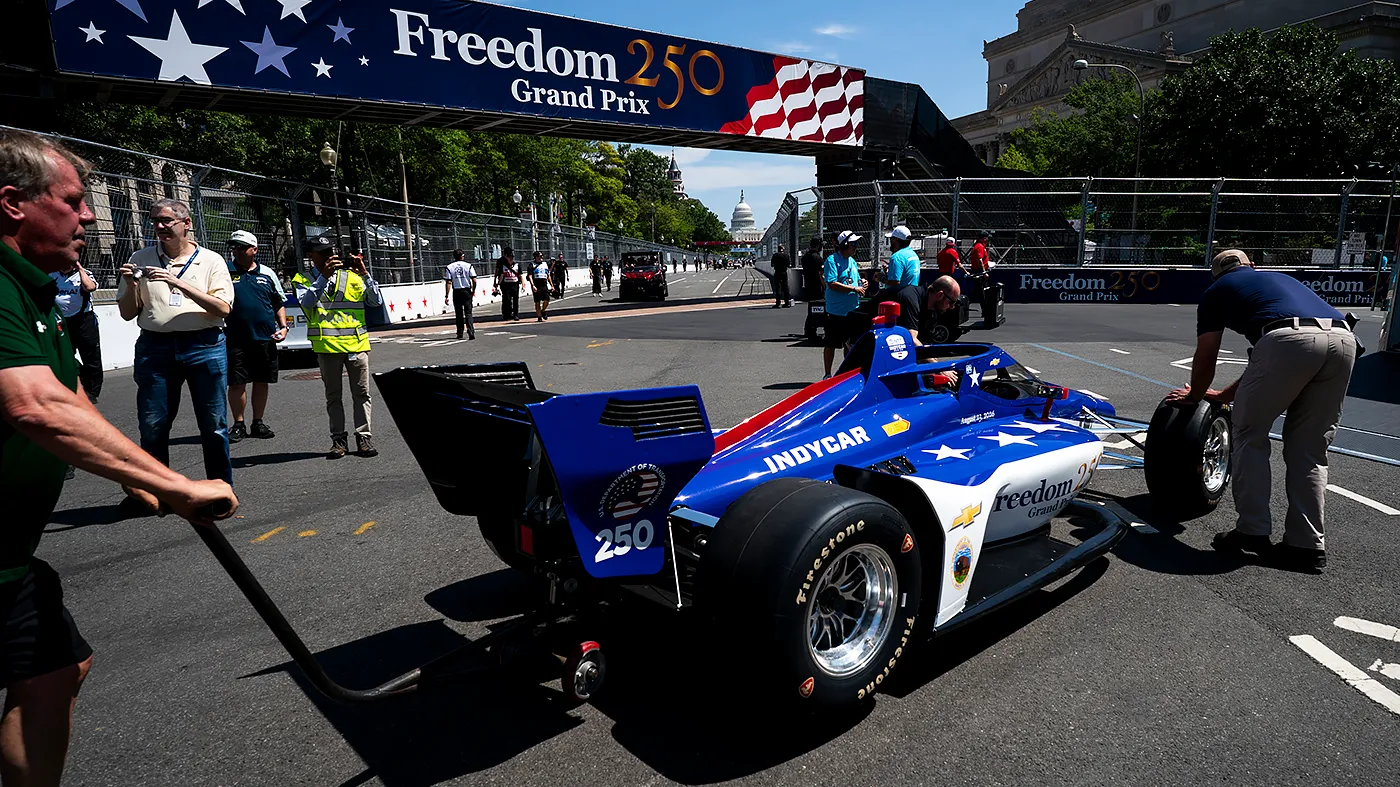
The streets of Washington will be filled with the roars of professional motor sports this weekend as the IndyCar Series brings its high-speed show to the nation’s capital for the first time ever during the final stretch of its 2026 season.
The event, which spans two days and will close streets around the National Mall and downtown D.C., is being billed as one of the final spectacles commemorating the country’s 250th birthday at the behest of President Trump.
Here’s everything you need to know ahead of Sunday’s Grand Prix in D.C.
Sunday’s race will mark a dramatic conclusion to a summer in D.C. that came with a slew of major sports and cultural events presided over by Trump’s administration.
The president hosted the Great American State Fair, facilitated a UFC primetime fight just outside the White House and delivered an address to the nation on July 4 before one of the largest fireworks displays downtown D.C. has seen.
This weekend’s race was not on the initial 2026 IndyCar schedule, and it came at Trump’s behest.
Trump reportedly had been musing about a road race on D.C. streets for months, and in January, he directed the departments of Transportation and the Interior to designate a race route through the National Mall.
The Freedom 250 Grand Prix will serve as the first auto race held on the streets of the nation’s capital, with organizers saying this week it will likely be a “one-and-done” event.
Top Trump administration officials, like Transportation Secretary Sean Duffy, are seeking to cast the event as a moment of unity for the country.
“And I think if you look at the political divide in America, this is an event that brings America together,” Duffy told the New York Post this week. “Cars and racing is freedom and American.”
Trump and first lady Melania Trump are expected to take a ceremonial lap around the course in “The Beast” on Sunday before the race starts, likely drawing even more attention to the unique end-of-summer showcase.
IndyCar looking to create the right ‘visuals’
The race for the IndyCar championship is entering its final stretch, and several of the sport’s top names will be racing this weekend in D.C.
Series points leader Álex Palou will be in the field, along with top-ranked American Kyle Kirkwood, both of whom feature cars built by Honda Racing.
The action starts Saturday with two practice races. Qualifying is set for that afternoon.
Sunday’s race day activities will begin with a warmup at 9 a.m. before President Trump waves the green flag at 1 p.m.
Those who follow the sport closely say Sunday’s spectacle will be a major moment for a racing league that has catered largely to a niche audience for decades.
“It’s all about the visual for me. You know, time and place,” longtime motor sports journalist Curt Cavin wrote this week. “The visuals of the U.S. Capitol, Washington Monument, White House and the rest of the elements that make the city the most recognizable in the world will give the sport much-craved relevance. Everything else is secondary, including the actual race, which at close to three hours will be interesting in itself. Let’s see how cool all of this looks.”
Race day will have a major impact on life in D.C.
The buildout for Sunday’s race has been underway for weeks, closing city streets and making things difficult for commuters during a usually sleepy time of year in the district, when schools are closed and Congress is on recess.
In addition to the 1.7-mile track featuring seven turns or 147 laps, IndyCar has put up massive hospitality suites, fenced off sidewalks on major downtown thoroughfares and left much of the usually busy National Mall unpassable to vehicle or pedestrian traffic during the tourist season.
Local officials have been urging D.C. residents who do not plan to attend the race to stay away from the area all weekend, while those who do have tickets should seek public transportation to get to their designated viewing areas.
“This is worse than cherry blossom,” D.C. commuter Nancy Marlow told local radio station WTOP this week, referencing the annual springtime festival that draws thousands to D.C.’s Tidal Basin. “I’ve been out here over an hour. This time of year, it normally takes me 20 minutes.”
Other spots further from the racetrack have also been impacted, like the small streets near the Lincoln Memorial, which was closed briefly Friday while a promo for the race’s television coverage was being filmed.
Anyone who has ever been to an IndyCar race knows the races are, if nothing else, loud and can cause the ground to shake.
This has been a major point of concern for D.C. residents, business owners and operators of iconic district museums and art galleries that are either directly along the racetrack or not far away.
In a letter sent to the National Park Service late last month, the nonprofit New Living Deal raised concern the race “may harm historic properties directly adjacent to the race course.”
“Such vibrations are well above normal street traffic and even go beyond those of jackhammers, pile drivers, and even freight trains, which are commonly mitigated pieces of equipment during construction projects for noise as well as vibration due to their extremely high potential for impacts,” the nonprofit wrote. “Like many others across the nation, we question the necessity and cost of this event and seek clarity about the steps we assume are already being taken to mitigate adverse effects and harm to historic structures surrounding the proposed race course.”
A spokesperson for the National Gallery of Art told WTOP it had conducted a vibration study in preparation for the race and put forth “a set of measures to ensure the safety of our staff, visitors, collection and facilities.”
Spanning 1.7 miles, Sunday’s race will wind through some of D.C.’s most notable downtown streets and pass dozens of iconic landmarks and federal buildings.
The start and finish line has been placed on 3rd Street NW between Pennsylvania and Maryland avenues, just blocks from the U.S. Capitol.
Racers’ first turn will be west on Pennsylvania Avenue, where they will speed past the National Gallery of Art and National Archives before heading south on 9th Street NW past the Smithsonian.
The race track turns again on 7th Street NW through the heart of the National Mall, where the White House and Capitol will be most visible from inside a racer’s vehicle.
The final stretch of the race will come along Independence Avenue SW, where drivers will head east before a sharp left turn at the National Museum of the American Indian and up 3rd Street NW toward the finish line and Delta 250 suites full of VIPs set to include President Trump.
Topics in this story
Gathered from external sources. Rights to this text belong to whoever originally published it.