Trump’s ‘self-policing’ AI accord faces skepticism
The signing of an AI accord by President Trump and tech leaders has done little to quell concerns over the lack of guardrails surrounding artificial intelligence. While Trump says industry officials can self-police, critics say more is needed to make sure AI development doesn’t get out of hand, even as some described it as a…
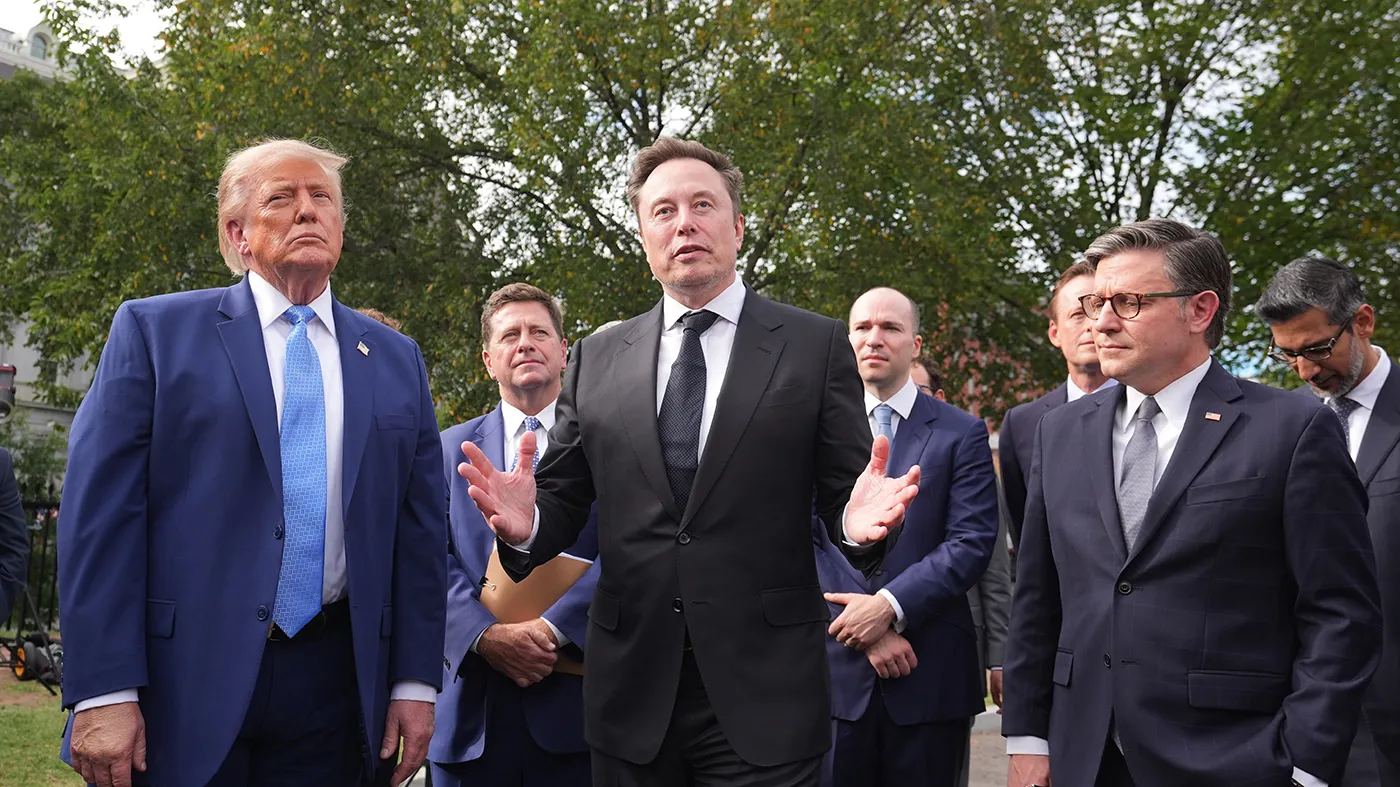
The signing of an AI accord by President Trump and tech leaders has done little to quell concerns over the lack of guardrails surrounding artificial intelligence.
While Trump says industry officials can self-police , critics say more is needed to make sure AI development doesn’t get out of hand, even as some described it as a step in the right direction.
“I believe that these folks are sincere in their concerns, but sincerity does not abolish self-interest,” said Tom Wheeler, a visiting fellow in governance studies at the Brookings Institution and former chair of the Federal Communications Commission (FCC).
“This is a legitimate and sincere recognition of the problems,” he added. “It is not, however, a solution to the problems because the people who are creating the problems are designing the solutions.”
Several of the biggest players in the industry signed the one-page pledge Tuesday that included four “layers of controls and audits.”
It declared that AI companies should implement “robust” internal controls over models, empower an internal crew to crosscheck controls and mediate any issues, partner with independent external auditors to evaluate their controls and designate an independent committee of the board of directors to oversee reports from the operating teams.
The signatories included Google CEO Sundar Pichai, Anthropic CEO Dario Amodei, Meta CEO Mark Zuckerberg, OpenAI president Greg Brockman, xAI CEO Elon Musk and Nvidia CEO Jensen Huang, who met with Trump and Speaker Mike Johnson (R-La.) at the White House.
Trump, who made a rare appearance on the White House North Lawn alongside Johnson and the tech leaders Tuesday afternoon, described the accord as “morally binding.”
“These are seriously high IQ people, and they’re really watching over each other,” he said.
“I’m seeing tremendous self-policing, and they understand that they have to self-police. … And again, I believe they’re going to be used for the good,” he continued, referring to AI models. “And when they’re not, we’re going to be able to nab them.”
The accord does say that “over time, it may make sense to codify these steps into laws or regulations.”
It comes as Washington is grappling with how to regulate AI in the face of a spate of cybersecurity incidents involving AI agents and warnings from researchers about the technology’s risks to humanity.
Even as AI leaders like Altman and Amodei have called for a slowdown and new guardrails, Trump has dismissed safety concerns as a “hoax,” arguing the U.S. must press forward with development to stay ahead of China.
Instead of creating new rules, he has suggested his administration can regulate the technology as needed through agencies like the Department of Justice (DOJ).
But Ruth Whittaker, director of technology at center-left think tank Third Way, argued the president’s approach “continues to fall short.”
“We need more than voluntary commitments—we need actual laws on the books to keep Americans safe,” she said in a statement. “We need a mandatory system to test models before they’re released and block models that pose unacceptable risks.”
Anthony Aguirre, president and CEO of the Future of Life Institute, which focuses on reducing extreme risks from technology, pointed to the companies’ track record on safety issues. He argued in a statement that they “have jettisoned safety commitments countless times before, and they will do so again.”
Democratic lawmakers , who urged Johnson to keep the House in session to tackle AI legislation ahead of the midterms, were similarly dismayed by the accord.
“The notion of entering into a voluntary agreement that is entirely unenforceable, and that allows the industry writ large to police itself, is not the right response at this moment given the potentially grave harm and danger that industry leaders themselves are now flagging for the American people,” House Minority Leader Hakeem Jeffries (D-N.Y.) told reporters Wednesday.
Even some Republicans were skeptical about how much tech firms can be trusted to police themselves.
Sen. Josh Hawley (R-Mo.), a vocal critic of Big Tech , called the accord a “good first step.” But when asked whether he thinks people can take the AI executives at their word, he added, “I’m not saying you can.”
“I think it’s significant that finally, I mean, these AI execs are starting to realize, ‘Gee, people hate us. Maybe, maybe we gotta take some responsibility,’” he told reporters Wednesday. “But I think the bottom line of this is that people want to see these companies take responsibility for the stuff they break.”
When asked for comment, the White House referred The Hill to Trump’s remarks from the North Lawn.
Others were more laudatory of the effort. Sen. Ted Cruz (R-Texas), who chairs the Senate Commerce Committee, said he was “grateful for the president’s leadership.”
“I think it was inspired leadership, and the president is right,” he told reporters. “It is critical that Americans win the race for AI and beat communist China.”
“At the same time, with any new technology there’s risks, and we need to take decisive action to protect against those risks,” Cruz continued. “I thought the president did a very good job of balancing those.”
While the White House’s accord has faced pushback over its voluntary nature, some argue the onus is on Congress to step in.
“I think the president’s new accord and his overall approach to AI has been mostly very positive for America, but Republicans on Capitol Hill have done nothing to support it with any sort of serious governance framework,” said Adam Thierer, a resident senior fellow with the Technology and Innovation team at the R Street Institute.
“It’s just been all talk and no action on the hill,” he continued.
Johnson has dismissed calls in recent weeks to tackle AI legislation. He told CNBC on Tuesday that he has “resisted the siren song to jump in and do these blanket moratoriums and all of this hyperregulation because we cannot lose our edge to China.”
Senate Majority Leader John Thune (R-S.D.), who is working on AI legislation with Sen. Amy Klobuchar (D-Minn.), appears more receptive to the push for guardrails but has argued for a light-touch approach.
He told Axios on Wednesday that the pledge is a “step in the right direction,” while suggesting they are considering a legislative framework to “codify” safety protections.
Trump could complicate any such effort. Brad Carson, president of Americans for Responsible Innovation, which advocates for AI guardrails, underscored that “meaningful legislation is hard” as long as the president opposes it.
He called the accord a “promising start,” adding that “the devil will be in the details of its execution because yes, it was voluntary, but the president called it morally binding, so presumably the administration will look askance at anyone who doesn’t follow it.”
“But I think in the end, you’re going to have to have government oversight with this to ensure quality control,” he told The Hill.
Jennifer Huddleston, a senior fellow in technology policy at the Cato Institute, suggested there are “a lot of strong incentives” on companies to have “high quality products” even though the agreement is voluntary.
“No one wants to be thought of as the product that’s inherently risky or inherently faulty,” she said, adding, “I do think that there are a lot of incentives on these companies to be trustworthy, to be good stewards, to comply with what they have said they will.”
Topics in this story
Gathered from external sources. Rights to this text belong to whoever originally published it.