Trump touts Venezuela deal, but political, logistical hurdles stand between US and oil
President Trump announced last week that the U.S. would team up with a Venezuelan company to pump oil from a large swath of the South American nation’s reserves — but actually getting that petroleum out of the ground could come with significant hurdles. Announcing the agreement with Venezuela, Trump said Friday evening it would “substantially…
President Trump announced last week that the U.S. would team up with a Venezuelan company to pump oil from a large swath of the South American nation’s reserves — but actually getting that petroleum out of the ground could come with significant hurdles.
Announcing the agreement with Venezuela , Trump said Friday evening it would “substantially lower Gas Prices for all Americans, long into the future.”
Trump batted down criticisms Monday over how long it would take to gain benefit from the oil fields, predicting progress in less than three years, but that would be far outside the window of having an impact on American gas prices before the midterm elections.
“Ultimately, prices are going to come down. Now, will it happen before the election? I can’t tell you that,” Trump said in remarks in the Oval Office.
But experts say that any savings could be a long time away and require significant physical infrastructure and overcoming political and legal obstacles.
Patrick De Haan, head of petroleum analysis at GasBuddy, told The Hill that Trump’s assertion that the deal will bring down prices could be true “several years from now” but not right away.
De Haan noted that there could be legal risks to the agreement, but if it is allowed to stand, “with huge investments, with a big increase in oil production, it could be big. But, again, the gas price impacts are years down the road, not days, weeks or months.”
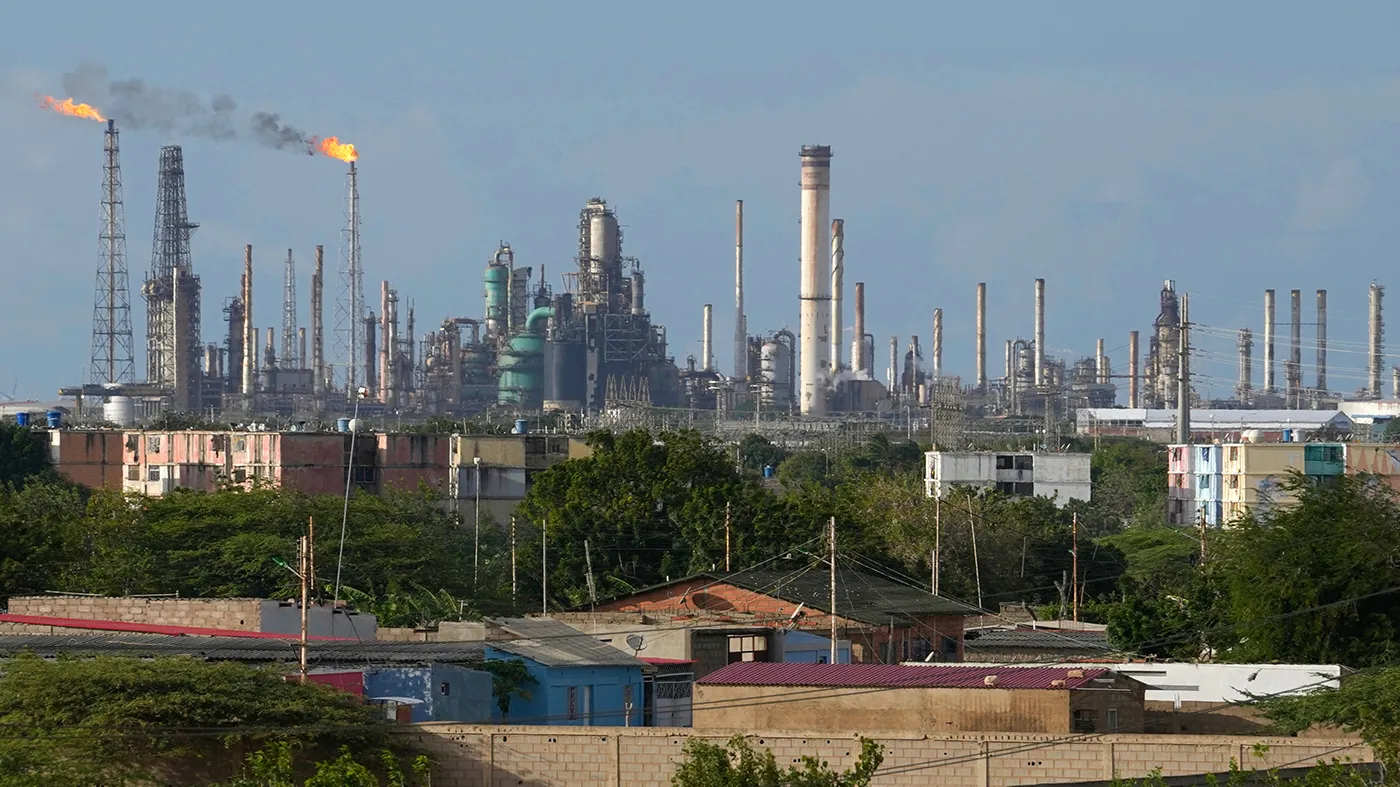
Part of the reason it could take so long for Venezuela’s energy to come to the surface is the state of the country’s infrastructure.
“Venezuelan oil infrastructure has fallen significantly into disrepair over years of mismanagement and corruption,” De Haan said. “That has resulted in Venezuela’s oil output plummeting in the last several years, and all of it needs to be rebuilt: from oil upgraders to pipelines to the grid. All of this needs work before you’re able to successfully increase production in a meaningful way.”
Andy Lipow, president of consulting firm Lipow Oil Associates, said that such infrastructure upgrades could take 10 years to complete.
“It’s going to take a decade to upgrade the infrastructure system to have a really material impact on the oil market,” Lipow said, though he added, “that is not to say that we can’t see some incremental improvements in the next year or two.”
Citing a projection that getting to high levels of Venezuelan oil production could cost some $180 billion , Lipow said there’s “an extraordinary amount of money that needs to be spent just to get oil out of the ground and delivered to the market before it’s even refined.”
Vijay Vaitheeswaran, director of the energy security and climate change program at the Council on Foreign Relations, similarly said that the oil in question will “absolutely not” get to the market and bring down prices ahead of the midterms.
Vaitheeswaran said the deal may separately give U.S. producers more confidence and could also bolster other investments by American firms in Venezuelan oil.
“We’re going to probably see more money coming sooner from the private sector and some uptick in Venezuelan oil output,” Vaitheeswaran said. “That’s maybe part of what the administration is counting on is a short-term bump. Whether we’ll really see the long-term gusher coming, I have my doubts.”
Over the weekend, Venezuela’s interim president, Delcy Rodríguez, said additional deals could be coming from Chevron, BP, Shell, Repsol and Eni.
A forthcoming deal with Chevron could be a “significant announcement,” according to a person familiar with the matter.
At the same time, much of the future of the oil covered by the U.S. government deal is unclear.
Trump administration officials have said that the deal would be a joint venture between the U.S. and a private Venezuelan oil company, but they did not say which one. They said the U.S. would get 55 percent “effective output” of the joint venture, which would have access to about 21 percent of Venezuela’s proven oil reserves.
But it’s not clear how much, if any, of the 65 billion barrels of reserve oil the U.S. says the joint venture will have access to would actually make it out of the ground.
“The proven reserves of a country are best guesses at how much oil might be recoverable under the surface,” De Haan said.
“It’s not like Venezuelan oil is just sitting in tanks above the ground,” he said, adding that the oil in question is “undrilled” and “unverified.”
The Wall Street Journal reported that the company in question is North American Blue Energy Partners, which is led by Alejandro Betancourt, a businessman with close ties to Rodríguez and who has faced investigations of alleged money laundering, though no charges have been filed. The Washington Post reported that the U.S. intervened in a Swiss criminal case against Betancourt, lobbying to avoid criminal charges and end travel restrictions against the businessman, who was based in the U.K.
The Journal also reported that the U.S. would take a 35 percent stake in North American Blue Energy Partners and would be able to buy 20 percent of the oil it unearths at cost.
Meanwhile, there’s already a discrepancy between the two governments over how long the deal will last, with U.S. officials announcing 100-year “concessions” for oil fields while Rodríguez described a 25-year agreement.
And some experts are also raising concerns about the legality of the deal given a prohibition in Venezuela’s Constitution, specifically Article 12, which makes the country’s mineral and hydrocarbon deposits, including oil, inalienable. The provision, included in Venezuela’s 1999 Constitution, also predates it.
“It’s absolutely quite clear that it is unconstitutional in Venezuela,” said Phil Gunson, senior analyst for the International Crisis Group and based in Caracas.
“Oil — and all minerals that are under the soil — belong to the nation and cannot be sold off, mortgaged, whatever. They are public property.”
And advocates for a democratic transition in Venezuela say the U.S. deal is impossible to carry out because of Rodríguez’s illegitimacy — her position as head of government only made possible by the Trump administration’s seizure of former President Nicolás Maduro and greenlighting of her to continue governing.
“Delcy is the wrong person to make this deal,” Rep. Maria Elvira Salazar (R-Fla.) wrote in an updated post on social platform X. She initially came out criticizing Trump’s deal with Rodríguez as having no chance of surviving the end of the president’s term in office.
“We want this agreement to last 100 years. Only a government backed by strong democratic institutions and the rule of law can guarantee it. And that will only be possible with free elections.”
Rep. Carlos Gimenez (R-Fla.), without addressing the oil deal, referred to Rodríguez as an “interim-dictator” and “slimy climber” and called for momentum on a democratic transition.
Nearly nine months since the U.S. seized Maduro from his presidential compound, there is painfully slow progress on the transition front. The first meeting between the Rodríguez government and opposition representatives, headed by Dinorah Figuera, took place between Aug. 6 and 12. A joint statement said the meetings addressed judicial reform and accessing frozen Venezuelan funds to aid victims of the June 24 earthquake.
The U.S. has facilitated the return of opposition politicians earlier exiled from Venezuela and secured others’ release from prison, although hundreds of opposition politicians remain behind bars. María Corina Machado, the Nobel prize-winning opposition figure who documented Maduro’s election loss in 2024, has yet to return to the country because of U.S. opposition.
“There is some momentum, and we should support that. I do. But that’s why this deal is such a bad deal. This deal reinforces the autocratic regime in Venezuela,” said Michael McFaul, senior fellow with the Hoover Institution and professor of political science at Stanford University. McFaul, a former ambassador to Russia during the Obama administration, criticized Trump’s deal as immoral, impractical and destined to failing, vowing it will unravel if a Democratic administration comes in after 2028.
“The much more logical, prudent, and I think more likely to succeed sequencing would be democracy first, reestablishing the rule of law, and then doing these deals about American investment in Venezuela, which I know from talking to many Venezuelan opposition leaders, they support,” McFaul added.
But Gunson, of the International Crisis Group, said Trump’s pursuit of an oil deal with Rodríguez appears to be in direct conflict with his administration’s stated goals of a democratic transition.
“Trump has installed in Venezuela an autocratic government that does what he tells it and therefore, it’s not a great leap of imagination to assume that he’s not in a hurry to change that situation,” he said.
Topics in this story
Gathered from external sources. Rights to this text belong to whoever originally published it.