US military takes lighter touch toward new targets in boat strike campaign
A year into its deadly sea-based campaign to stamp out “narco-trafficking,” the U.S. military is zeroing in on a new target — “floating refueling stations” — and taking a more human approach to sinking the vessels. Since last September, U.S. forces have carried out more than 60 lethal drug boat strikes and have killed more…
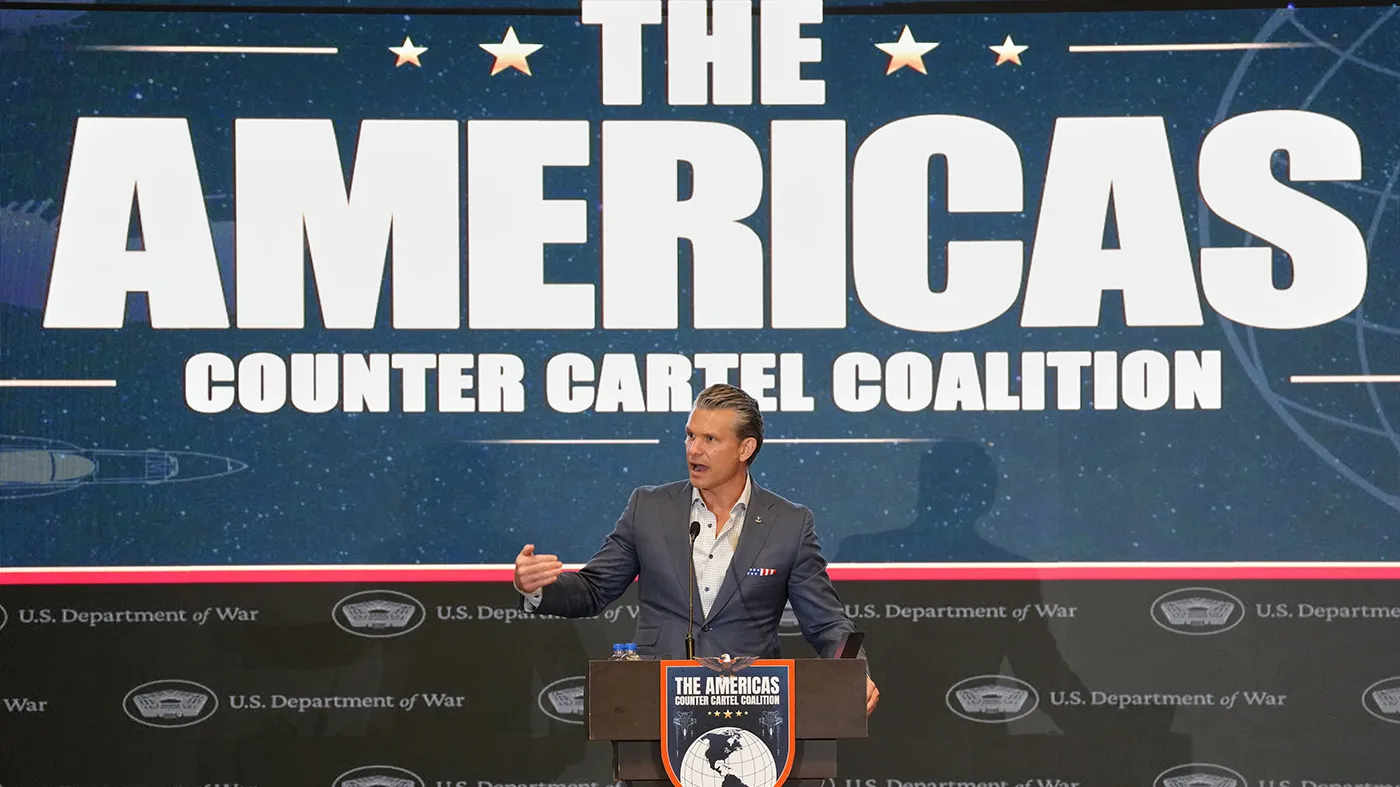
A year into its deadly sea-based campaign to stamp out “narco-trafficking,” the U.S. military is zeroing in on a new target — “floating refueling stations” — and taking a more human approach to sinking the vessels.
Since last September, U.S. forces have carried out more than 60 lethal drug boat strikes and have killed more than 200 “narco-terrorists” on both ends of South America.
In six instances of going after these larger refueling vessels off the coast of Ecuador, U.S. Southern Command (Southcom) — which oversees U.S. military operations in Central and Latin America — has reported no deaths of those on board.
Instead, a helicopter hovers over the water and U.S. Marines from the 24th Marine Expeditionary Unit board the repurposed fishing vessel to remove the crew on board, who are handed over to Ecuadorian authorities. And then the boat gets blown up.
The recent operations, which have been carried out with Ecuador’s blessing, mark a stark change from the direct hits — often shared in videos from the Pentagon — that have been described by critics as summary executions.
The new approach aligns with a more traditional law enforcement strategy in choking off drug smuggling in the Western Hemisphere, multiple experts told The Hill this week.
“First of all, the fact that the crews have not been killed in an act of extrajudicial violence is obviously a huge step forward,” Annie Pforzheimer, the former director for international narcotics and law enforcement at the U.S. Embassy in Mexico City, told the Hill in an interview.
“Secondly, the choice of the targets appears to be looking at the chain of drug trafficking importance, moving up further from the actual vessels transporting the finished product to a refueling node of the drug trafficking network,” she continued.
“And by moving up from the smaller boats that are moving products to a larger boat that is refueling others, you’re sort of getting closer to the people who are actually running the whole operation, and those are the people who are clearly more important and useful targets that you would eventually want to develop a legal case against,” Pforzheimer said.
The drug boat strikes, which kicked off on Sept. 2, 2025, have come under scrutiny from law-of-war experts , Democrats in Congress and some in the international community — arguing the U.S. was killing people without due process and violating international law.
The administration has pointed to the classified, written opinion from the Justice Department’s Office of Legal Counsel that outlines the legal rationale to carry out the strikes, stating that service members participating in the attacks cannot be prosecuted.
Secretary of State Marco Rubio acknowledged on Wednesday that the six recent interdictions — the first of which occurred on Aug. 28 — took place in Ecuador’s territorial waters and that the target selection depends on the vessel, the threat it poses and its location.
“These are part of the bilateral agreements we have with these countries, which is, I think, an incredible advance … for the first time, to have countries that are willing to participate in these efforts in their territorial waters, and then obviously we have to operate according to their laws in their territorial waters or their systems and protocols that they set in place,” he told reporters.
“The important point is that these routes are being disrupted; these routes are being ended.”
The deadly strikes on “narco-trafficking” boats, by contract, have been unilateral operations in international waters.
Asked why Southcom was still sinking refueling vessels as part of the operations, a U.S. military official said once a vessel is confirmed to be “actively supporting illicit activities,” like narcotics trafficking, “leaving it intact could allow criminals to continue or resume those activities.”
“Sinking the vessel ensures that it cannot be reused for criminal operations, thereby safeguarding maritime security,” the official said, adding that the operations are carried out under the U.S. and international legal frameworks “governing maritime law enforcement.”
Lee Schlenker, a research associate with the Global South program at the Quincy Institute for Responsible Statecraft, said the new front in Southcom’s counter-cartel campaign is a “novelty” and a “welcome one at that,” considering the operations appear less lethal.
“I think it is very apparent that you can make the argument that this is more effective in going after the logistics supply network if these larger vessels are indeed providing fuel,” he said in an interview with The Hill.
A U.S. Defense official, granted anonymity to speak freely about internal military matters, said a fishing boat is “more difficult” to replace than a speed boat with three engines, but argued that both the lethal strikes and recent interdictions are “effective.”
“It’s like hitting a coca lab or sanctioning their bank accounts — all of them are effective at their respective level,” the official told The Hill.
Southcom has said in all six cases that the floating vessels were operating in support of Los Choneros , an organized criminal syndicate which emerged in Ecuador and was designated last September as a foreign terrorist organization by the U.S. government.
Several experts said they expect other countries, such as Colombia and El Salvador, to partake in similar interdictions with the U.S. military.
“El Salvador has been a willing partner, not just in sort of lending its installations and its civilian and military infrastructure for broader sort of U.S. operations tied to narco-trafficking in the region, but also for interdiction efforts that have been historic seizures that we’ve seen in cooperation with Salvadoran naval authorities in the Pacific as well,” Schlenker said.
Rubio said on Tuesday that Colombian authorities are working with the Pentagon on the new security cooperation and equipment purchases.
“In the end, the majority of this fight the Colombian authorities are willing to take on themselves,” the secretary of State told reporters. “They just need our help with equipment; they need our help with intelligence; they need our help sometimes with some specialized training.”
The lethal boat strikes have not stopped either. The U.S. military blew up an alleged drug-smuggling go-fast vessel in the Caribbean on Wednesday, killing three “narco-terrorists.”
Since unleashing Operation Southern Spear, U.S. forces have conducted at least 69 strikes and killed at least 230 “narco-terrorists” across the Caribbean and Eastern Pacific, according to the Trump administration’s posts about the attacks.
The Pentagon has spent more than $820 million on Operation Southern Spear, according to a late July Inspector General report sent to Congress .
The Trump administration has branded the drug boat strikes as part of an effort to weaken, degrade and dismantle drug-smuggling cartels in the Western Hemisphere and argued the yearlong campaign yielded results. Southcom’s counternarcotics operations have reported at least 50 percent drops in illicit maritime activity across the Caribbean and Eastern Pacific.
Experts are skeptical of the effectiveness.
Adam Isacson, the director for Defense Oversight at the Washington Office on Latin America, downplayed the figures as “not that impressive” because there are “so many other” vectors drug traffickers can take.
Brian Finucane, a former legal adviser on use of military force at the State Department, said he has not seen evidence that the deadly boat strikes have reduced cocaine trafficking into the U.S.
Since President Trump’s return to the White House, the administration has designated 20 Latin American-based cartels and other criminal groups as foreign terrorist organizations.
Finucan, who is now a senior adviser in the U.S. Program at the International Crisis Group, said the designations are “something of a red herring” because those groups are not terrorist organizations the same way al Qaeda is.
“They’re criminal organizations, but they like profit, not political objectives, in which they use violence against civilians to further their goals,” he said in an interview.
Gen. Francis Donovan, the Southcom commander, told Congress in March that drug boat strikes alone “aren’t the answer” to the U.S.’s drug problems.
Pforzheimer, now an adjunct senior fellow with the Indo-Pacific Security Program at the Center for a New American Security, said one metric of success in the U.S. campaign would be making a criminal case to identify the entire cartel organization and tracing their money so that the leaders could be brought to trial which would “significantly disrupt the functioning” of the group.
Individual drug boats are “extremely” easy to replace by criminal networks, she said.
“Blowing something up seems like a really, really useless gesture because that is not going to stop anybody from moving anything,” she noted.
Topics in this story
Gathered from external sources. Rights to this text belong to whoever originally published it.