Fed Extends Pause on Reserve Management Purchases to Mid-October
The Federal Reserve said Monday for the second straight month it won’t buy Treasury bills for reserve management purposes in the upcoming period, an indicati...
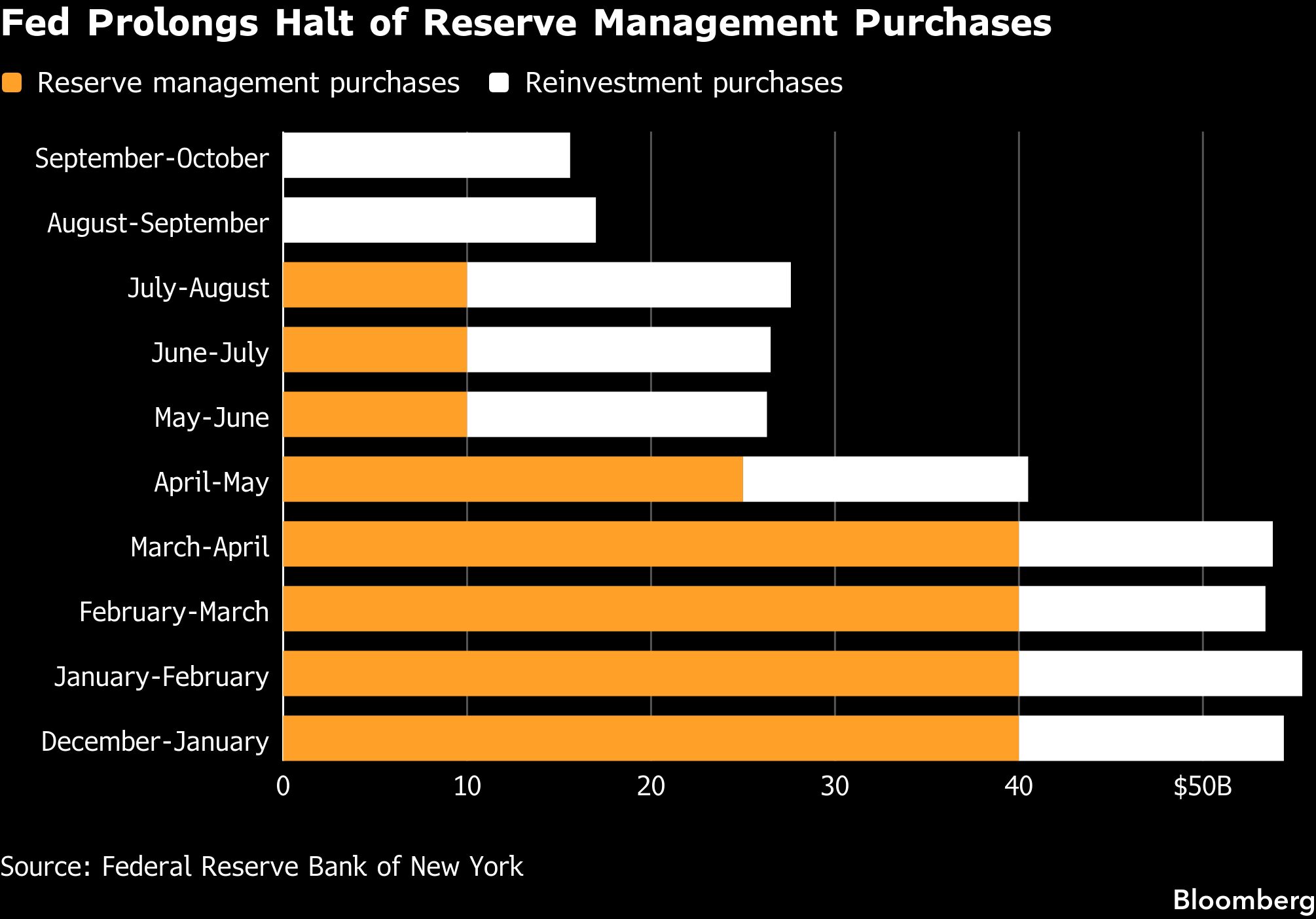
(Bloomberg) -- The Federal Reserve said Monday for the second straight month it won't buy Treasury bills for reserve management purposes in the upcoming period, an indication that policymakers are comfortable with the level of bank reserves in the financial system.
While the New York Fed's open markets desk doesn't plan on conducting reserve management purchases over the monthly period ending Oct. 14, it still plans on buying about $15.6 billion in reinvestment purchases over the time, according to its website.
The hiatus signals the Fed is confident in the smooth functioning of funding markets. That's borne out with the Secured Overnight Financing Rate — a benchmark rate based on the cost of borrowing against Treasury securities — trading at or below the interest on reserve balances rate, or IORB, for most of the past month, as well as the Treasury Department's paydown of bill supply ahead of the quarterly tax deadline. The change doesn't signal any shift in monetary policy or balance-sheet strategy.
Wall Street strategists from Wells Fargo and Bank of America expected RMPs to be on hiatus this month before resuming in mid-October in anticipation of pockets of pressure in the funding markets that are expected to surface when Treasury ramps up bill issuance beginning next month. Barclays Plc strategist Samuel Earl sees purchases moving back up to $10 billion in October and $20 billion in November.
Citigroup Inc. strategists, however, see the Fed remaining on pause for the rest of the year, noting that bank reserve balances have already been pushed back to a "lightly abundant regime."
Bank reserves stood at $3.04 trillion as of Sept. 9. That's up from $2.85 trillion at the end of last year and above the year-to-date average of $3.01 trillion.
The Fed abruptly stopped shrinking its balance sheet — a process known as quantitative tightening — at the end of 2025 and pivoted to adding reserves back into the financial system by buying short-term Treasuries due in less than a year.
In December, the central bank began buying about $40 billion of bills each month in a bid to ease the pressures that were building in short-term rates. At that time, then-Chair Jerome Powell said the Fed was "front-loading" its purchases to ensure there were enough reserves through the April tax season.
Topics in this story
Gathered from external sources. Rights to this text belong to whoever originally published it.