‘The time to get it done is now’: Lawmakers stress urgency on permitting reform bill
Lawmakers on both sides of the aisle are banding together to stress the need for Congress to act now and pass a major bipartisan permitting reform bill, before the makeup of the legislative branch changes next year. At The Hill’s Bipartisan Blueprint event Tuesday, members of Congress tied the bill — the Bipartisan American Affordability…
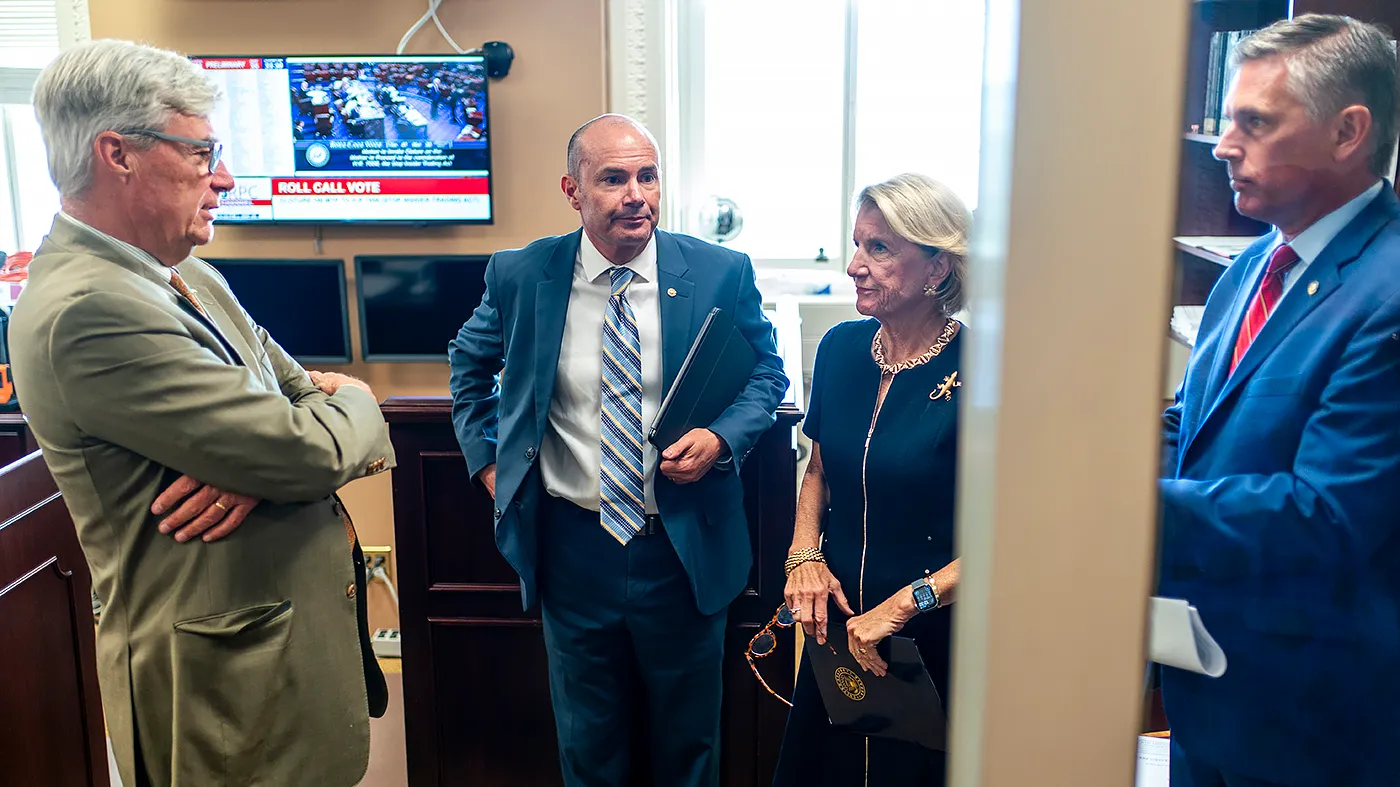
Lawmakers on both sides of the aisle are banding together to stress the need for Congress to act now and pass a major bipartisan permitting reform bill , before the makeup of the legislative branch changes next year.
At The Hill’s Bipartisan Blueprint event Tuesday, members of Congress tied the bill — the Bipartisan American Affordability and Jobs Act (BAAJA) — directly to Americans’ concerns about rising costs coming out of the midterms.
“This last election said a lot when people talk about affordability,” Rep. Harriet Hageman (R-Wyo.) told The Hill’s Rachel Frazin. “You don’t have affordability unless you have reliable and affordable energy.”
The Senate advanced the BAAJA on Monday night in a vote that showed bipartisan support for the legislation. Senators voted to invoke cloture 70-27 on the substitute amendment sponsored by Sen. Shelley Moore Capito (R-W.Va.), the chair of the Environment and Public Works Committee.
That sets up a final vote for the legislation in the Senate, but it would still need to get through the House and be signed by President Trump.
Sen. Martin Heinrich (D-N.M.), ranking member of the Energy and Natural Resources Committee and one of the bill’s co-sponsors, said the Senate may still amend the bill’s text before final passage.
In the House, the bill faces opposition from both sides, though lawmakers at the event Tuesday remained optimistic.
“It’s 70-plus votes in the Senate, and I think that that bodes well in the House for both Republicans and Democrats to recognize that this truly is one of those compromise bills that benefits everyone,” Hageman said.
The bill would speed the construction of energy, mining and infrastructure projects, while limiting environmental challenges under the Clean Water Act, the Endangered Species Act, the National Environmental Policy Act and the National Historic Preservation Act.
The legislation faces opposition from some House Democrats, including Reps. Jared Huffman (Calif.), Adelita Grijalva (Ariz.), Summer Lee (Pa.), Melanie Stansbury (N.M.) and Rashida Tlaib (Mich.).
Huffman, who is in line to chair the House Natural Resources Committee, says the bill would constrain National Environmental Policy Act reviews, radically alter transmission approvals and let companies sue the government for damages if they can show they were discriminated against on the basis of fuel type.
Trump’s opposition to wind turbines had also left some of the bill’s proponents worried.
Rep. Vicente Gonzalez (D-Texas) said Congress should take action now because a better bill may never come.
“This is not a bad deal, and the time to get it done is now,” Gonzalez told Frazin. “You may look for a better day down the road, and then that day never gets here. … We’ve been waiting for this way too long, and I think the American people deserve action from Congress.”
The bill’s proponents argue lengthy environmental reviews and litigation can hold up permitting of infrastructure and energy projects for decades.
Heinrich, asked about a wind turbine project in New Mexico that took 17 years to permit and build, said he believed the new legislation would have had it done in five years.
“If you have all the boxes checked, like this is one of the best-designed projects that I’ve had to engage with, and it still took 17 years, you know that something’s wrong,” Heinrich said.
Some Republicans fear the BAAJA could lead to more renewable energy projects, specifically wind, and Democrats worry it may lead to more fossil fuel projects that could harm the environment.
Sen. Kevin Cramer (R-N.D.) sees it differently, arguing the BAAJA levels the playing field between energy sources and encourages production of all types.
“This is fuel neutral,” Cramer said. “We truly do need whatever fuel we can use at any particular spot to generate electricity at a good cost.”
“I think what it locks in is that there’s a system and a process for determining the best source at any given moment,” he later added.
Hageman said she sees the bill as delivering incentives for both parties.
“If California wants wind power, they’re going to have to find a way to get it there. And if we can’t build the projects in Wyoming, they’re not getting that power,” Hageman said. “That, to me, is the bipartisan support for this.”
Gonzalez represents Corpus Christi, Texas, which has been nearing a water crisis for months and is hoping to build desalination plants that have been stalled for years.
“We want to try to make the process as smooth as possible,” Gonzalez said. “We’ll be able to produce more energy, we’ll be able to create a lot of new jobs. I think it’ll be transformative, and it’s been a long time coming.”
Topics in this story
Gathered from external sources. Rights to this text belong to whoever originally published it.